

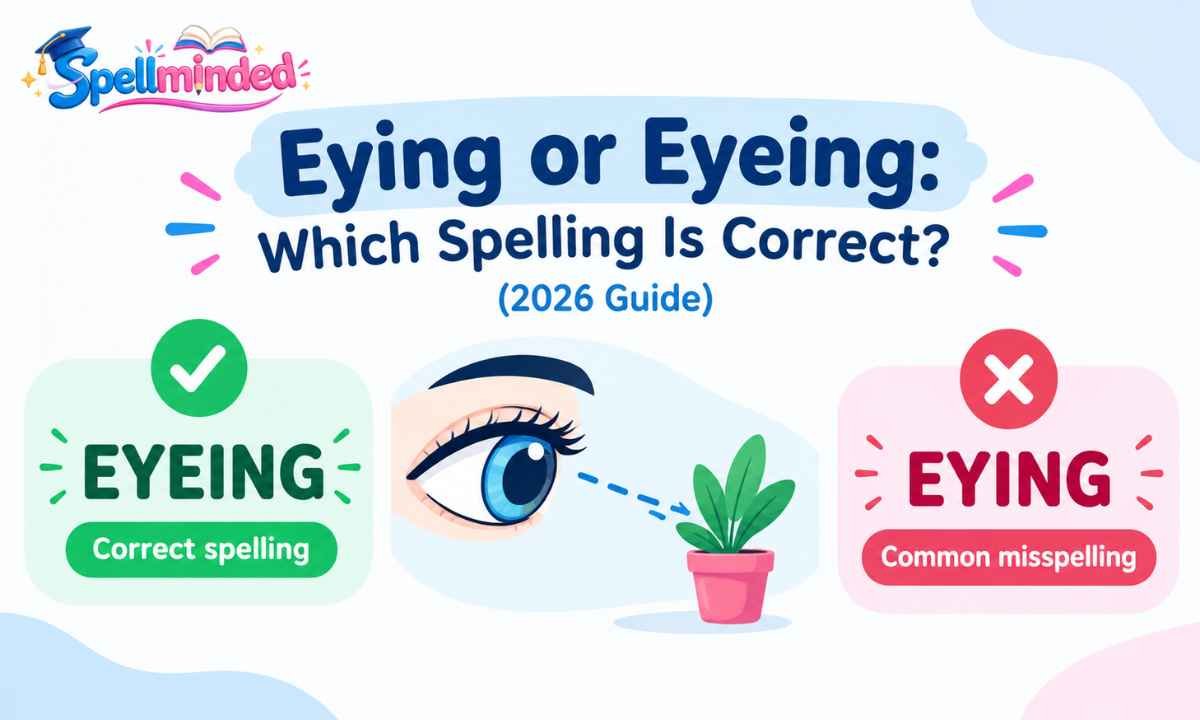
You’re typing a quick message and you land on the word. Is it “eying” or “eyeing”? You stare at the screen. Both look a little odd, and your spell-checker may underline one of them, or neither.
Here’s the good news: this isn’t a right-or-wrong question. Eying or Eyeing both appear in standard English dictionaries. This guide shows you why two spellings exist, which one to pick, and how to stay consistent.
Quick Answer
Both spellings are correct. Eying or Eyeing are two accepted forms of the same word: the present participle of the verb “eye.”
“Eyeing” is the main dictionary form and the safer default. “Eying” is an accepted variant. Pick one and use it throughout your writing.
Where Do These Words Come From?
Both words grow out of “eye.” Most people know it as the body part you see with. But “eye” also works as a verb.
To eye something means to look at it closely, often because you want it or you’re thinking about it.
- She eyed the last slice of pizza.
- He eyed the clock.
Add -ing to a verb and you get its present participle. That’s how “look” becomes “looking.” And that’s exactly where “eye” runs into trouble, because it already ends in a silent e.
Why Are There Two Spellings?
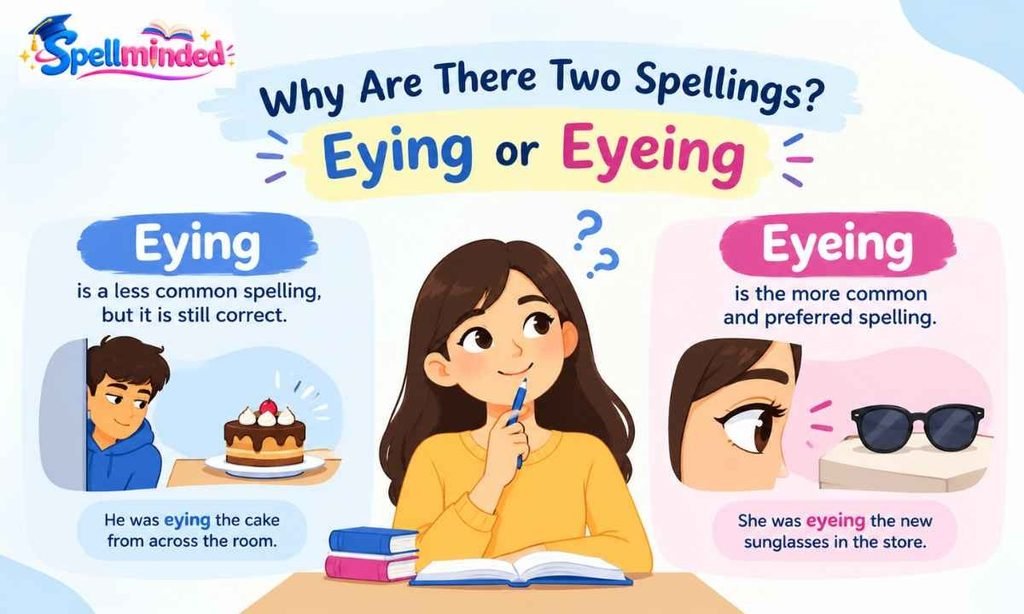
Eying or Eyeing both exist because English has two habits that pull in different directions when a word ends in e.
The “Drop the E” Habit
Most verbs that end in a silent e lose it before -ing:
- make → making
- take → taking
- write → writing
Follow that pattern with “eye” and you get “eying.”
Why “Eyeing” Keeps the E
Many readers feel “eying” looks cramped. It hides the word “eye” that the whole thing is built on.
English sometimes keeps the e for clarity. Compare dye → dyeing and singe → singeing. With “dye,” dropping the e would give “dying,” which is a completely different word. “Eyeing” works the same way: it keeps the root visible.
Dictionaries accept both, so neither spelling is a mistake.
The Meaning Is Exactly the Same
There’s no difference in meaning between the two. Both describe looking at something with interest, attention, or intent.
- She’s eyeing the new laptop.
- She’s eying the new laptop.
Same sentence, same meaning. If you’re hunting for synonyms, try watching, studying, considering, or setting your sights on. Each one fits slightly different situations. “Eyeing” often carries a hint of wanting, as in “eyeing a promotion.”
Comparison Table
Think of this table as “preferred form” versus “accepted variant,” not right versus wrong.
| Feature | Eyeing | Eying |
| Status | Main dictionary form | Accepted variant |
| Meaning | Looking at with interest | Looking at with interest |
| Pronunciation | Same as “eying” | Same as “eyeing” |
| How it looks | Keeps the full word “eye” visible | Follows the “drop the e” habit |
| Safe to use? | Yes | Yes |
Which One Should You Use?
When you’re choosing between Eying or Eyeing, one rule handles almost every situation: pick one and stay consistent.
What Should YOU Write?
Ask who’s reading and where it’s going. Then use the form that fits. If nobody has told you which to use, go with “eyeing.”
If You’re Writing for a US Audience
Use “eyeing.” It’s the main entry in American dictionaries and the form most readers expect.
- The company is eyeing new markets.
If You’re Writing for a UK Audience
Either works. You’ll see “eying” in some British writing. But dictionaries list both, and “eyeing” is perfectly fine there too.
- The cat is eying the bird.
If You’re Not Sure
Choose “eyeing.” It’s the main dictionary form, and it’s easy to recognize at a glance.
One caution if you write for a publication: style guides can differ on small spellings like this. Check your own house style before you hit send.
Common Mistakes People Make
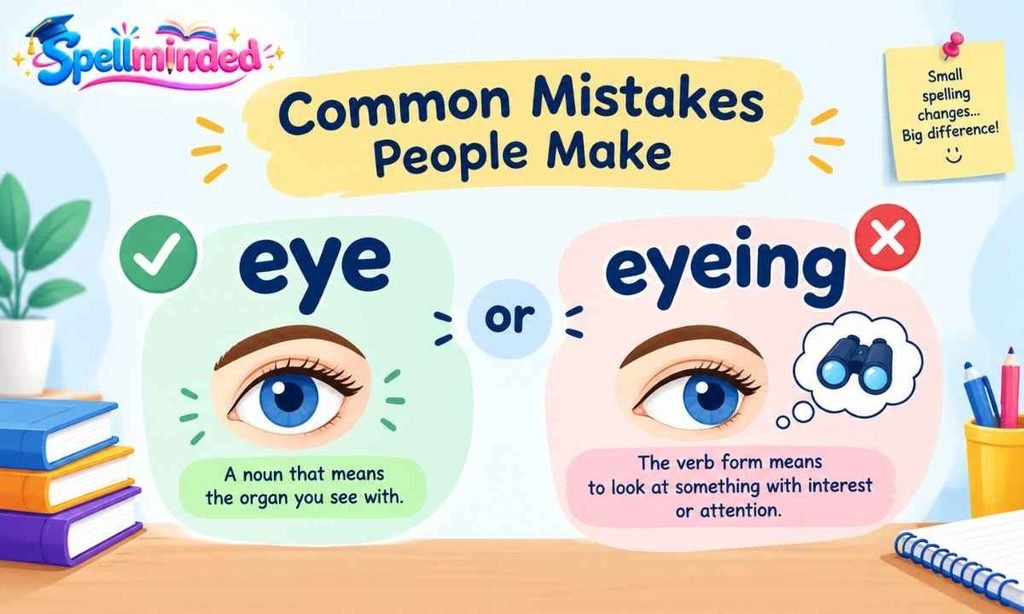
None of these mistakes is a big deal. Here’s what to watch for.
1. Thinking One Spelling Is Wrong
This is the most common slip. Some people assume “eying” is a typo, or that “eyeing” is the sloppy one. Neither is true. Both appear in standard dictionaries.
2. Spelling It “Eyeingg” or “Eyeng”
Extra or missing letters creep in fast when you’re typing quickly.
- ✅ eying
- ✅ eyeing
- ❌ eyeingg
- ❌ eyeng
Slow down on the middle of the word. That’s where it usually goes wrong.
3. Confusing “Eyeing” With “Seeing”
They aren’t the same thing. “Seeing” is just using your eyes. “Eyeing” means looking with purpose.
- I saw the car. (You noticed it.)
- I was eyeing the car. (You were interested in it.)
4. Forgetting the Meaning
“Eyeing” isn’t only about looking. It often means thinking about getting something or doing something.
- She’s eyeing a promotion at work.
Watch the preposition too. “Eye” takes its object directly, so write “eyeing the promotion,” not “eyeing on the promotion.” The exception is a for that starts its own phrase, as in “eyeing him for the job,” where “for” connects to the role, not the verb.
Everyday Real Life Examples
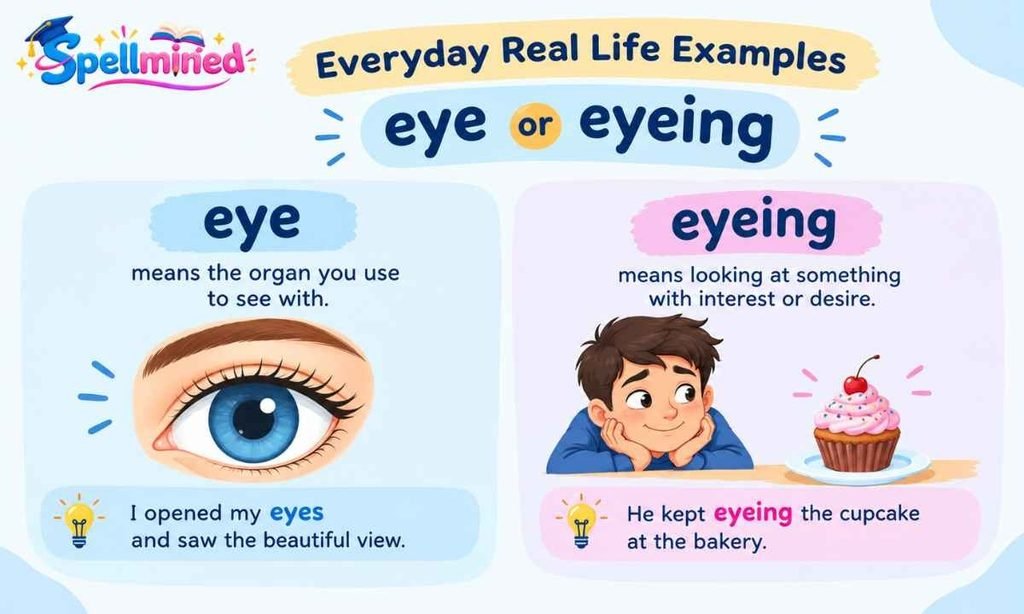
Here’s how Eying or Eyeing shows up in real life, so you can see the word working.
In Emails
- I’m eyeing the 3 PM slot for our meeting.
- We’re eyeing a new project next month.
In News Headlines
- Company eyeing expansion in Asia.
- Investors are eying new opportunities.
On Social Media
- I’ve been eyeing these shoes for weeks!
- He’s eying that new phone model.
In Daily Conversations
- The dog is eyeing my sandwich.
- They’re eyeing a trip this summer.
- She’s eying the top score in the class.
Notice the pattern. The meaning always stays the same: interest, attention, or intent.
Simple Learning Section for Students
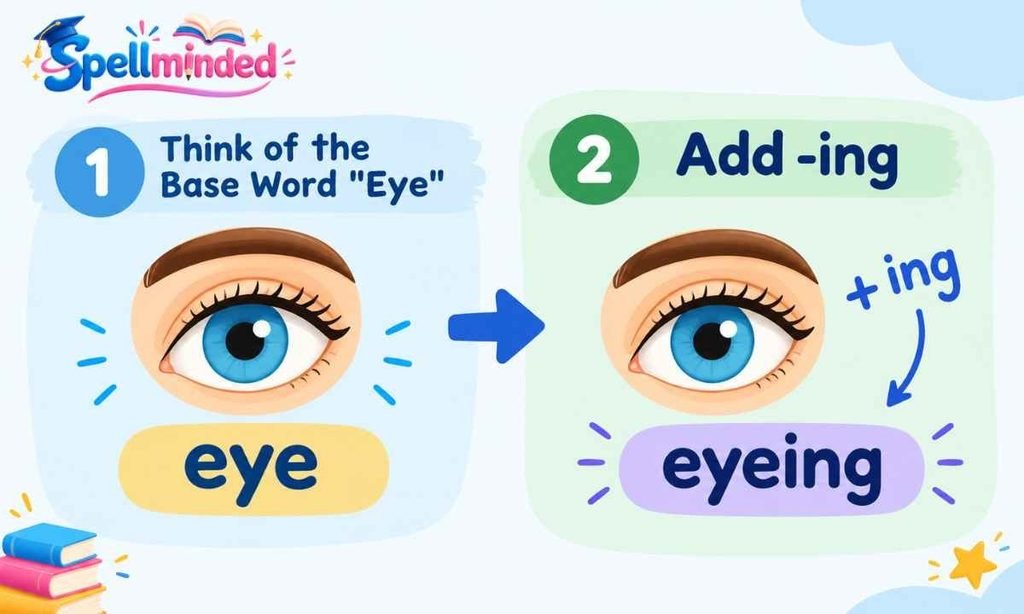
Eying or Eyeing trips up learners at every level. Here’s a patient, two-step way to handle it.
Step 1: Think of the Base Word “Eye”
Start with the verb: to eye. Say it out loud. “She eyes the cake.”
Step 2: Add -ing
Now you choose.
- Follow the usual rule and drop the e? That gives “eying.”
- Keep the whole word and add -ing? That gives “eyeing.”
Both are right. If you want one to stick with, go with “eyeing.”
Easy Memory Trick
Picture “eyeing” as a word that keeps its whole eye in view, the way you keep your eyes on something you want. The e stays, and so does the full word “eye.” If you ever forget which form to use, keep your eye on “eyeing.”
Practice Sentences
Read these aloud. Every sentence is correct.
- The child was eyeing the chocolate.
- The manager is eying a promotion.
- The team is eyeing victory.
- The cat is eying the fish.
Now write one of your own. Use either spelling, then check that you used the same one every time.
Frequently Asked Questions
Is “eying” ever wrong?
No. “Eying” is an accepted variant listed in standard dictionaries. It would only count as an error if your publication’s style guide requires “eyeing.”
Eying or Eyeing: Which Spelling Is More Common?
“Eyeing” is the main dictionary form and the safer pick. It’s a bit like ageing and aging: two accepted spellings, one that most readers see more often.
Do “Eying” and “Eyeing” Mean or Sound Different?
No. They have the same meaning and sound identical, like “eye-ing.”
Which Spelling Should Students Use in Exams or Formal Writing?
Use “eyeing” if you’re unsure. Whichever you choose, stay consistent. Switching between the two in one piece looks careless.
What’s an Easy Way to Remember Which Spelling to Use?
Keep your eye on “eyeing.” It holds on to the whole word “eye,” so it’s hard to forget the e.
Conclusion
The doubt around Eying or Eyeing is easy to clear up. Both spellings are correct, both mean the same thing, and both appear in standard dictionaries. “Eyeing” is the safer default.
So here’s your rule. Eying or Eyeing, pick one and keep it the same all the way through. Do that, and you can write with confidence the next time you catch yourself eyeing something you want.