


You’re halfway through an email and you type “please see below.” Then you stop. Something looks off. Is that one L or two? Autocorrect stays silent because both are real words. So you squint, retype it, and hope for the best.
That tiny doubt is incredibly common, and you can clear it up in seconds. This guide settles the bellow or below question with plain rules, real examples, and memory tricks that stick. You’ll also see how each word sounds, where it comes from, and the slip that causes most mix-ups.
Quick Answer
- Below (one L) means under, lower than, or less than. Use it for “see below,” “below zero,” and “below average.”
- Bellow (two Ls) means a loud, deep shout or roar. Use it only when you’re describing a sound.
- Not describing a sound? Then it’s “below.” That covers nearly every case.
Bellow
Bellow is a real word with real volume. As a verb, it means to shout in a deep voice, or to make the loud, hollow sound a bull makes. As a noun, it’s the roar itself.
Picture a coach yelling from the sideline. Picture a storm booming over a valley. That’s the energy. A bellow isn’t polite conversation. It’s loud, low, and impossible to miss.
Part of speech: verb or noun. Past tense: bellowed. -ing form: bellowing.
How to Use “Bellow” in a Sentence
Here’s bellow in action:
- The coach began to bellow instructions after another missed pass.
- A deep bellow rolled out of the barn. The farmer knew the bull was loose.
- She bellowed his name across the crowded market.
- The old sergeant bellows every order, even at breakfast.
- Nobody expected such a huge bellow from such a small dog.
Notice the pattern. In every example, someone or something is making a big noise. If your sentence has no sound in it, “bellow” probably isn’t your word.
How to Pronounce “Bellow”
Say it BELL-oh, with the stress on the first syllable. The first half sounds like “bell.” The ending rhymes with “go.”
Now compare it with “below,” which is bih-LOH. The stress lands on the second syllable instead. So these two words don’t just look alike on the page. They sound different out loud, which makes a handy check. If you hear BELL-oh in your head, you’re writing about a roar.
Bellows – The Noun Form
You may also meet bellows, which is a different noun. It’s the tool that pumps air onto a fire. Merriam-Webster notes that it’s plural in form but can take a singular or plural verb. It also names the pleated, expandable part of some cameras.
Don’t confuse it with the verb. The blacksmith’s bellows pushes air. When he bellows, he’s shouting. Both keep the double L.
Below
Below is the everyday workhorse. It means at a lower level, under, or less than something else. It works as a preposition or an adverb. It never works as a verb.
You’ll use it for position (“the cellar below”), for rank (“below the manager”), and for amount (“below average”). It’s all over emails, forms, recipes, and instructions. That’s exactly why it gets mistyped so often, and why the bellow or below mix-up happens to careful writers.
How to Use “Below” in a Sentence
- Please read the steps below before you begin.
- Temperatures dropped below freezing overnight.
- The submarine glided below the surface.
- Her score landed below the class average.
- The village sits below the mountain, tucked out of the wind.
None of these has anything to do with noise. They’re about where something sits or how much of something there is. That’s the quick test for “below.”
Bellow or Below – Quick Answer
Here’s the short version for when you’re in a hurry.
| Word | Part of speech | Meaning | Example |
| Below | Preposition, adverb | Under, lower than, or less than | Sign your name below the line. |
| Bellow | Verb, noun | To shout deeply; a loud roar | The sergeant bellowed the order. |
The rule fits in one line. Sound or shout? Bellow. Position, level, or amount? Below.
Here’s one more shortcut. If “shout” or “roar” fits the sentence, you want bellow. If “under” or “beneath” fits, you want below. These two words are never interchangeable.
The Origin of Bellow and Below
Words carry history. Looking at where each one came from clears up the bellow or below puzzle, because their backgrounds explain why they ended up with such different jobs.
The Etymology of “Bellow”
Merriam-Webster dates the first known use of bellow to before the 12th century. So it has been around since the Old English era. The word likely imitates the sound it describes, a bit like boom or moo.
That fits how dictionaries still list it. The first sense is the loud, hollow call of a bull. The “shouting in a deep voice” meaning came along as people borrowed the animal’s roar for human voices.
The Etymology of “Below”
Below is a Middle English compound built from be- and low. Put them together and you get, roughly, “at a low place.” The meaning sits right there in the spelling.
That’s useful for your memory. Below splits cleanly into be plus low. Bellow doesn’t. Its doubled L breaks that pattern, which is a clue that it’s the odd one out.
British English vs. American English Spelling
There’s nothing to memorize here. Both words are spelled the same way in British and American English. The meanings match too. So whichever version of the bellow or below question you’re asking in English, geography won’t change the answer.
One small footnote: Bellow also appears as a capitalized surname. Saul Bellow, the novelist, is the best-known example. If you spot it capitalized and it’s a name, it isn’t the verb at all.
Which Spelling Should You Use?

Run through these three quick questions:
- Is it a sound or a shout? Use bellow.
- Is it about where something is, or how much? Use below.
- Which swap works? If “shout” or “roar” fits, it’s bellow. If “under” or “beneath” fits, it’s below.
A part-of-speech check helps too. Need an action word, a verb? That’s bellow. Need a word that shows position? That’s below.
And if you’re typing “see ___” at the end of a message, the answer is almost always below.
Still unsure? Read the sentence out loud. When the bellow or below choice trips you up mid-sentence, your ear often catches what your eye misses.
Common Mistakes with Bellow or Below
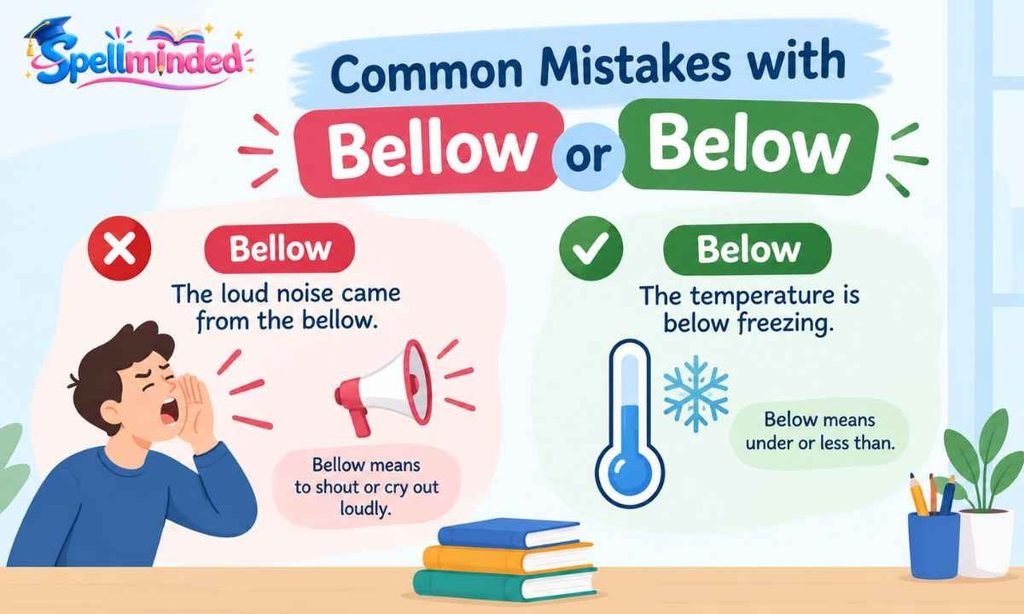
Picture this: you’re typing fast and your fingers know the word. Your brain is already on the next sentence. That’s when the extra L slips in. Here are the slips that show up most.
Why the Extra L Sneaks In
There are three likely reasons. First, the words differ by one letter, so your eye accepts either. Second, plenty of common words carry a double L in the middle, like hello, yellow, and fellow. That makes the doubled version feel familiar. Third, spell-check stays quiet because “bellow” is a real word.
None of this means you’re a weak speller. It just means your brain is on autopilot.
❌ “See bellow” / ✓ “See below”
❌ Please see the details bellow.
✓ Please see the details below.
This is by far the most common slip. You mean “lower on the page,” which is a position. Position always takes one L.
❌ “Fell bellow zero” / ✓ “Fell below zero”
❌ Sales fell bellow last year’s numbers.
✓ Sales fell below last year’s numbers.
Any level, rank, or amount works the same way. “Below average,” “below budget,” and “below zero” all take one L.
❌ “The crowd began to below” / ✓ “The crowd began to bellow”
❌ The crowd began to below when the whistle blew.
✓ The crowd began to bellow when the whistle blew.
Here the mistake runs the other way. “Below” can’t be a verb. If someone or something is roaring, you need “bellow.”
❌ “She bellowed quietly” / ✓ “She called quietly”
❌ She bellowed quietly across the room.
✓ She called quietly across the room.
This one isn’t a spelling error. It’s a meaning clash. A bellow is loud by definition, so “quietly” fights it. A phrase like “a low bellow” is fine, because “low” can mean deep in pitch.
Bellow or Below in Everyday Examples
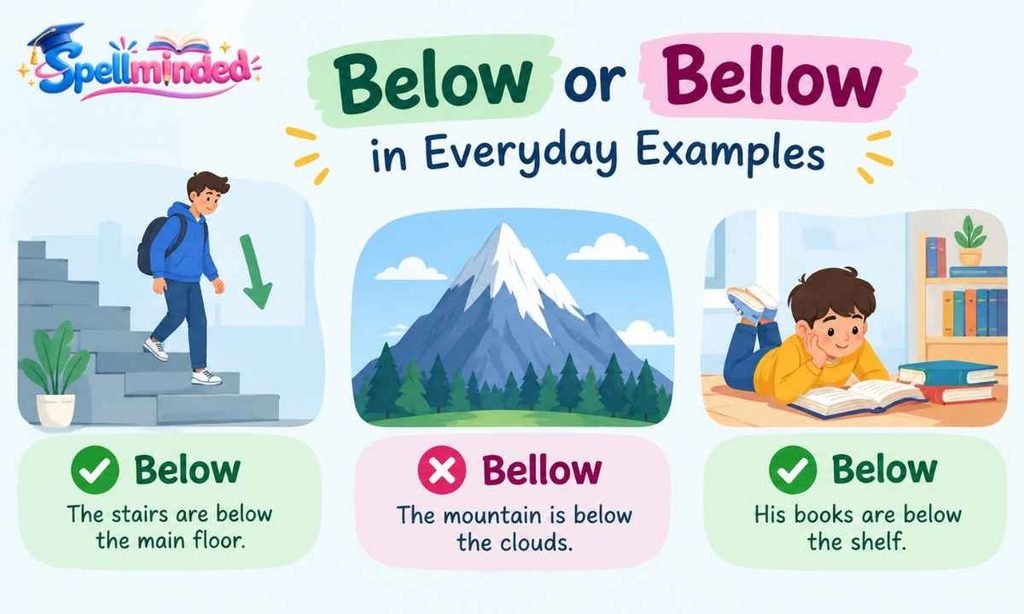
Here are both words in realistic spots, so you can see how they behave.
Using bellow correctly:
- The angry customer started to bellow at the cashier over a refund.
- The stadium erupted in a collective bellow after the winning goal.
- We heard him bellowing from across the warehouse.
- The elephant let out a deep bellow and slipped back into the brush.
- He doesn’t talk at normal volume. He bellows everything.
Using below correctly:
- Scroll below to find the FAQ section.
- The apartment below ours plays music all night.
- Earnings came in below expectations again.
- The valley below glittered with the lights of a thousand homes.
- Children below the age of twelve get in free.
Both words in one sentence: The coach let out a bellow at the players warming up below the stands.
Memory Tricks That Stick
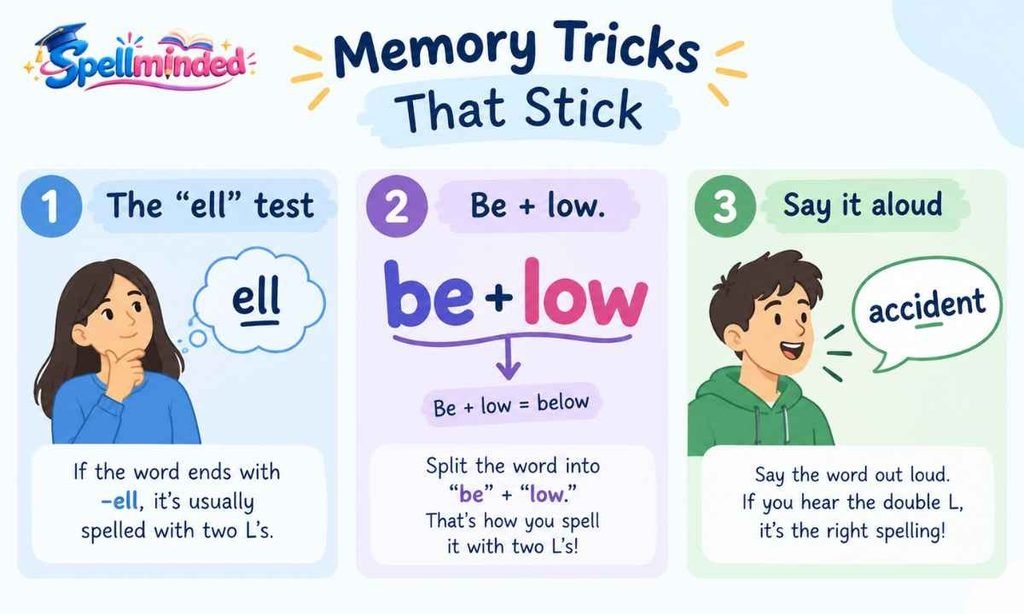
Trick 1: The “ell” test. Yell and bellow are close cousins in meaning, and both contain “ell.” If you could swap in “yell,” keep the double L. Otherwise, go with one L.
Trick 2: Be + low. Below breaks neatly into be and low. If something is below, it is being low. Bellow can’t be split that way.
Trick 3: Say it aloud. BELL-oh is the roar. bih-LOH is the position. When the stress sits on the first syllable, you’re writing about noise.
Pick whichever trick feels natural. You only need one.
Bellow or Below – How Common Is Each Word?
They’re not equally common. “Below” is a high-frequency word. ProWritingAid’s grammar guide estimates that it appears roughly 294 times for every appearance of “bellow.” That’s one resource’s figure, so treat it as a rough guide. The direction is clear, though.
Why does that matter? The more often you type a word, the easier it is to slip. “Bellow” tends to turn up in specific places like sports coverage, nature writing, and fiction. Everywhere else, it’s more likely a typo.
Here’s a practical tip. Use Find in your document and search for “bellow.” Check each hit. If there’s no roar in the sentence, change it to “below.”
Bellow vs. Below Comparison Table
Think of this table as a set of questions you can ask any sentence. The answers point you to the right word.
| Ask the sentence | Bellow | Below |
| Is it a sound or shout? | Yes | No |
| Is it about position or level? | No | Yes |
| Is it about a number or rank? | No | Yes |
| Can it be a verb? | Yes (bellowed) | No |
| Quick swap word | shout, roar | under, beneath |
| Spelling | Double L | Single L |
| Pronunciation | BELL-oh | bih-LOH |
| Spelled differently in UK and US? | No | No |
Whichever column collects the most “yes” answers is your word.
Frequently Asked Questions
Is “bellow” ever correct instead of “below”?
Yes, but only when you mean a loud roar or shout. They’re two separate words, not two spellings of one. For position, level, or amount, “bellow” is always a mistake.
Is it “please see below” or “please see bellow”?
It’s always “please see below.” You’re pointing to something lower on the page, and that’s a position. One L is all you need.
What does “bellow” mean, and how is it different from “below”?
“Bellow” means to shout in a deep voice, or the loud roar itself. “Below” means under or lower than. One describes sound. The other describes position or amount.
How do you pronounce “bellow” and “below”?
“Bellow” is BELL-oh, with the stress on the first syllable. “Below” is bih-LOH, with the stress on the second. Saying them aloud is a quick way to tell them apart.
What’s the easiest way to remember the difference?
Use the “ell” test. If “yell” could replace the word, it’s “bellow.” For everything else, “below” has just one L and splits into be and low. When the bellow or below choice feels unclear, say the word out loud.
Conclusion
So, bellow or below? For position, level, or amount, it’s below, with one L. For a loud, deep roar, it’s bellow, with two. Most of the time, you’ll want “below.”
Next time you type “see below,” you can hit send with confidence. Remember the “ell” test and remember be + low. If you’re still unsure, say the word aloud. That’s all it takes.


