

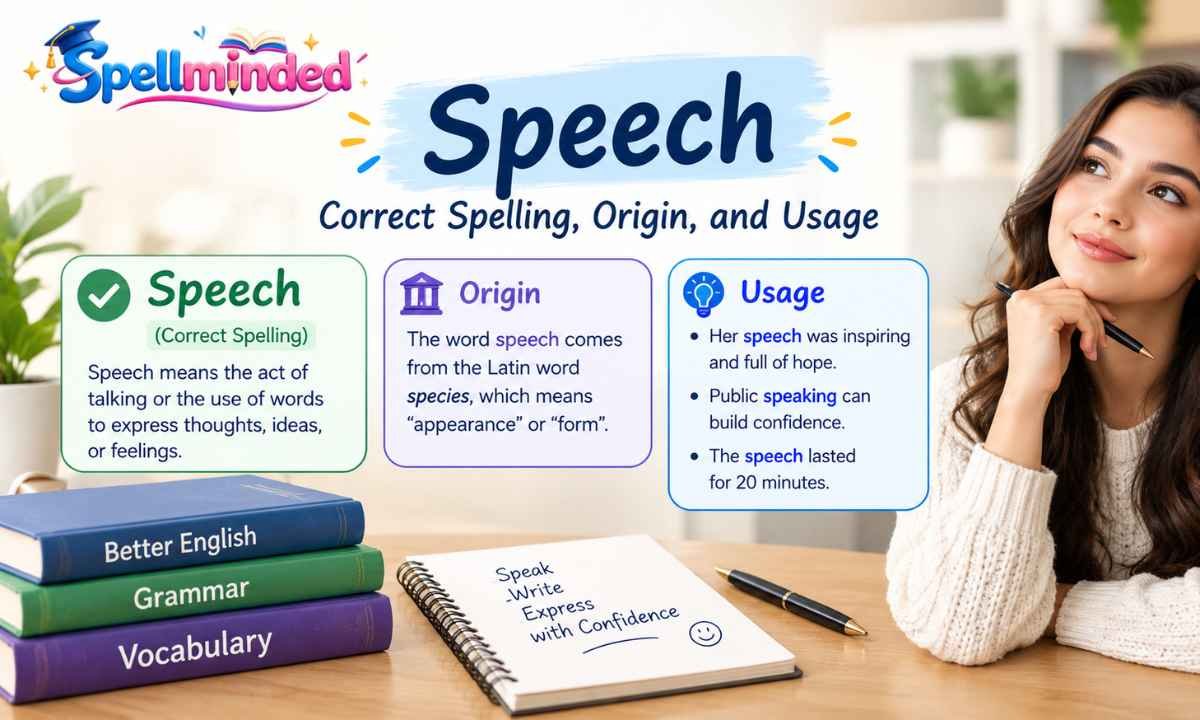
You’re mid-sentence, the word you need is “speech,” and suddenly you’re not sure. Was there an “a” in there? Autocorrect doesn’t always rescue you, so you stop typing and look it up.
This guide settles the Speach or Speech question right away. Then it explains why the mix-up happens, where the word comes from, and how to remember the spelling for good.
Quick Answer: The correct spelling is speech, with two e’s. “Speach” is a misspelling and not an English word. In the Speach or Speech question, only one option is ever right.
Speach vs Speech: The Two Spellings at a Glance
Here’s a quick look at each spelling before we go deeper.
Speach
“Speach” is not a word. Major dictionaries, including Merriam-Webster and Collins, list “speech” as the standard spelling. None of them treat “speach” as a valid alternative.
You’ll see it now and then in emails, captions, and school work. It’s always a slip. No region, style guide, or formal setting accepts it.
Speech
“Speech” is the correct spelling. It’s a noun with several related meanings:
- The ability to speak, or the act of speaking
- A formal talk given to an audience
- A person’s manner of speaking
- A particular language or dialect
It’s pronounced /spiːtʃ/, and the plural is speeches.
Speach or Speech – Quick Answer
The correct spelling is “speech.” The letters run s-p-e-e-c-h, with no “a” anywhere.
So in the Speach or Speech debate, “speech” wins every time. Whether you’re writing an email, a school essay, or a caption, the spelling doesn’t change.
Examples:
- ✅ Correct: She gave a moving speech at the wedding.
- ❌ Incorrect: She gave a moving speach at the wedding.
- ✅ Correct: The mayor’s speech ran twenty minutes.
- ❌ Incorrect: The mayor’s speach ran twenty minutes.
- ✅ Correct: Freedom of speech is protected in many countries.
- ❌ Incorrect: Freedom of speach is protected in many countries.
The Origin of Speech
Knowing where a word comes from can make its spelling easier to hold onto.
According to Merriam-Webster, “speech” comes from Middle English speche, which comes from Old English sprǣc or spǣc. Those forms are related to the Old English verb sprecan, meaning “to speak.” The word was already in use before the 12th century.
It has relatives across the Germanic languages, too. German Sprache and Dutch spraak come from the same family.
Here’s the interesting part. Over time, English settled on “speech” for the noun, while the verb “speak” kept its “ea.” Two closely related words ended up spelled differently. That’s a quirk of history, not a rule you missed.
Why Do People Write “Speach”?
It’s a very natural mistake. Three things usually cause it:
- The verb “speak.” The two words are related, and “speak” has “ea.” It feels logical that the noun would too.
- The “-each” words. Teach, reach, and beach all end in “-each.” “Speech” sounds like it belongs in that group.
- Spelling by ear. English doesn’t always match sound to letters. When you write a word the way it sounds, “ea” and “ee” are easy to swap.
None of this means you’re bad at spelling. English is inconsistent, and this word is one of its classic traps.
British English vs American English Spelling
Some words really do change across the Atlantic, like “color” and “colour.” So you might wonder whether “speach” is a British variant.
It isn’t. The Speach or Speech question has the same answer in both. Collins lists British and American entries for “speech,” and both use the same spelling.
Comparison Table
| Feature | British English | American English |
| Correct spelling | speech | speech |
| Incorrect spelling | speach | speach |
| Plural | speeches | speeches |
| Pronunciation | /spiːtʃ/ | /spiːtʃ/ |
| Accepted variant | None | None |
Which Spelling Should You Use?
Always use “speech.” Whatever your audience, and whatever the style guide, any Speach or Speech decision comes out the same way.
A Simple Memory Trick
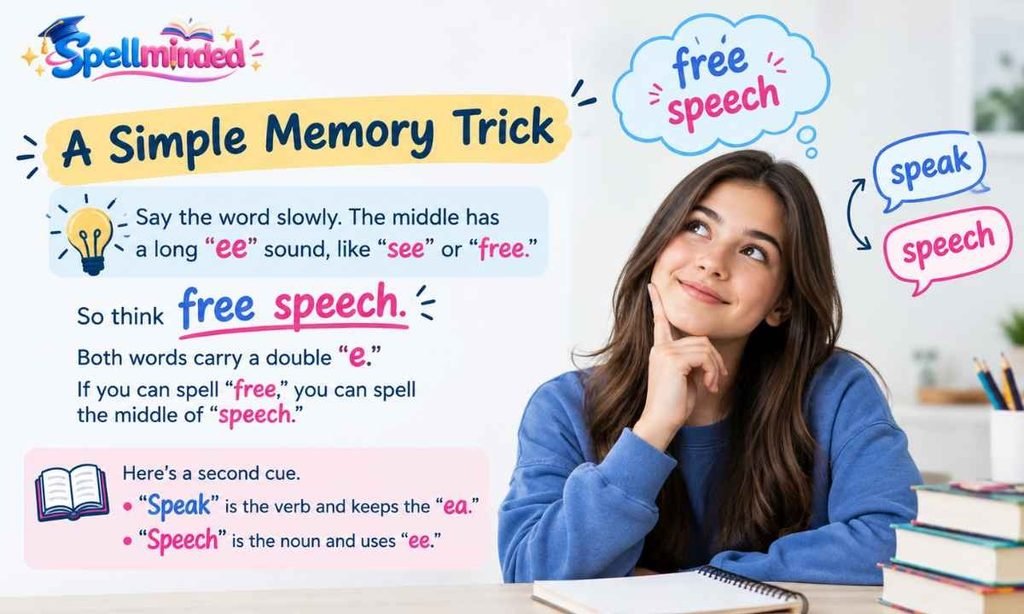
Say the word slowly. The middle has a long “ee” sound, like “see” or “free.”
So think free speech. Both words carry a double “e.” If you can spell “free,” you can spell the middle of “speech.”
Here’s a second cue. “Speak” is the verb and keeps the “ea.” “Speech” is the noun and uses “ee.”
Common Mistakes with Speech
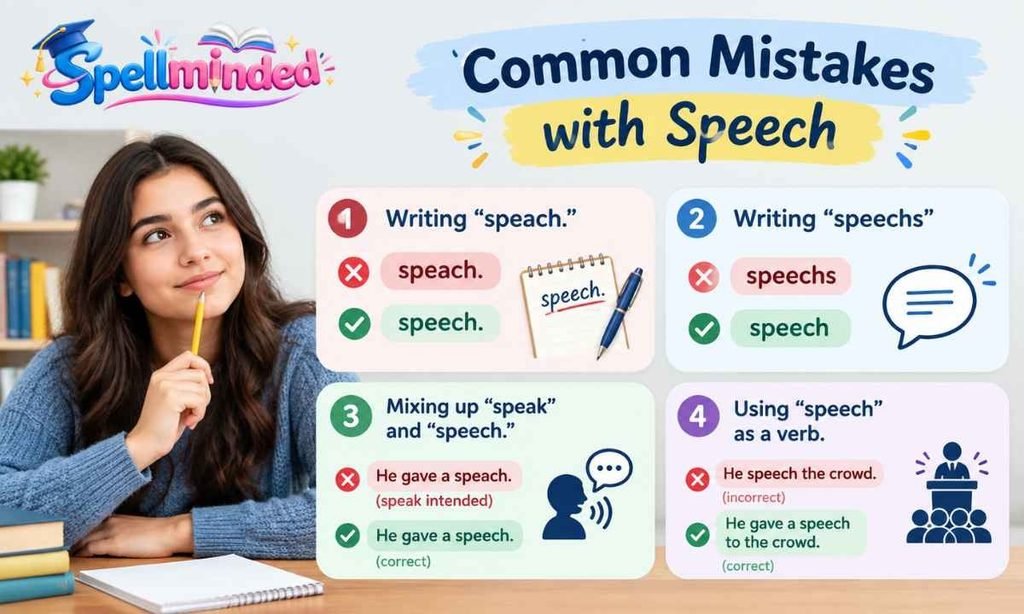
Picture this. You’ve finished a long email, you’re about to hit send, and you spot “speach” in the second line. It happens to everyone. These are the slips to watch for:
- Writing “speach.” This is the most common mistake by far.
- Writing “speechs.” The correct plural is “speeches.”
- Mixing up “speak” and “speech.” “Speak” is a verb. “Speech” is a noun.
- Using “speech” as a verb. Some dictionaries list a rare, dated verb form, but it isn’t standard. Use “speak,” “give a speech,” or “address” instead.
Corrections:
| Incorrect | Correct |
| She gave a great speach. | She gave a great speech. |
| He made three speechs today. | He made three speeches today. |
| I need to speech to the board. | I need to speak to the board. |
| The speach was very moving. | The speech was very moving. |
Speech Therapy: Same Spelling, Same Rule
The same rule applies to “speech therapy.” It’s never “speach therapy.” Speech therapy helps people with speaking, voice, and language, and the professionals who provide it are often called speech-language pathologists or speech and language therapists.
Keep the spelling right on resumes, websites, and appointment forms. It’s a small detail that looks careful.
Speech in Grammar
You’ll also meet this word in grammar lessons, and the spelling never changes.
- Part of speech: a category such as noun, verb, or adjective. “Speech” itself is a noun.
- Direct speech: the exact words someone said, in quotation marks. She said, “I’m tired.”
- Indirect speech: a report of what was said, with no quotation marks. She said that she was tired.
Speech in Everyday Examples

Seeing the word in context helps it stick. Here’s how “speech” appears in real writing.
1. Emails
- “Please review my draft speech before Friday.”
- “Her speech at the team meeting covered next quarter’s goals.”
2. News
- “The governor’s speech focused on public transport.”
- “Reporters are analyzing the minister’s speech for hints about the budget.”
3. Social Media
- “Best graduation speech I’ve ever heard. 🎓”
- “Free speech comes with responsibility.”
4. Formal Writing
- “The candidate’s speech outlined a plan for education reform.”
- “In her acceptance speech, the author thanked her editors and readers.”
Speach or Speech for Students
If you’re a student, this word comes up often. Speeches are assigned in English, public speaking, and debate classes, and the word appears on rubrics and instructions.
A few tips help:
- Copy the spelling from your assignment title. If it says “speech,” match it.
- Run a spell check, then read your final draft once, looking only for this word.
- Use the “free speech” trick to double-check under exam pressure.
- Remember the plural: “speeches.”
Speech – Google Trends & Usage Data
I can’t quote live Google Trends numbers here, so this section sticks to what the search behavior itself shows. People who look up this spelling often go on to related searches: whether “speach” is a word, examples, grammar, speech therapy, and quizzes.
That pattern points to a spelling-check habit. Readers want a fast yes-or-no, then a little proof.
Usage backs up the answer. Standard dictionaries carry only “speech,” and spell-checkers commonly flag “speach” as an error. In published writing, from news to textbooks, “speech” is the form you’ll see.
Comparison Table: Speech vs Speach
| Feature | Speech | Speach |
| Correct English word | ✅ Yes | ❌ No |
| Listed in major dictionaries | ✅ Yes | ❌ No |
| Has a definition | ✅ Yes | ❌ No |
| Fine in formal writing | ✅ Yes | ❌ Never |
| Valid in British English | ✅ Yes | ❌ No |
| Valid in American English | ✅ Yes | ❌ No |
| Plural form | ✅ speeches | ❌ None |
Quick Quiz: Speach or Speech?
Choose the correct spelling for each blank.
- She gave a short ______ at the party. (speech / speach)
- Freedom of ______ is a common topic in civics class. (speech / speach)
- He booked a ______ therapy session. (speech / speach)
- The plural of the word is ______. (speeches / speechs)
- Which word has the “ee” sound in the middle: “speak” or “speech”?
Answers: 1. speech. 2. speech. 3. speech. 4. speeches. 5. speech.
Frequently Asked Questions
Is “speach” a word?
No. “Speach” isn’t an English word. It’s a misspelling of “speech.”
Is it “speech therapy” or “speach therapy”?
It’s “speech therapy.” The Speach or Speech rule holds for professional terms too, and the correct spelling is always “speech.”
What is the easiest way to remember how to spell “speech”?
Think free speech. Both words have a double “e” in the middle. Also remember that the verb “speak” keeps “ea,” while the noun “speech” uses “ee.”
What is the plural of “speech”?
The plural is “speeches.” “Speechs” is incorrect.
Why is “speech” spelled differently from “speak”?
The two words are related, but English settled on different spellings as it developed. The noun became “speech,” and the verb stayed “speak.”
Conclusion
The answer to Speach or Speech is simple. “Speech” is the correct spelling in British and American English alike, and “speach” is always a mistake.
The mix-up is easy to understand, since “speak” and words like “teach” and “reach” all use “ea.” Just remember free speech, with its double “e,” and you’ll get it right every time.