

You’re typing a quick message about the weekend plan. You write “outting,” then pause. Something looks off. Your spell-checker stays quiet, and now you’re doubting a word you’ve used for years.
This guide settles the outting or outing question in seconds. You’ll get the correct spelling, the rule behind it, and a simple test you can run in your head every time.
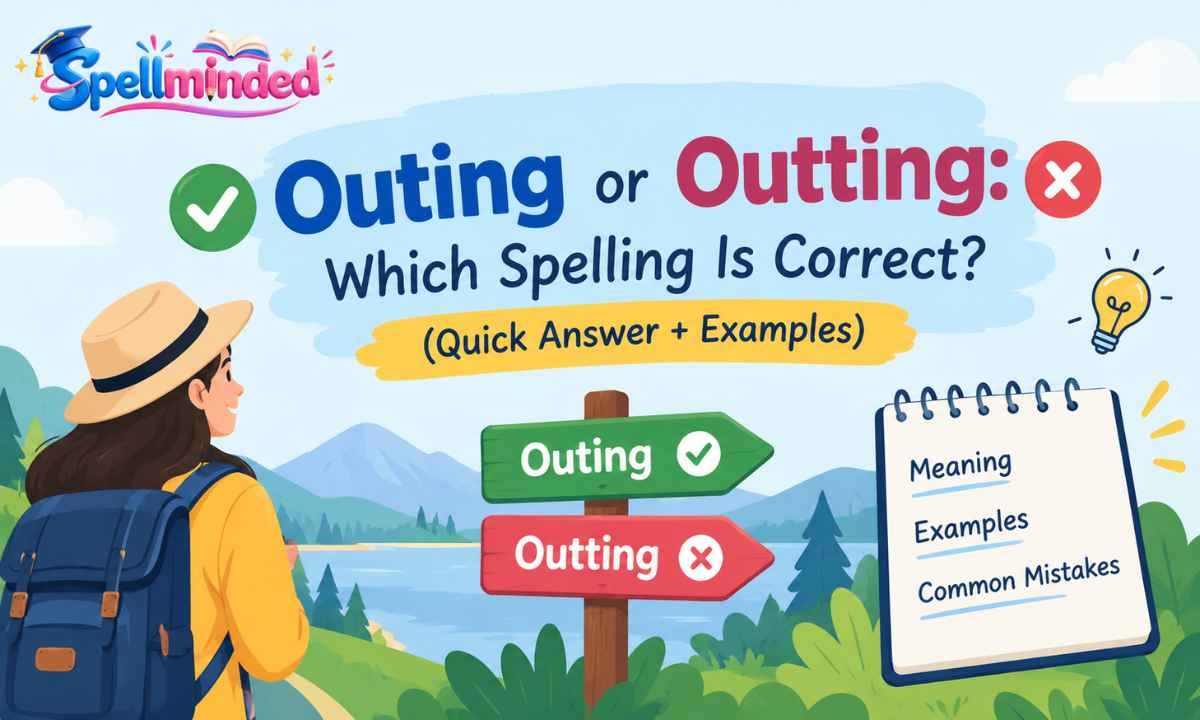
Quick Answer: Outting or outing? The correct spelling is outing, with one “t.” “Outting” is a misspelling. Merriam-Webster and Oxford both list “outing” with a single “t,” and neither gives “outting” as a variant.
What Does “Outting” Mean?
Nothing. “Outting” isn’t a word. It has no definition, no part of speech, and no context where it counts as correct. Merriam-Webster and Oxford both give “outing” as the standard form.
So why does it look so convincing? Because it’s a believable slip. It’s a real word wearing one extra letter, not a separate word with its own meaning.
If you’ve typed it, you’re in good company. It’s one of the easiest spelling mistakes to make. The fix takes two seconds: drop the second “t.” There’s no hidden meaning to look up and no special case to memorize. The word you want is simply “outing.”
What Does “Outing” Mean?
“Outing” is a noun, pronounced OW-ting. Merriam-Webster lists several related senses. Here are the three you’ll meet most often.
1. A Short Trip or Excursion
This is the everyday meaning. Oxford describes it as a short trip taken for pleasure or education, usually with a group and lasting no more than a day. It’s the word you’ll find in school newsletters, event invitations, and weekend plans.
- We planned a family outing to the lake.
- The school outing to the science museum ran late.
- Their annual team outing is always a hit.
Notice that the trip doesn’t have to be far or fancy. A picnic in the park counts. So does a class visit to the library.
2. The Act of Publicly Disclosing Private Information
Here, “outing” means publicly revealing something private about a person without their consent. Merriam-Webster’s definition covers the public disclosure of a prominent person’s covert sexual orientation or gender identity.
This sense is heavier than the first one. It can hurt people, so use it with care and only when the context is clear.
- Critics condemned the tabloid for outing the actor.
3. A Public Appearance or Performance
Merriam-Webster also lists “outing” for an appearance in a competition or a role. You’ll see this sense often in sports and entertainment writing.
- It was her first outing as a director.
- The pitcher struggled in his latest outing.
Outting or Outing – Quick Answer
The outting or outing question has a one-line answer: write “outing.” The table below covers every form you’re likely to type.
| Form | Correct? | Note |
| outing | ✅ Yes | Standard spelling |
| outings | ✅ Yes | Correct plural |
| outed | ✅ Yes | Past tense of the verb “out” |
| outting | ❌ No | Misspelling |
| outtings | ❌ No | Misspelled plural |
| outted | ❌ No | Misspelled past tense |
Notice the pattern. Every correct form has a single “t.” Every incorrect form has two.
If you only have three seconds, here’s the shortcut. Say the word “out,” then tack on “-ing.” Nothing else changes, so nothing else gets added.
The Origin of “Outing”
“Outing” is built from the word “out” plus the suffix “-ing.” Merriam-Webster dates its first known use to 1821, so this isn’t a new word or a recent spelling quirk.
The trip meaning is the classic everyday one. The disclosure meaning shows up mostly in news and social commentary. Different uses, same spelling.
The logic never gets complicated. You start with “out” and add “-ing.” Nothing doubles. Today’s standard dictionaries list only the single-“t” form.
That also explains why “outing” feels so regular once you see it. Plenty of words take “-ing” the same way, such as “shouting,” “counting,” and “sprouting.” None of them double the “t,” and neither does this one.
British English vs. American English Spelling
Some English words do split by region. “Travelling” is the British spelling and “traveling” is the American one. “Cancelled” and “canceled” work the same way.
“Outing” isn’t one of those words. Merriam-Webster, a US dictionary, lists “outing.” Oxford, a UK-published dictionary, shows the same single-“t” form. There’s no regional exception and no informal variant.
So whether you’re writing for readers in London or Los Angeles, the spelling stays identical. If you spot “outting” on a UK site, it’s the same typo you’d find on a US one.
Which Spelling Should You Use?
Use “outing.” Every time. In emails, essays, captions, newsletters, and formal reports alike. When outting or outing comes up, the answer never changes.
Here’s a test that works better than “just remember it.” Compare put and out:
- put has one vowel (u) before the final “t.” Result: putting.
- out has two vowels (ou) before the final “t.” Result: outing.
Run this check before you add “-ing.” One vowel and one final consonant? Double the consonant. A vowel pair? Leave it alone.
That one habit also protects you on other words. You’ll never be tempted by “shoutting” or “scoutting” again.
Here’s a practical safety net, too. Before you send or publish, use your Find tool to search for “outt.” It catches “outting,” “outtings,” and “outted” in one pass.
Why Do People Write “Outting”? The Double Consonant Rule Explained
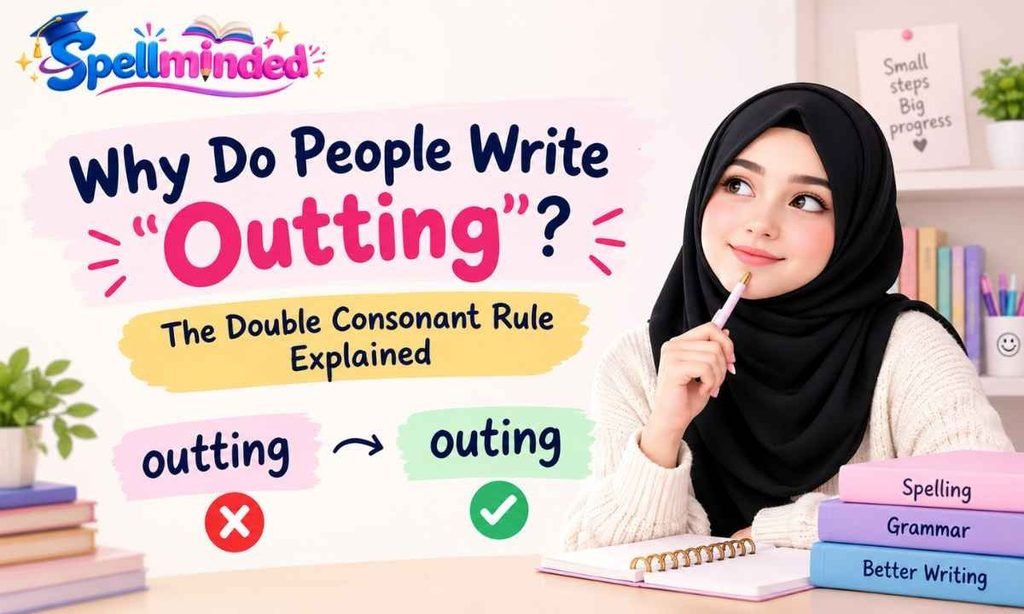
Picture yourself typing fast. “Run” becomes “running.” “Sit” becomes “sitting.” “Hit” becomes “hitting.” Your fingers pick up a rhythm: take a short word, double the last letter, add “-ing.”
Then “out” arrives, and the habit fires on its own. That’s the usual road to “outting.”
The real rule is narrower than the habit. Double the final consonant before “-ing” when a one-syllable word ends in a single vowel followed by a single consonant.
Longer words can double too, but only when the final syllable is stressed. That’s why begin becomes beginning, while visit becomes visiting. “Out” is a single syllable with a vowel pair, so it never qualifies.
That’s why these words double:
- run → running
- sit → sitting
- put → putting
“Out” doesn’t fit the pattern. Its vowel sound is spelled with two letters, “o” and “u.” That’s a vowel pair, so the rule doesn’t apply. Its relatives behave the same way:
- shout → shouting
- scout → scouting
- pout → pouting
A second “t” can also sneak in when your finger lingers on the key. Some spell-checkers may not flag it, so don’t count on them to catch it for you.
Common Mistakes with “Outing”
Most outting or outing slips fall into a few patterns. Here are the fixes at a glance:
- ❌ We took many outtings this summer.
- ✅ We took many outings this summer.
- ❌ The tabloid outted the actor.
- ✅ The tabloid outed the actor.
- ❌ It was a outing for the whole team.
- ✅ It was an outing for the whole team.
That last one is an article mistake, not a spelling error. Use “an” before “outing,” because the word starts with a vowel sound.
A related slip is doubling the “t” in other “-out” words. Writers sometimes type “shoutting,” “scoutting,” or “poutting” for the same reason. All three should have a single “t” before “-ing.”
Two more habits are worth watching:
- Mixing up the meanings. A team outing is a day out. Outing someone is a serious act. Re-read your sentence so the tone matches what you mean.
- Trusting autocorrect blindly. Tools miss things. Give your text a quick check by eye before you hit send.
“Outing” in Everyday Examples

Here’s how the word works in different settings.
Family and social:
- Sunday’s outing to the farmers’ market became a weekly habit.
- The kids talked about the zoo outing all week.
Work:
- The team outing at the bowling alley lifted everyone’s mood.
- HR is booking a summer outing for all departments.
School:
- Parents must sign the permission slip for the outing.
- A museum outing can teach more than a week of lessons.
Sports and entertainment:
- The striker scored twice in his latest outing.
- It’s the band’s first outing since the new album.
Verb use:
- The newspaper was criticized for outing a private citizen.
- Nobody should be outed without their say-so.
Outting – Google Trends & Usage Data
Rather than quote shaky numbers, here’s what you can verify yourself.
Merriam-Webster and Oxford both list “outing” as the standard spelling. Neither presents “outting” as a variant. That alone tells you which side to bet on.
Merriam-Webster also shows the regular plural, “outings,” and lists the verb forms as outed, outing, and outs. Every one of them keeps a single “t.”
People search for outting or outing because the mistake looks believable. Some spell-checkers may let it through, so a quick manual check pays off.
Want to see the pattern for yourself? Type both spellings into Google Trends and compare them side by side. It takes under a minute.
Keyword Comparison Table
Every outting or outing slip maps to one simple fix. This table shows what people type, what they mean, and where each form tends to appear.
| What people type | Correct form | Where you’ll see it |
| outting | outing | Everyday writing |
| family outting | family outing | Social posts, invitations |
| school outting | school outing | Parent messages, newsletters |
| company outting | company outing | HR and event planning |
| day outting | day outing | Travel and leisure writing |
| outtings | outings | Plural references |
| outted | outed | Past tense of the verb |
Each pair differs by exactly one letter. That’s why the error is so easy to miss, and why it’s worth a second look.
Frequently Asked Questions
Is it outting or outing?
The correct spelling is “outing,” with one “t.” “Outting” is a misspelling that no standard dictionary treats as a valid form.
Is “outting” ever correct?
No. It isn’t a British variant, a slang spelling, or an alternate form. Whatever the sense, the spelling is “outing.” Whether you’re writing about a trip, a performance, or the verb, the single “t” stays.
Why isn’t the “t” doubled in “outing”?
The doubling rule applies to one-syllable words ending in a single vowel plus a single consonant. “Out” has the vowel pair “ou,” so it stays as it is.
What’s an easy way to remember the spelling?
Compare put and out. “Put” has one vowel, so it doubles to “putting.” “Out” has two vowels, so it simply becomes “outing.”
What’s the past tense of the verb “out”?
It’s “outed,” not “outted.” The verb forms are outed, outing, and outs, all with a single “t.”
Conclusion
Outting or outing? The answer is “outing,” every time. The extra “t” in “outting” comes from a habit that works for words like run and sit but not for a word with a vowel pair like “out.”
So keep it simple. Use “outing,” “outings,” and “outed” with one “t.” Run the put versus out check whenever you’re unsure, and give your text a quick read-through instead of leaning on autocorrect. One missing letter is a small fix, and it keeps your writing looking polished.