


You’re mid-sentence and you stop. Does the word take a “d” or a double “t”? Autocorrect doesn’t always rescue you. Second-guessing a word right before you hit send is no fun.
This guide settles the studder or stutter question fast. You’ll get the dictionary answer, the reason so many people slip, real examples, and a memory trick that sticks.
Studder or stutter? The correct spelling is stutter, with a double “t.” “Studder” is a common misspelling when you mean the speech pattern or condition.
Studder
The studder or stutter mix-up is easy to understand. Still, “studder” is a spelling mistake when you mean speech. That’s the sense nearly everyone is after.
It’s also, oddly, a real dictionary entry. Merriam-Webster defines a “studder” as a worker who inserts watch hairsprings into studs. That’s a watchmaking job. It has nothing to do with speech, and you’ll almost never meet the word outside that trade.
So if you’re describing someone who repeats sounds while talking, “studder” is wrong. “Studdering” and “studdered” are wrong too. The same goes for any sentence about a stalling engine or a glitchy video. Those need “stutter” as well.
Why does the mistake happen? Two reasons stand out. In casual American speech, the middle of “stutter” sounds like a soft “d”. Also, “studder” may get blended with “shudder”, since both words suggest a shaky, halting motion.
Here’s the catch. Because “studder” sounds the same as “stutter” out loud, your ear can’t help you. Only the spelling can.
Stutter
“Stutter” is the correct spelling. Dictionaries such as Merriam-Webster and Collins list it as the standard form.
It works in two ways:
- As a verb: “He tends to stutter when he’s nervous.”
- As a noun: “She has a mild stutter.”
As a verb, it means to speak with involuntary repetitions, prolongations, or blocks. As a noun, it names that speech pattern. People also use it for anything that moves or sounds in a halting way. An engine can stutter. So can a video stream. A stalled negotiation or a struggling economy can even “stutter” in news headlines.
The whole word family keeps the double “t”: stutters, stuttered, stuttering, and stutterer. The word is pronounced STUH-ter and rhymes with “butter.” The stress falls on the first syllable, and the middle sound is quick and soft. That soft sound is exactly what fools people at the keyboard.
Studder / Stutter – Quick Answer
Here’s the short version of the studder or stutter question:
- Stutter is correct for the speech condition, the verb, and the everyday metaphors.
- Studder is a misspelling in that sense. Its only dictionary meaning is a watchmaker’s job.
- American and British English both spell it stutter.
- Not sure? Write stutter.
If you remember only one thing, remember the double “t.”
Examples
Seeing the two spellings side by side makes the fix obvious. If you’re ever torn between studder or stutter in a sentence like these, check the table below.
| ❌ Incorrect (studder) | ✅ Correct (stutter) |
| She has always had a studder in public. | She has always had a stutter in public. |
| His studder eased after months of therapy. | His stutter eased after months of therapy. |
| The engine studdered before it died. | The engine stuttered before it died. |
| The video studdered and then froze. | The video stuttered and then froze. |
Notice the pattern. Only the spelling changes. The meaning and the grammar stay exactly the same. A quick test helps: if the sentence is about halting speech or halting movement, the word you want is stutter.
Every form of the word works the same way. Here are a few more correct sentences:
- She stutters less when she’s relaxed.
- He stuttered through the first line and then found his rhythm.
- Her stuttering improved with practice.
- The stutterer in the story becomes its bravest character.
The Origin of Stutter
Word histories help settle studder or stutter for good. So here’s where “stutter” comes from.
Merriam-Webster traces the verb to an English dialect word, “stut,” meaning to stutter. That word came from Middle English “stutten.” The dictionary also links it to Dutch “stotteren.” The “-er” ending gives the verb a repeated-action feel, which suits a word about repeated sounds.
Vocabulary.com adds that the word is somewhat onomatopoeic, meaning it imitates the sound it describes. It may also relate to Middle Low German “stoten,” which means to knock or strike against something. Picture words bumping into a wall. That image fits the way the word sounds, with its clipped, repeated “t” beats. The first known use in English dates to the 1500s.
None of this history supports “studder” as a variant. The watchmaker’s “studder” appears to come from a different word entirely: “stud.” That’s one more reason the double “t” in stutter is settled. The two words simply grew from different roots.
British English vs American English Spelling
Here’s the good news: there’s no split. Both varieties spell the word stutter.
The only difference is vocabulary. British speakers often say “stammer” as well. Americans lean toward “stutter.” Both words describe the same speech pattern. You’ll see “stammer” in British conversation and headlines. The spelling question stays exactly the same, though. If you choose “stutter,” you’re correct on both sides of the Atlantic.
| Variety | Standard spelling | Other common word |
| American English | stutter | stammer (less common) |
| British English | stutter | stammer (common) |
| Canadian and Australian English | stutter | stammer |
So in the studder or stutter debate, region never decides the answer. “Studder” isn’t accepted for speech in any of these varieties.
Which Spelling Should You Use?
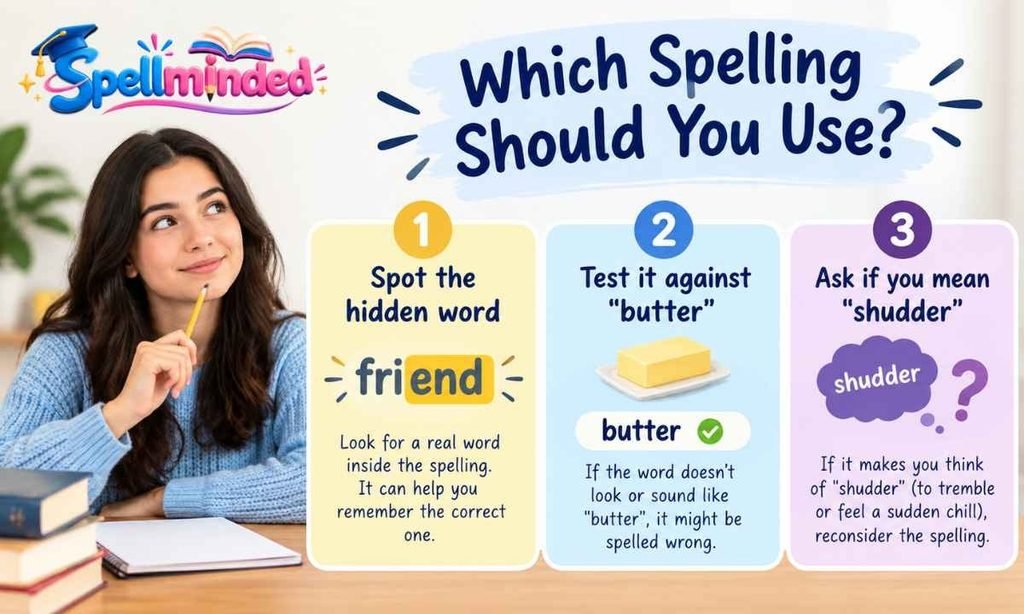
Use stutter. Every time, in every kind of writing.
Three quick tricks make it automatic.
Trick 1: Spot the hidden word. Look inside “stutter” and you’ll find “utter.” To utter is to speak. So stutter is a word about speaking, and the “utter” part is already spelled with a double “t.” You can’t borrow a “d” from a word that doesn’t have one.
Trick 2: Test it against “butter.” Say “butter” out loud. In American English, it often sounds like “budder.” Yet nobody spells it that way. Stutter follows the same rule: the “d” sound lives in your ear, but the double “t” belongs on the page.
Trick 3: Ask if you mean “shudder.” If you were about to type “studder,” pause. Are you describing a shiver or a tremble? Then “shudder” is your word. If you mean halting speech or a halting motion, it’s “stutter.” Neither one is spelled “studder.”
When studder or stutter trips you up mid-draft, run one of these tests. Then move on. And if your spellchecker underlines the word in red, treat that as your cue to check the double “t.”
Studder or Stutter in Adults
Many searches combine the spelling question with the word “adults.” Some people want the right word. Others want to understand the condition. This section covers both.
The spelling comes first. It’s stutter for adults, for children, and for everyone else. Whether an adult searches studder or stutter, the correct word never changes.
Now the condition. Stuttering often begins in childhood. Some children outgrow it. Others continue to stutter into adulthood. It says nothing about a person’s intelligence, ability, or confidence.
Adults who stutter can work with a licensed speech-language pathologist. Therapy often focuses on speaking comfort, easing tension, and building strategies for different situations. Results vary from person to person. If you’re looking for support, a licensed clinician or a national speech-language association is a sound place to start.
When you write about this topic, choose your words with care. Many writers prefer “a person who stutters” because it puts the person first.
One more tip for writers. Skip spellings that imitate a person’s stutter in a mocking way. If you quote someone who stutters, describe the moment plainly and let their words stand.
Stutter Synonyms and Related Words
Need an alternative? Match the word to the context.
Everyday synonyms
- Stammer
- Falter
- Hesitate
- Stumble over words
- Sputter
Clinical terms
- Fluency disorder
- Disfluency
- Speech disorder
Related uses
- Stutter step: In sports, a quick hesitation step used to throw off a defender. It’s a movement term, and it’s always spelled with a double “t.”
- In Spanish: tartamudear is the verb, and tartamudez names the condition.
“Stammer” is the closest match for speech. “Falter” and “hesitate” work for a pause in any activity. “Sputter” suits an engine or a burst of broken words. None of these terms involves “studder.” Pick the one that fits your sentence, then check the spelling of the word you chose.
Common Mistakes with Studder / Stutter

The mistakes follow one pattern. Writers swap the double “t” for a “d” in every form of the word. The fix is just as regular.
❌ Wrong:
- “She has a studder.”
- “He was studdering through the introduction.”
- “Her voice studdered with nerves.”
- “Is studdering a real condition?”
✅ Correct:
- “She has a stutter.”
- “He was stuttering through the introduction.”
- “Her voice stuttered with nerves.”
- “Is stuttering a real condition?”
Swap in the matching form of stutter, and you’re done.
Stutter in Everyday Examples

Here’s how the word reads in four common settings. After a few of these, studder or stutter should feel easy.
A calm, matter-of-fact tone works best:
“Thanks for your patience on our call. I stutter at times, so I may need a moment to finish my thoughts.”
News
News writing often keeps the word simple and respectful:
“The profile explored how a local teacher’s stutter shaped her approach to helping shy students.”
Social Media
Posts can be short and personal:
“A year of practice with my stutter. Some days are harder than others. Still showing up. #StutterAwareness”
Formal Writing
Academic and professional writing favors precise, neutral phrasing:
“The survey invited adults who stutter to describe their experiences in job interviews.”
The word stays the same in every setting. Only the tone changes.
Studder / Stutter – Google Trends & Usage Data
People keep typing “studder” for a simple reason. It sounds right, so they aren’t sure it’s wrong. That uncertainty keeps the phrase studder or stutter circulating in search.
Search engines often suggest the correct spelling and show results for “stutter.” Related searches show what readers want next. Common ones include the meaning, examples, pronunciation, whether “studder” is a word, “stutter step,” and the Spanish translation. That list matches the sections of this guide, so you can jump to whichever answer you need.
The pattern is clear. Spelling doubt is often the first step. Readers then move on to meaning and usage.
What does this mean for your writing? Readers who land on a page with “studder” in it may trust the rest of the page less. A correct spelling protects your credibility.
Exact search volumes shift from month to month. For current figures, check Google Trends directly.
Comparison Table: Studder vs Stutter
This table compares studder or stutter across what you hear and what you write.
| Feature | Studder | Stutter |
| Sound in casual American speech | Soft “d” sound | Soft “d” sound |
| Correct spelling for speech | ❌ No | ✅ Yes |
| Dictionary meaning | A watchmaker’s job | To speak with involuntary repetitions or blocks |
| Word forms | Not used for speech | stutters, stuttered, stuttering, stutterer |
| Used in American and British English | Not for speech | Yes, both |
| Formal writing | Avoid | Use |
| Spellcheck | Often flagged | Passes |
The sound is the same. Only the spelling makes the difference. Keep this table in mind whenever the two words look equally right on screen.
Frequently Asked Questions
Is “studder” ever correct?
Only as a rare watchmaking noun. Merriam-Webster defines it as a worker who fits hairsprings into studs. For the speech condition or the act of speaking that way, it’s always a misspelling.
What is the correct definition of stutter?
As a verb, it means to speak with involuntary repetitions, prolongations, or blocks. As a noun, it names that speech pattern or condition.
Is stutter the same as stammer?
In everyday use, yes. Both describe the same speech pattern. “Stammer” is common in British usage, while “stutter” is the standard spelling in both British and American English.
Why do people spell it “studder”?
In casual American speech, the middle “t” sounds like a soft “d,” the same way “butter” sounds like “budder.” Remember the trick: stutter hides the word “utter,” and the double “t” stays.
Can adults stutter?
Yes. Some children outgrow stuttering. Others continue to stutter as adults. A speech-language pathologist can help with strategies and support, and many adults find the right approach takes some experimenting.
Is stuttering a disability?
It depends on the person and the situation. Some people see it as a communication difference. Where the law applies, it may be treated as a disability when it significantly affects daily life. For personal or legal questions, ask a qualified professional.
How do you spell the past tense of stutter?
It’s “stuttered,” never “studdered.” The -ing form is “stuttering.” Both keep the double “t.” The same rule holds for “stutterer” and “stutters.”
What are some synonyms for stutter?
Common ones include stammer, falter, hesitate, and stumble over words. Clinical terms include disfluency and fluency disorder.
Conclusion
The answer to studder or stutter is settled. Stutter is correct, and “studder” is the mistake. You may hear a soft “d,” but the word is spelled with a double “t.” That gap between sound and spelling is the whole reason the mistake exists.
Keep the memory trick handy: stutter hides the word “utter” inside it. Use the correct spelling every time, in emails, essays, captions, and reports. And when you write about the speech condition itself, write with the same care you’d want as a reader.