

You’re typing fast and the sentence is almost done. Then you stop and stare at one word. Does it look a little short? That flicker of doubt hits almost everyone, and it usually lands on a word you use a hundred times a week.
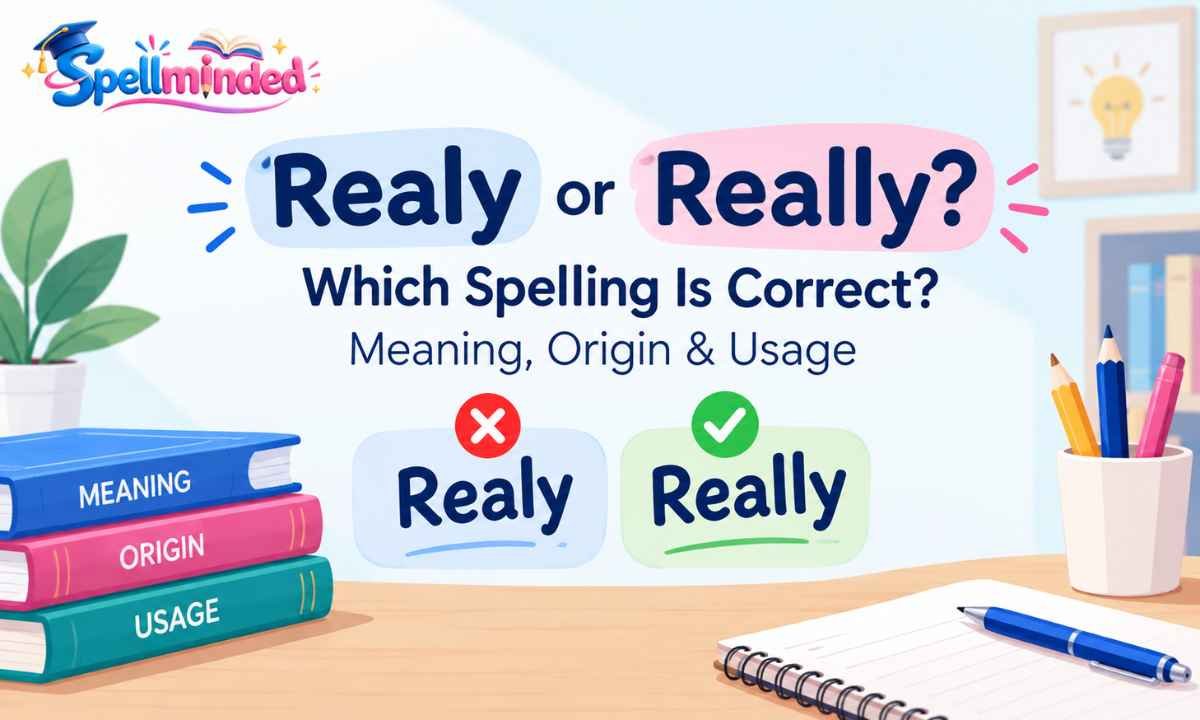
This guide settles it, with no grammar jargon. You’ll see why people search Realy or Really, how the word sounds, where it comes from, and a memory trick that actually sticks. Really, with two Ls, is the only correct spelling. “Realy” is a typing slip, not a variant.
Realy or Really – Quick Answer
The correct spelling is “really.”
- Correct: really (an adverb with two Ls)
- Incorrect: realy (not a word in any English dictionary)
- Why: it’s built from real + -ly, and both Ls stay.
In the Realy or Really debate, “really” wins every time, in American, British, and every other variety of English.
What Is “Realy”?
“Realy” is a misspelling. It’s what you get when the second L in “really” goes missing.
If you’ve searched for the Realy or Really meaning, here’s the honest answer: “realy” doesn’t have one. So is realy a word? No. You won’t find it as an entry in Merriam-Webster, Cambridge, or Oxford. It may appear as a username, a brand name, or a surname, but it isn’t an English word with a definition.
That’s also why it never gets a “correct” use. Every time you see it in a sentence, it’s standing in for “really.”
What Is “Really”?
“Really” is an adverb. It does a few useful jobs.
- In reality or in fact: “She isn’t really sick. She’s just tired.”
- Very or to a high degree: “That’s a really good idea.”
- To express surprise or doubt: “Really? You finished already?”
- To soften a statement: “Not really. I’d rather stay in.”
You’ll hear it in casual chats, read it in emails, and see it in headlines. It’s one of the most common words in everyday English.
Its parent is the adjective real, meaning genuine or actual. Add -ly and you get “really,” meaning “in a real way.” Nothing gets dropped in that process.
How to Pronounce “Realy” vs. How to Pronounce “Really”
Here’s the sneaky part. “Realy” has no official pronunciation because it isn’t a word. If you read it aloud, you’d say it exactly like “really.”
That’s why the mistake survives. In speech, the missing L is invisible, so your ear never warns you. Your eyes have to catch it. If you’ve ever wondered how to pronounce really, the two regional versions below cover it.
British English Pronunciation of Really
In British English, “really” is often pronounced close to REER-lee. The first vowel glides, a bit like the sound in “near.” Some speakers stretch it into two soft beats, closer to REE-uh-lee.
The stress falls on the first syllable. Both versions have two clear syllables, and both keep the L sound before the final “ee.”
American English Pronunciation of Really
In American English, “really” usually sounds like REE-lee. Some speakers add a light extra beat in the middle, giving REE-uh-lee. Dictionaries commonly list both.
Again, the stress sits on the first syllable. The accents differ a little, but the spelling stays the same.
The Origin of “Really”
The story starts with “real.” Dictionaries trace it back through Old French and Medieval Latin realis to Latin res, meaning “thing.” So the root idea is something that actually exists.
English then added the -ly ending to turn the adjective into an adverb. That gave us “really,” meaning “in actual fact.”
Over the centuries, the word also picked up its “very” sense. That’s the one in “really tired” or “really cold.” The core spelling never changed, because the formula stayed simple: real + -ly.
For you as a writer, the takeaway is practical. The first L belongs to “real.” The second L comes from “-ly.” Both parts are doing a job, so neither can vanish.
British English vs. American English Spelling
Many spelling pairs split along the Atlantic. Think color and colour, or center and centre. This isn’t one of them.
In the Realy or Really question, there’s no regional split. British, American, Canadian, and Australian English all spell it “really.” You won’t find a version where “realy” is acceptable.
The only real difference between the two is how people say it, as you saw in the pronunciation section. When you proofread, you don’t need to switch spellings to suit your audience. Two Ls, everywhere.
Which Spelling Should You Use?
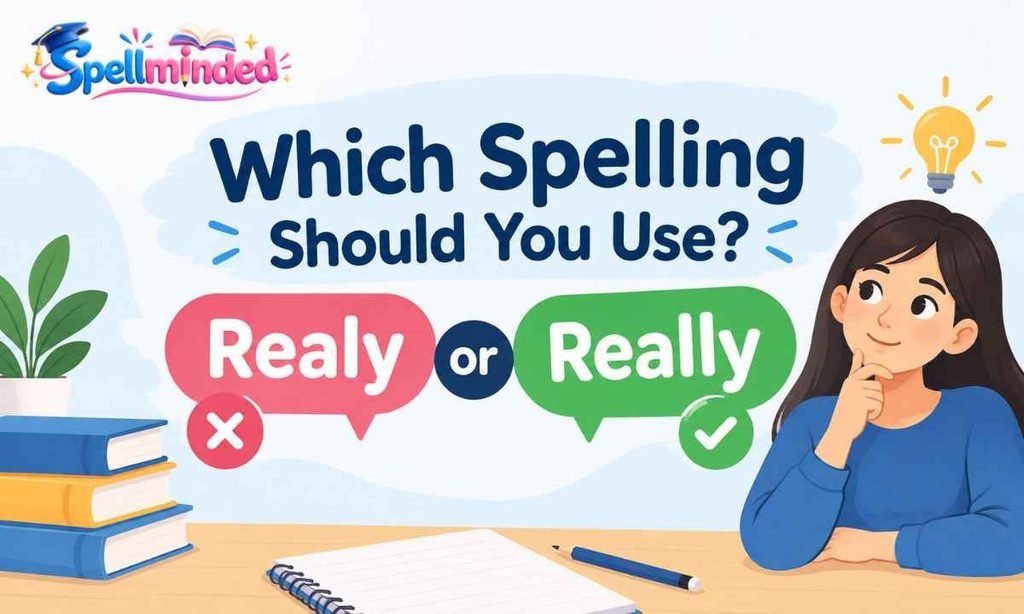
Use really. Every time, in every setting.
When Realy or Really comes up in a draft, treat “realy” as a typo to fix, not a choice to weigh. It doesn’t belong in emails, essays, texts, captions, or reports.
A quick grammar note helps here. Real is an adjective, so it describes nouns, as in “a real problem.” Really is an adverb, so it modifies verbs, adjectives, or other adverbs, as in “really helpful.” If you’re intensifying another word, you almost always want the “-ly” form, and that form always has two Ls.
Common Mistakes with “Really”
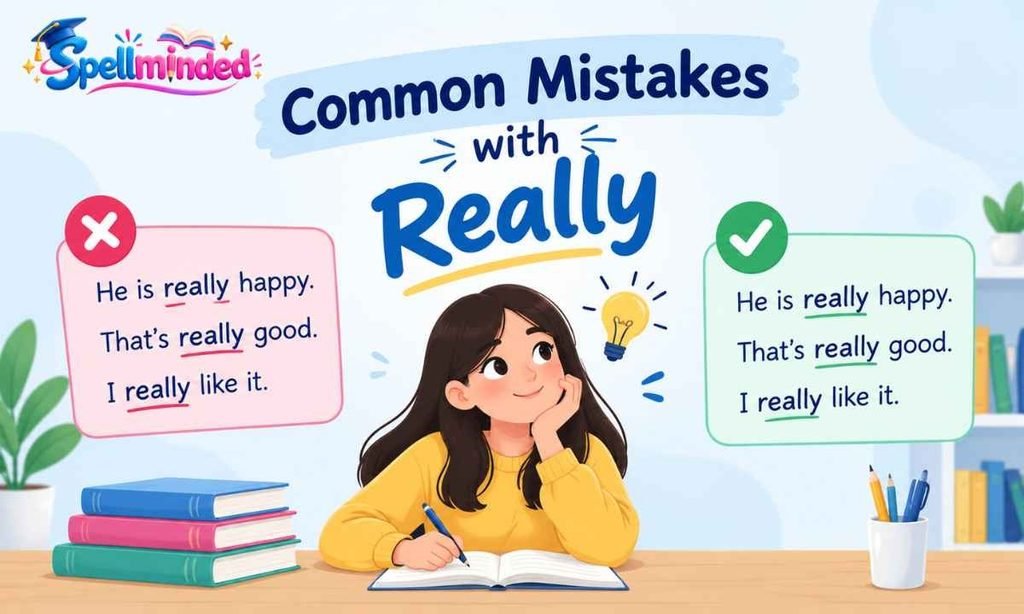
The Realy or Really slip is the big one, but it isn’t the only trap. Watch for these.
- Dropping an L: writing “realy” instead of “really.”
- Adding an extra L: writing “reallly” when your finger lingers on the key.
- Spelling it by sound: “rilly” or “reely” may look cute in a text, but they aren’t standard spelling.
- Using “real” as an adverb: “I’m real tired” shows up in casual speech, but formal writing wants “really tired.”
- Overusing it: “really” is correct but often vague. Stacking it in every sentence weakens your point.
The first mistake is the most common by far. The others are small slips that a quick proofread catches.
Why Do People Misspell “Really” as “Realy”?
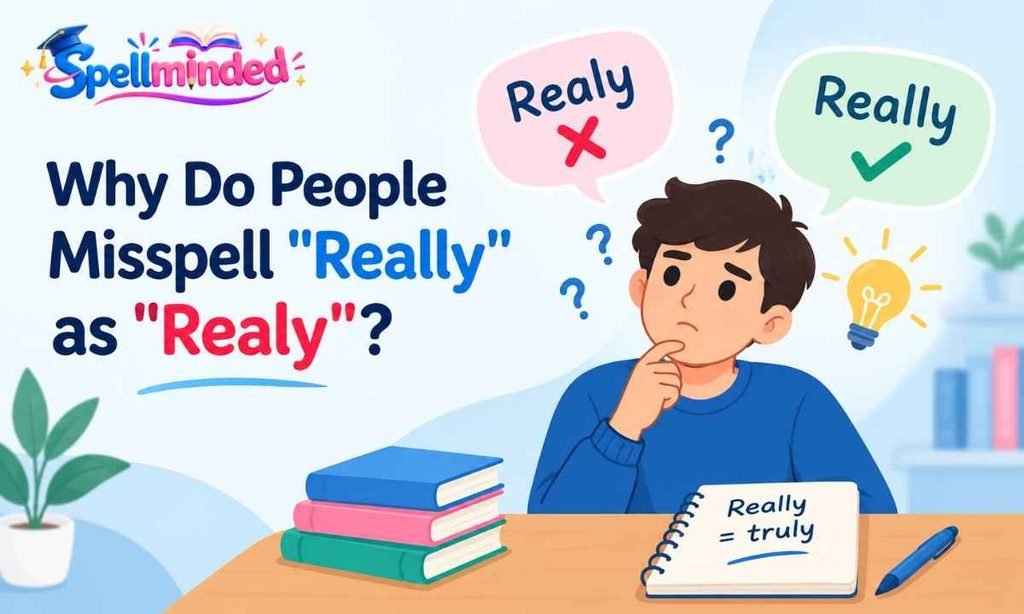
There are a few honest reasons.
It’s a double-letter word. Double letters are easy to skip. When you type quickly, one L can simply not happen.
Other -ly words don’t double. Think of “nicely,” “safely,” or “lately.” In those words, the base ends in e, so you add -ly without any repeated letter. Your brain learns a single-L pattern and applies it to “really” by habit.
Speech doesn’t show the doubled L. As you saw above, you pronounce the word the same either way. Nothing in your ear says “two Ls.”
It looks almost right. “Realy” is one letter short, and your eyes fill in the gap. That’s the same reason you can read a sentence with a swapped letter and not notice.
None of this means you’re a poor speller. It means your brain is taking a shortcut.
How to Remember the Correct Spelling of “Really”
Here’s a trick based on word families, not on rote memory.
Rule of thumb: if a word ends in L and you add -ly, you keep both Ls.
Look at how it plays out:
| Base word | Add -ly | Result |
| actual | + ly | actually |
| usual | + ly | usually |
| final | + ly | finally |
| total | + ly | totally |
| real | + ly | really |
“Really” follows the same pattern as words you already spell correctly. You’d never write “usualy” or “finaly,” so don’t write “realy.”
Next time you hesitate over Realy or Really, run the check. Say “real,” add “-ly,” and keep every letter. If you can spell actually, you can spell really.
If you like a quick mental picture, think of the two Ls as a pair of legs. The word needs both of them to stand up.
“Realy or Really” Synonyms
Sometimes the best fix is a different word. “Really” is correct, but it’s also very common. Here are some swaps, depending on the tone.
- Truly: “I’m truly grateful for your help.”
- Genuinely: “She was genuinely surprised.”
- Actually: “It actually worked.”
- Honestly: “Honestly, I loved it.”
- Very: “That’s very kind of you.”
- Extremely: “The test was extremely difficult.”
- In fact: “In fact, we finished early.”
- Seriously: “Seriously, thank you.”
If you’re curious about translations, “really” often corresponds to सच में or वाकई in Hindi and talaga in Tagalog.
Notice that none of these synonyms fixes the spelling problem for “realy.” They just give you options. The right spelling is still “really” whenever you choose that word.
“Really” in Everyday Examples
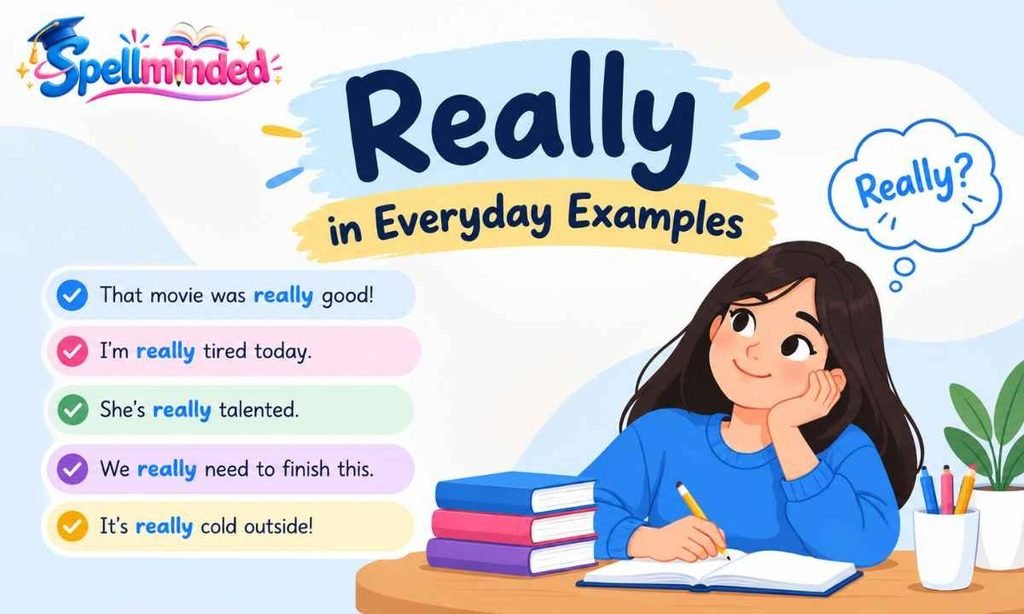
Seeing the word in context makes it stick. Here’s how “really” shows up in different places, with the misspelled version for contrast.
Emails
- ✅ “I really appreciate your quick reply.”
- ❌ “I realy appreciate your quick reply.”
- ✅ “Thanks again. I really enjoyed our call.”
A typo in an email can feel bigger than it is, because people read the first line fast. Giving it a quick scan before you send is worth the five seconds.
News
- ✅ “Officials said the storm was really two systems merging.”
- ✅ “Voters are really split on the measure, the poll shows.”
- ❌ “Voters are realy split on the measure.”
News writing tends to use “really” sparingly. Even so, the spelling holds steady.
Social Media
- ✅ “This playlist is really good.”
- ✅ “Really? That’s how it ends?”
- ❌ “This playlist is realy good.”
Social posts are casual, so people forgive a slip. Still, if the post is for a brand or a business page, a clean spelling looks more polished.
Formal Writing
- ✅ “The committee was really concerned.” (acceptable)
- ✅ “The committee was genuinely concerned.” (stronger for formal tone)
- ❌ “The committee was realy concerned.”
In academic or professional writing, the spelling is still “really.” Many style guides simply prefer a more precise word such as “genuinely” or “considerably.” That’s a style choice, not a spelling rule.
Realy or Really – Google Trends & Usage Data
If you compare the two terms in Google Trends, the pattern is easy to picture. “Really” sits far above “realy” in overall search interest, because it’s an everyday word that people use constantly.
The misspelling shows up as a smaller, steady stream of searches. Most of it comes from people double-checking before they hit send, which fits the Realy or Really question this article answers.
You’ll also notice that spelling-check searches tend to cluster around writing-heavy moments, such as school terms and busy work periods. Treat that as a general pattern to explore yourself, since the exact shape depends on your region and date range. Either way, the lesson is the same: the correct form dominates real usage, and the misspelling is a small, recurring slip.
Comparison Table: Realy vs. Really
Here’s the Realy or Really question in one glance.
| Feature | Realy | Really |
| Correct spelling? | ❌ No | ✅ Yes |
| Part of speech | None (not a word) | Adverb |
| Dictionary entry | None | Merriam-Webster, Cambridge, Oxford |
| Number of Ls | One | Two |
| How it’s built | No valid formation | real + -ly |
| Safe in formal writing? | No | Yes |
| Example | ❌ “I realy mean it.” | ✅ “I really mean it.” |
Frequently Asked Questions
Is “realy” ever correct in any form of English?
No. “Realy” isn’t a standard spelling in American, British, or any other major variety of English. It may turn up as a name or username, but as an English word, the answer is always “really.”
Why does “realy” look almost right?
It’s one letter short of the real thing. Your brain also knows plenty of single-L “-ly” words, like “nicely,” so the shorter shape feels familiar. Doubling the L is what makes it correct.
Can I use “really” in formal writing?
Yes, the spelling is perfectly fine. Some formal styles prefer stronger words such as “genuinely” or “significantly,” so you may want to vary it. Either way, never use “realy.”
Will spell-check always catch “realy”?
Not always. Most spell-checkers flag it, but it can slip through in text boxes without spell-check, in names, or when autocorrect is off. A quick read-through is the safest backup, especially for the Realy or Really slip.
What is the easiest way to remember the spelling of “really”?
Use the word-family rule: if a word ends in L, adding “-ly” keeps both Ls. You already spell actually, usually, and finally correctly, and “really” follows the same pattern.
How is “really” pronounced in British English?
It’s often REER-lee, with a gliding first vowel, or REE-uh-lee. The stress falls on the first syllable.
How is “really” pronounced in American English?
It’s usually REE-lee, and sometimes REE-uh-lee. Again, the first syllable carries the stress.
What are some synonyms for “really”?
Good options include truly, genuinely, actually, honestly, very, extremely, and in fact. Pick the one that matches your tone.
Conclusion
The answer is short and final: really is the correct spelling, with two Ls. “Realy” is a dropped-letter typo, not a regional variant or a casual alternative. That’s true in British English, American English, and everywhere in between.
You don’t need to memorize an arbitrary rule. Just remember that real plus -ly keeps both Ls, the same way usually and finally do. Give your sentences a quick proofread for the missing L before you hit send, and you’re done.