

You’re typing a message and the word for “how loud” pops up. You write it, then stop. Something looks off. Is there an n hiding at the end?
Relax. Plenty of people freeze on this word, and autocorrect doesn’t always rescue you. This guide settles volumn or volume in seconds. You’ll also learn why the wrong spelling feels so natural, where the word comes from, and how to lock in the right version for good.
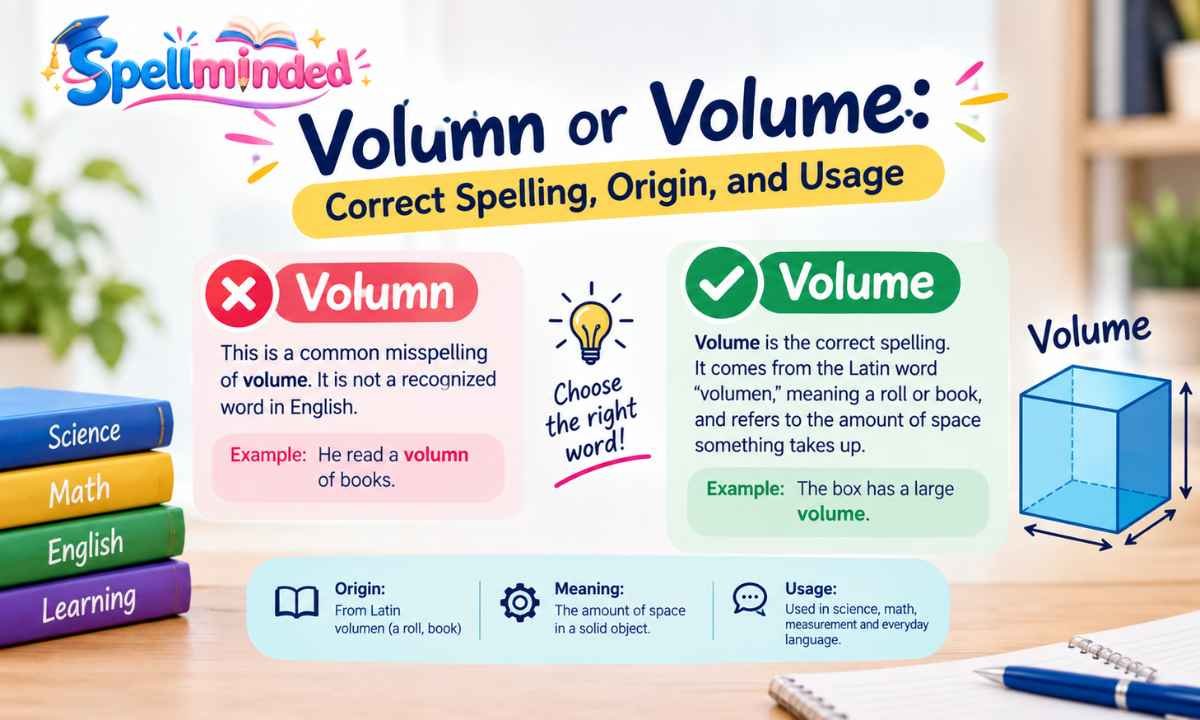
Volumn or Volume – Quick Answer
- Correct spelling: volume
- Wrong spelling: volumn. It’s a common mistake, not a variant.
- Quick rule: in the volumn or volume debate, pick the word that ends in -ume, like perfume and costume.
That’s the whole verdict. The rest of this page explains why, so you can spell it with confidence.
Volumn
“Volumn” isn’t a British spelling. It isn’t an old-fashioned form either. It’s a slip that spreads because the word looks like others that end in -mn.
Dictionaries list only volume. Spell-checkers underline the other version. Editors fix it every time.
Volume
Volume is a noun with several related meanings. Dictionaries define it as the loudness of a sound, the space an object occupies, or an amount or bulk of something. In everyday writing, you’ll use it four ways:
- Sound: how loud something is. Please turn the volume down.
- Space: how much room something takes up, measured in cubic units or liters. In physics and chemistry, that means the volume of a gas, liquid, or solid.
- Books: one book in a set or series. Volume 2 comes out in March.
- Amount: a large quantity of something. The volume of emails doubled.
The abbreviation is vol. Oxford Learner’s Dictionaries lists it for the book-in-a-series sense. The plural is volumes.
Why Your Brain Says “Volumn”
Ever typed a word, saw no red squiggle, and doubted it anyway? That’s the volumn effect. Nothing looks obviously broken. Nothing feels right either. Three things cause it.
The -umn Pattern Trap
English has a small family of words where a silent n trails an m. Think of column, autumn, solemn, and hymn. Your brain spots the pattern. Then it applies the pattern to volume.
That’s the trap. Volume never belonged to that family. Its family is perfume, costume, assume, and presume. All of them end in -ume.
How to Pronounce Volume (and Why the Sound Misleads You)
Say it out loud: VOL-yoom. That middle “yoo” sound is the tricky part. Oxford shows two standard pronunciations, one British and one American. The British-style version is usually VOL-yoom. The American-style version is often VOL-yum.
Say it fast and the ending shrinks into a quick “yum.” Nothing in that sound tells you an e is coming. So your hand fills in a letter that feels right. Rushed typing makes it worse, because the last letters are the ones we check least.
One more point for anyone searching “volumn or volume sound.” The loudness meaning is spelled the same way as every other meaning. Sound volume, math volume, book volume: always volume.
“But I’ve Always Spelled It That Way”
Some readers swear they learned volumn years ago, maybe from an old stereo dial. That’s a fair memory. Habits stick.
However, habit isn’t a spelling rule. Dictionaries list volume only, and that has to guide your writing. If you learned it the other way, you’re in good company. The fix takes about one minute.
The Origin of Volumn or Volume
A volume used to be something you unrolled. Early books were scrolls. The word for one came from the Latin verb for “to roll.”
English took the word in the late 14th century from Old French volume and directly from Latin volumen, meaning a roll of manuscript. The Latin word comes from volvere, “to turn around” or “to roll.” So a volume is literally a thing that’s been rolled up.
The meanings grew from there. The sense of a single book in a set appears by the 1520s. By the 1640s, the word also meant bulk or total quantity. That makes sense, since a big book has size. The loudness meaning arrived much later, in the 19th century.
Notice what English kept. It took the French-style ending, -ume. The Latin final n didn’t come along. That’s why the English word ends in a silent e.
British English vs American English Spelling
Some people wonder whether volumn is the British version. It isn’t. Oxford’s American and British entries both spell the word volume.
Key Point
Unlike colour and color, or centre and center, this word has no regional split. The volumn or volume question has one answer everywhere. Only the pronunciation shifts a little.
Comparison Table
| Where you’re writing | Correct spelling | Accepted? |
| American English | volume | ✅ Yes |
| British English | volume | ✅ Yes |
| Any other English | volume | ✅ Yes |
| Any region | volumn | ❌ No |
Which Spelling Should You Use?
Always volume. No exam, audience, or genre needs the other version. Whatever your volumn or volume doubt, the answer stays the same.
Audience-Based Advice

- Students: Use volume in essays, lab reports, and exams. A wrong spelling on a simple word stands out to markers.
- Professionals: Use volume in emails and reports. Sales volume, call volume, and order volume all look sloppy with a stray n.
- Bloggers and marketers: Use volume in headlines and headings. Terms like “search volume” appear constantly in your field.
- English learners: Use volume and say “VOL-yoom” aloud as you write it. The sound helps lock in the spelling.
Common Mistakes with Volumn or Volume

Most errors around volumn or volume fall into five types. Here’s each one, plus the fix.
1. The classic slip: volumn
- ❌ Please lower the volumn.
- ✅ Please lower the volume.
2. An extra n before the e: volumne
- ❌ The volumne of the tank is 40 liters.
- ✅ The volume of the tank is 40 liters.
3. A dropped final e: volum
- ❌ Turn up the sound volum.
- ✅ Turn up the sound volume.
4. A borrowed spelling: volumen
Volumen is the correct spelling in Spanish and German. In English, it’s an error.
- ❌ The volumen of sales rose.
- ✅ The volume of sales rose.
5. Mixing up volume and column
A column is a pillar, a line of cells in a spreadsheet, or a newspaper feature. A volume is a book or a measure of space.
- ❌ I read her advice volume every Sunday.
- ✅ I read her advice column every Sunday.
A Memory Trick That Actually Sticks

Picture a rolled scroll. That’s what the first volumes were. The root behind the word, volvere, also gives us revolve, evolve, and involve. All of them are about turning or rolling.
Now finish the scroll. A tidy ribbon ties it shut, and the ribbon is the final e. There’s no dangling n on a scroll.
Still not sure? Recite the -ume family: perfume, costume, assume, volume. If volumn or volume ever trips you up again, the family will pull you back.
Volumn or Volume in Everyday Examples

Seeing the right spelling in action helps it stick. Every sentence below uses volume correctly.
Emails
- “Could you lower the volume on the shared speaker? It’s tough to focus.”
- “Our order volume rose again this quarter. Great work, everyone.”
News
- “Trading volume jumped on Tuesday as investors reacted to the announcement.”
- “Officials warned that the volume of traffic would double during the festival.”
Social Media
- “Turn the volume up before you go live!”
- “Volume 3 of my favorite manga just dropped. I finished it in one sitting.”
Formal Writing
- “The library holds the complete works in twelve volumes.”
- “In physics, the volume of a gas changes with pressure and temperature.”
- “Students measured the volume of the liquid in a graduated cylinder.”
Volumn or Volume – Google Trends & Usage Data
People search for this pair all the time. That alone shows how common the doubt is. It also means careful writers double-check before they hit publish.
Want proof of which spelling wins? Try Google Ngram Viewer. It charts how often a word appears in printed books over time. Volume has been the standard printed spelling since the 1800s. Type both spellings into the tool and compare the lines. Expect a lopsided result.
Dictionary coverage tells the same story. OneLook, a tool that searches many dictionaries at once, lists 74 dictionaries that define volume. Run the same search for the misspelling and see what comes back.
Comparison Table: Volumn vs Volume
Here’s volumn or volume at a glance. The table shows what each spelling looks like and what it really is.
| Spelling | What it actually is | Verdict |
| volume | The standard English noun | ✅ Correct |
| volumn | A misspelling that copies column and autumn | ❌ Wrong |
| volum | A misspelling with the final e dropped | ❌ Wrong |
| volumne | A misspelling with an extra n before the e | ❌ Wrong |
| volumen | The Spanish and German spelling | ❌ Wrong in English |
Related Spelling Pairs Worth Knowing
If this trap caught you, these look-alikes might too:
- Volcano or volcanoe: the singular is volcano, with no extra e.
- Volunteer or volounteer: volunteer has just one o after the l.
- Autumn or autum: the silent n belongs in autumn. It never belongs in volume.
Frequently Asked Questions
Is “volumn” ever correct?
No. It’s a misspelling in every context, whether you mean loudness, space, or a book. Dictionaries list volume only.
Why do people spell volume as “volumn”?
Mostly pattern habit. Words like column and autumn end in -mn, so the brain assumes volume does too. The soft “yoom” sound and rushed typing add to the confusion.
Is “volumn” a British spelling?
No. Oxford’s British and American entries both spell it volume. The two versions differ only in pronunciation.
What’s the easiest way to remember how to spell volume?
Link it to perfume, costume, and assume. All of them end in -ume. You can also picture a rolled scroll, since that’s what a volume originally was.
What does volume mean, and how do you pronounce it?
It’s a noun for loudness, the space something fills, a book in a series, or a large amount. Say VOL-yoom (British style) or VOL-yum (American style).
Conclusion
When you weigh volumn or volume, the answer never changes. The correct spelling is volume, and volumn is always a mistake. The word came into English from Latin volumen, “a roll,” and it belongs with perfume, costume, and assume.
If you’ve typed the wrong version before, relax. It’s a slip that happens to careful writers. Next time you hesitate, picture the scroll and finish with -ume. That little rolled-up word will keep you right.