

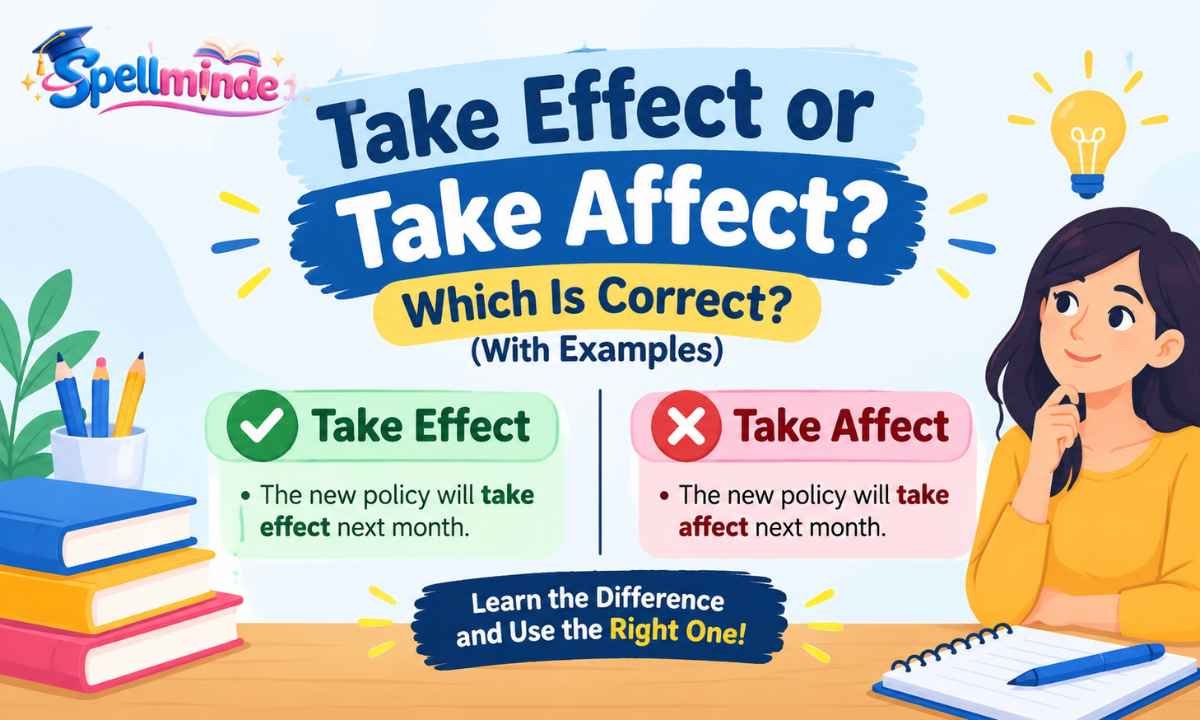
You’re about to send a policy update. The sentence reads, “The new rule will take ___ on Monday.” Your cursor blinks. Spellcheck says nothing, because both words are real. That take effect or take affect doubt hits even careful writers.
This guide settles the Take Effect or Take Affect confusion for good. I checked Merriam-Webster and Dictionary.com, then added examples and memory tricks you can use right away.
“Take effect” is the correct phrase. “Take affect” is always a mistake.
My Quick Answer
The correct phrase is “take effect.” In the Take Effect or Take Affect debate, effect wins every time.
It means to become operative or to start working. For example: “The new law takes effect on January 1.” I couldn’t find “take affect” as an entry in any dictionary I checked.
Why I Found “Take Effect” Is the Only Correct Choice
Think of “take effect” as a fixed idiom, like “take place” or “take hold.” Merriam-Webster lists it as an idiomatic phrase and dates it to the 14th century. The words are locked together.
So the take effect or take affect question isn’t a coin flip. The idiom is set, and “effect” is the noun inside it. Swapping in “affect” breaks the phrase.
The RAVEN Rule I Use
RAVEN is a handy memory aid that Dictionary.com also uses.
Remember: Affect is a Verb. Effect is a Noun.
“Take” pairs with a noun here, so the answer is effect.
My Definition and Meaning Analysis
Merriam-Webster gives two meanings of “take effect”: to become operative, and to begin producing the intended result. Here’s how that looks in real life.
1. Laws, Rules, and Policies
The rule becomes official. “The new tax rule takes effect on January 1.”
2. Medicine and Treatment
The treatment starts working. “The painkiller should take effect within half an hour.”
3. Changes and Decisions
The change begins. “The price change took effect immediately.”
4. Plans and Strategies
The plan becomes active. “Our new strategy took effect last quarter.”
Why “Take Affect” Is Always Wrong
Some guides say you can’t “take” a verb, and that logic mostly holds. I’d put it more simply: “take affect” swaps the wrong word into a fixed idiom. Nothing about the take effect or take affect choice is regional or optional.
One more trap deserves a mention. “This change will take effect Monday” and “This change will affect everyone” are both correct. They just say different things. The first is about timing, and the second is about impact.
Real-World Examples I Collected

Here are examples sorted by field. Notice that “effect” is the right word every single time.
Legal and Government Examples
- The new regulations take effect next month.
- The ceasefire took effect at midnight.
- The treaty will take effect once it’s ratified.
- When did the amendment take effect?
Medical and Health Examples
- The anesthesia should take effect in a few minutes.
- How long does it take for the medication to take effect?
- The vaccine has taken effect after the second dose.
Business and Workplace Examples
- The salary increase takes effect on July 1.
- When will this take effect? That’s the first question employees ask.
- How will this affect me? That’s the second question.
- The merger takes effect after shareholder approval.
Technology and Systems Examples
- The software update takes effect after a restart.
- Your new security settings take effect immediately.
- Subscription changes take effect when payment clears.
Environmental and Weather Examples
- The weather warning takes effect at 6 p.m.
- The new pollution limits take effect over the next decade.
- Conservation measures took effect slowly.
Education and Learning Examples
- The new curriculum takes effect in September.
- The grading change took effect this semester.
- Tuition increases take effect next academic year.
Common Mistakes I Found
These are the take effect or take affect slips I see most often, with fixes:
- ✗ The law will take affect tomorrow. → ✓ The law will take effect tomorrow.
- ✗ When does the medicine take affect? → ✓ When does the medicine take effect?
- ✗ The policy took affect immediately. → ✓ The policy took effect immediately.
Take Effect vs. Take Affect: My Complete Comparison
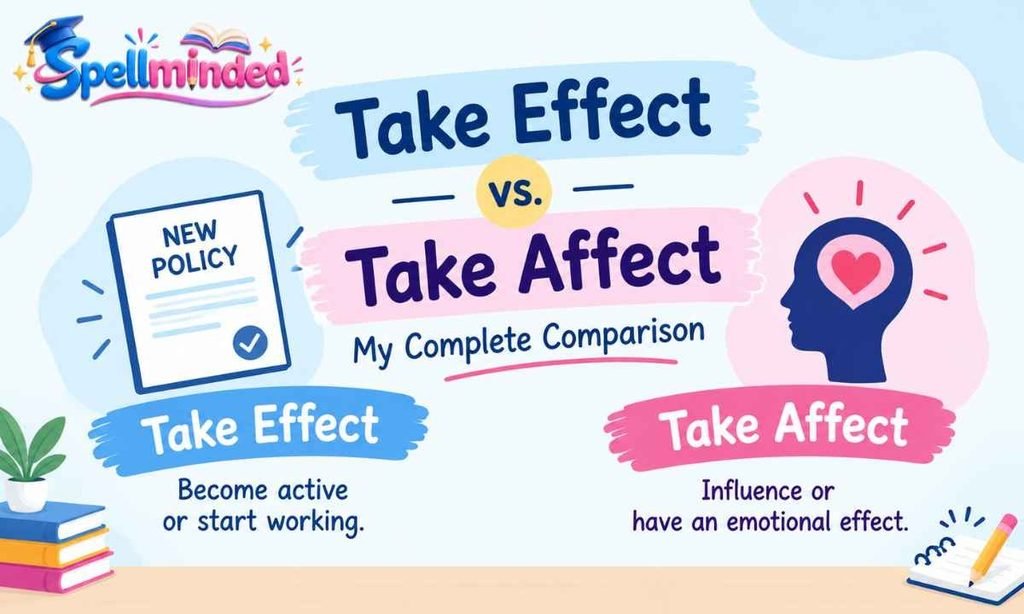
Here’s the quick, what-to-type-versus-what-to-avoid view:
| Take effect | Take affect | |
| Verdict | Correct | Incorrect |
| Meaning | Become operative; start working | None as an idiom |
| Dictionary status | Listed as an idiom | Not found in the dictionaries I checked |
| Past tense | took effect | took affect (wrong) |
| Fix | Use it | Change “affect” to “effect” |
My Memory Tricks and Tips
Pick the trick that clicks for you. Any one of them is enough.
Tip #1: The RAVEN Mnemonic
Remember: Affect = Verb, Effect = Noun. “Take effect” needs the noun, so use “effect.”
Tip #2: The “The” Test
Put “the” in front of the word. “The effect” sounds natural. “The affect” usually sounds odd. If “the” works, you probably need “effect.”
Tip #3: The Result Connection
Effect and “end result” both start with E. Something that takes effect produces a result.
Tip #4: The “A” for Action
Affect starts with A, like action. “To affect” something is to act on it. A rule doesn’t act on anything when it “takes effect.” It just starts.
Tip #5: The “Kick In” Swap Test
This is my favorite for this phrase. Replace “take effect” with “kick in” or “start working.” If the sentence still makes sense, the right word is effect.
Quick practice (answers below):
- The new policy will take ___ on Monday.
- Late nights ___ my focus.
- The medicine should take ___ soon.
Answers: 1. effect. 2. affect (they influence it). 3. effect.
Special Cases I Discovered
English loves exceptions. Two of them are worth knowing, and neither rescues “take affect.”
Can “Effect” Be a Verb?
Yes. As a verb, “effect” means to bring about. For example: “She hopes to effect real change.” It’s formal and fairly rare. It still has nothing to do with “take affect.”
Can “Affect” Be a Noun?
Yes, in psychology. There, “affect” means a visible emotional expression, as in “The patient showed a flat affect.” Again, that’s a separate technical word. It doesn’t create an idiom.
Common Phrases I Found with “Effect”
“Effect” shows up in many set phrases. In all of them it’s the noun.
Have an effect on
This means to influence something. “Late nights have an effect on my focus.” The same logic covers “She has that effect on people.” Here “effect” is the result. If you use a verb instead, you’d say “She affects people.”
In effect
This means currently in force, or “in practice.” “The old rule is still in effect.”
Side effects
These are unintended results, often from medication. “Drowsiness is a common side effect.”
Greenhouse effect
This is the heat-trapping process in Earth’s atmosphere.
But for effect
You’ll usually see just “for effect,” meaning for dramatic impact. “He paused for effect.”
Special effect
These are visual or sound techniques in film. “The movie’s special effects were stunning.”
Go Into Effect and Come Into Effect
“Go into effect” is common in American writing, and “come into effect” is common in British writing. Both mean the same as “take effect.” With a date, “on” is the safe choice: “takes effect on 1 October.” You’ll also see “from,” as in “comes into effect from 1 October.”
Why This Mistake Is So Common
Writers stumble for a few predictable reasons:
- They sound almost identical. In normal speech, the two words are hard to tell apart.
- They overlap in meaning. Both involve change or results.
- They differ by one letter. An A and an E are easy to swap.
- Both are real words. Word processors often miss the error, which is why the take effect or take affect mix-up survives careful proofreading.
My Research Finding
I checked dictionaries and usage guides. Every one that covers the phrase gives “take effect.” None supports “take affect.” The error lives mostly in drafts, forum posts, and the occasional headline.
Professional Context Examples
In formal writing, the right word matters even more.
Legal Documents
“The amendment takes effect once both parties sign.”
Medical Instructions
“Give the antacid some time to take effect.”
Business Communications
“Please note that these changes take effect Monday.”
News and Journalism
“The ceasefire took effect at midnight.”
Explore More Grammar Guides
If this helped, these related topics are worth a look:
- Affect vs Effect: The Full Rule
- Effect Change or Affect Change?
- Into Effect or Into Affect?
- Side Effect or Side Affect?
Frequently Asked Questions
Take Effect or Take Affect: Which Is Correct?
“Take effect” is correct. It means to become operative or to start working. In the take effect or take affect choice, “effect” is the only form dictionaries support. For example: “The new law takes effect on January 1.”
Is “take affect” ever correct?
No. Not in the sense of something starting to work. Rare technical uses of “affect” as a noun, such as in psychology, don’t change that.
How do I remember the difference between effect and affect?
Use RAVEN: Remember Affect = Verb, Effect = Noun. For this phrase, the “kick in” swap is even faster. If “kick in” fits, write “effect.”
What is the past tense of “take effect”?
It’s “took effect.” Use “has taken effect” or “have taken effect” for the present perfect. The other forms are “takes effect” and “taking effect.” The word “effect” never changes.
What is the difference between “take effect” and “go into effect”?
Practically nothing. Both mean to become operative. “Go into effect” is common with laws and rules. British writers often prefer “come into effect.” Every version uses “effect.”
Why doesn’t spellcheck always catch “take affect”?
Both words are spelled correctly, so many tools won’t flag it. A quick read-aloud and the “kick in” test will catch it faster than software will.
Conclusion
Use “take effect.” It’s a fixed idiom that means to become operative or to start working, and “effect” is the noun inside it. Resolving take effect or take affect comes down to that one phrase.
Next time you doubt yourself, swap in “kick in.” If it fits, you want “effect.” RAVEN is your backup. Either way, you’ll hit send with confidence.