


You’re typing a caption for your mountain photos. Then you freeze. Does that word have a c in it? Autocorrect doesn’t always catch it. So you second-guess yourself right before hitting send.
The answer is short. In standard English, trek is correct and treck is a misspelling. This guide settles the treck or trek question fast. Then it covers the word’s origin, correct usage, common slips, and an easy way to remember the spelling.
Quick Answer
Treck or Trek: the correct spelling is trek.
- Trek is correct. It means a long, difficult journey, often on foot.
- Treck is a misspelling. Standard English dictionaries list trek, not treck.
- Trek works as a noun and a verb: trek, trekked, trekking.
- Example: We went on a three-day trek through the hills.
Simple Origin or Background
Trek is a borrowed word. It came into English from Afrikaans, which took it from Dutch. Merriam-Webster traces it to a Dutch verb meaning to pull or haul, and it dates the first known English use to 1835. Oxford Learner’s Dictionaries tells the same broad story: a mid-19th-century word from South African Dutch.
In South Africa, the word described travel by ox wagon. Settlers also used it for long migrations across rough country. English speakers liked it and stretched it to cover any hard, tiring journey. Today it fits hiking trips, expeditions, and tough trips of every kind.
Here’s where the confusion starts. Merriam-Webster’s word history lists Dutch forms spelled with ck. Those spellings never became English. Still, they hint at why the ck version looks familiar. The treck or trek question has a tidy ending, though. English kept the plain k.
Clear Explanation of the Difference
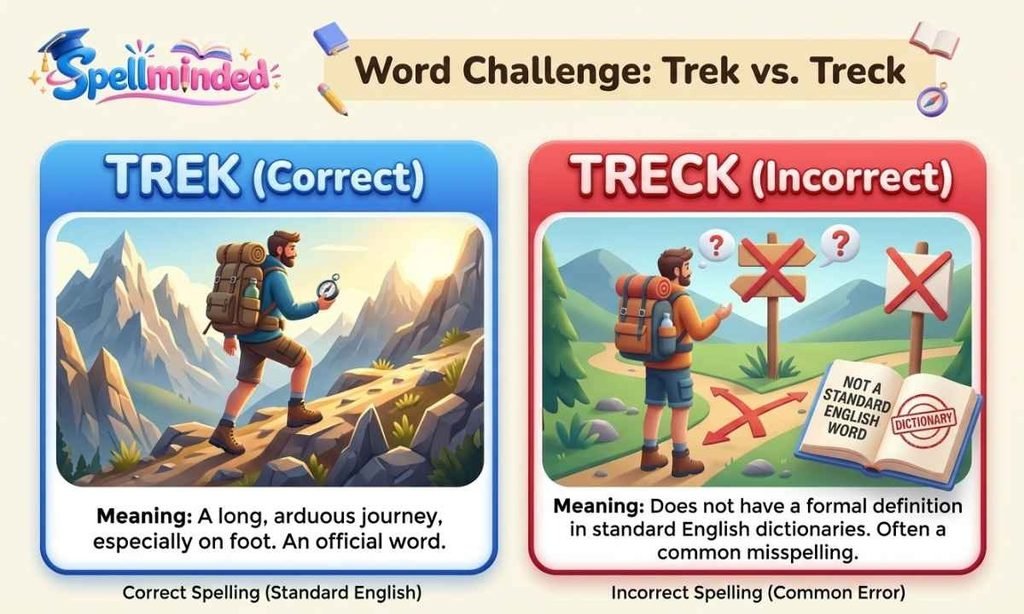
The difference here isn’t about meaning. It’s about spelling. Only one of these two is a real English word.
What “trek” means
Trek means a long, difficult journey. Merriam-Webster describes the noun as an arduous trip and the verb as making your way with effort. Think mountains, forests, deserts, or any route that tests your legs. A trek isn’t a casual walk. It takes planning, stamina, or both.
Say it in one syllable: /trɛk/. It rhymes with deck and neck.
Here’s trek in a sentence:
- We planned a five-day trek through the Himalayas.
- The group trekked across the plains at dawn.
- The trek back to camp felt endless.
Close synonyms include journey, trudge, slog, and expedition. The related forms are treks, trekked, trekking, and trekker.
What “treck” means
Treck has no meaning of its own in English. It’s simply a misspelling of trek. Garner’s usage tip on the word treats it that way. It also flags trecking as an inferior form of trekking.
You’ll sometimes see Trek in brand names or in Star Trek. Those are names, not spelling options. They don’t make treck acceptable.
- Wrong: We went on a treck in the mountains. ❌
- Right: We went on a trek in the mountains. ✅
Comparison Table
| Word | Correct? | Meaning | Example |
| trek | Yes | A long, difficult journey | The trek took all day. |
| treks | Yes | Plural noun or verb form | She treks every summer. |
| trekked | Yes | Past tense of trek | We trekked for hours. |
| trekking | Yes | The activity, or the -ing form | Trekking is popular here. |
| treck | No | Misspelling of trek | ❌ A long treck |
| trecking | No | Misspelling of trekking | ❌ Trecking in Nepal |
| trecked | No | Misspelling of trekked | ❌ We trecked home |
The short version: if a c sits before the k, the spelling is wrong.
Which One to Use and When
Facing treck or trek in your own writing? The rule never changes. Pick trek every time.
Use “trek” when you mean:
- a long, tiring journey
- a multi-day hike in the mountains or forest
- a hard walk over rough ground
- any difficult trip, even one that isn’t in nature
That last point surprises people. A brutal commute can be a trek too. For example: The trek from the station took forty minutes in the rain.
Avoid using “treck”
Treck reads as a typo. Skip it in school work, emails, articles, reports, and anything formal. If a spell checker flags it, accept the fix. A reader who spots treck may start doubting the rest of your writing. One missing letter is a small price for a cleaner page.
Common Mistakes People Make
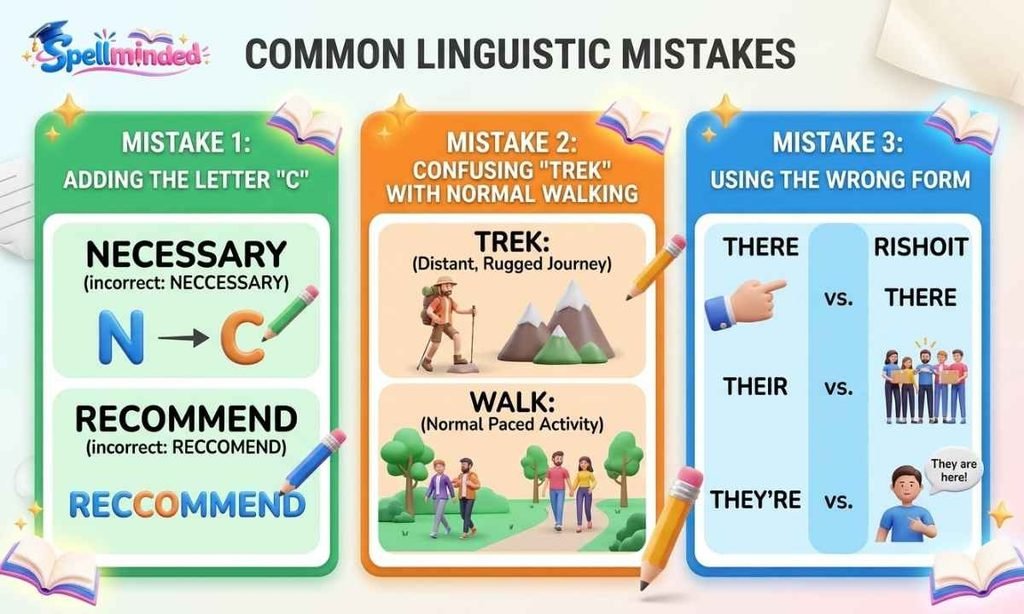
Picture this. You’re typing a travel caption, and the treck or trek doubt hits again. A few slips cause most of the trouble.
Mistake 1: Adding the letter “c”
This is the big one. Trek rhymes with deck and neck. So the ck ending feels natural. English has plenty of words built that way. Fast typing makes it worse. Yet this word arrived from Afrikaans, and it kept a plain k.
- Wrong: a treck across the valley
- Right: a trek across the valley
Mistake 2: Confusing “trek” with normal walking
This one is about word choice, not spelling. A stroll in the park isn’t a trek. A multi-day mountain hike is. A hike suggests a shorter, easier walk. A trek adds distance and difficulty.
Don’t mix up track and trek either. A track is a path, or the act of following something. A trek is the long journey itself.
- Track: We followed the track to the lake.
- Trek: The trek to the lake took two days.
Mistake 3: Using the wrong form
The extra c spreads to other forms. Wrong: trecking, trecked, treking. Right: trekking, trekked.
Notice the double k. Trek adds another k before -ed and -ing. Writing treking with a single k is wrong too.
Everyday Real-Life Examples
Seeing the right spelling in real sentences settles treck or trek fast. Here’s how trek shows up in daily writing.
In emails
Emails stay short and professional:
- Our group is planning a weekend trek in the hills.
- I just got back from a trek through the forest.
In news writing
News copy uses trek for long or tough journeys:
- Hundreds of hikers began the long trek to the summit.
- Rescuers completed a difficult trek through deep snow.
On social media
Captions are casual. The spelling stays the same:
- Sunrise trek done. Worth every step.
- Booking my first trekking trip for summer.
In everyday conversation
Spoken English works the same way:
- “What did you do on your holiday?” “We went on a trek in the mountains.”
- “The trek to the waterfall took three hours.”
Notice that none of these sentences needs a c.
Learning Tips for Students and Beginners

Treck or Trek stops being a puzzle once you have a trick that sticks. Try these four steps.
Tip 1: Remember the short spelling
Trek has just four letters: t, r, e, k. Say it slowly and spell each sound. You’ll hear a k at the end and no separate c.
Tip 2: Connect the word with adventure
Think of a trek as a journey where you travel light. A trekker packs only what’s needed. The word does the same thing. It drops the extra c and keeps the essentials. Picture a mountain trek, a jungle trek, or a desert trek, and the short spelling follows.
Tip 3: Practice spelling
Write three quick sentences with trek, trekked, and trekking:
- We want to trek to the lake.
- She trekked for six hours.
- Trekking is his favorite hobby.
Typing the right forms a few times builds the habit.
Tip 4: Read travel stories
Travel books, documentaries, and outdoor blogs use trek all the time. Seeing it in real stories trains your eye to expect the plain k.
Frequently Asked Questions
Is “treck” a real English word?
No, treck is a misspelling. In the treck or trek debate, trek is the only standard spelling, even though names like Star Trek use it as a proper name.
Why do people write “treck”?
The ck ending shows up in words like deck, neck, and check. Because trek sounds just like them, fast typing and guesswork slip a c in.
What does “trek” mean, and can it be a verb?
Trek means a long, difficult journey. It also works as a verb: trek, trekked, trekking. Close synonyms include journey, trudge, slog, and expedition.
Is trekking the same as hiking?
They overlap. Hiking suggests a shorter, easier walk, while trekking usually means more distance and tougher ground. You’ll see trek most often in travel, adventure, and outdoor writing.
What is an easy way to remember how to spell “trek”?
Think of a trek as a journey where you travel light. The word does too. It packs only t, r, e, and k, with no extra c.
Conclusion
The treck or trek puzzle has a clear answer. Trek is the correct spelling. Treck is a common mistake. It isn’t a regional variant either.
Keep one rule in mind: end with a plain k and never add a c. The same goes for trekked and trekking. If you ever doubt yourself again, picture the packed-light hiker with nothing extra and nothing wasted. Now go enjoy your next trek.