


You’re typing a quick note about a craft project. Your fingers hit “glue,” then pause. Does the “e” stay before “-ing” or not? Autocorrect stays quiet, and now you’re second-guessing yourself.
This guide settles gluing or glueing in under a minute. You’ll get the verdict, the simple rule behind it, and a memory trick that makes the “e” stop bothering you.
Quick Answer: Gluing vs Glueing
- Gluing or Glueing: the spelling to use is gluing. It’s the standard form in American and British English.
- Glueing is a rare variant. Most style guides and spell-checkers treat it as an error.
- The rule: drop the silent “e” from “glue” before adding “-ing.”
If you want to be safe in school, at work, or online, write gluing.
Simple Origin and Background
“Glue” comes from Old French glu, which traces back to the Latin word for a sticky substance. In English it works as both a noun and a verb.
- Noun: “Pass me the glue.”
- Verb: “I’ll glue the pieces together.”
Gluing is the present participle of the verb. It simply means the act of joining things with glue.
The spelling question is the same across English, so there’s no separate version for different countries. Merriam-Webster and the Britannica Dictionary both list gluing first and mention glueing as a variant. Oxford’s American dictionary lists only gluing as the “-ing” form.
Clear Explanation of the Difference
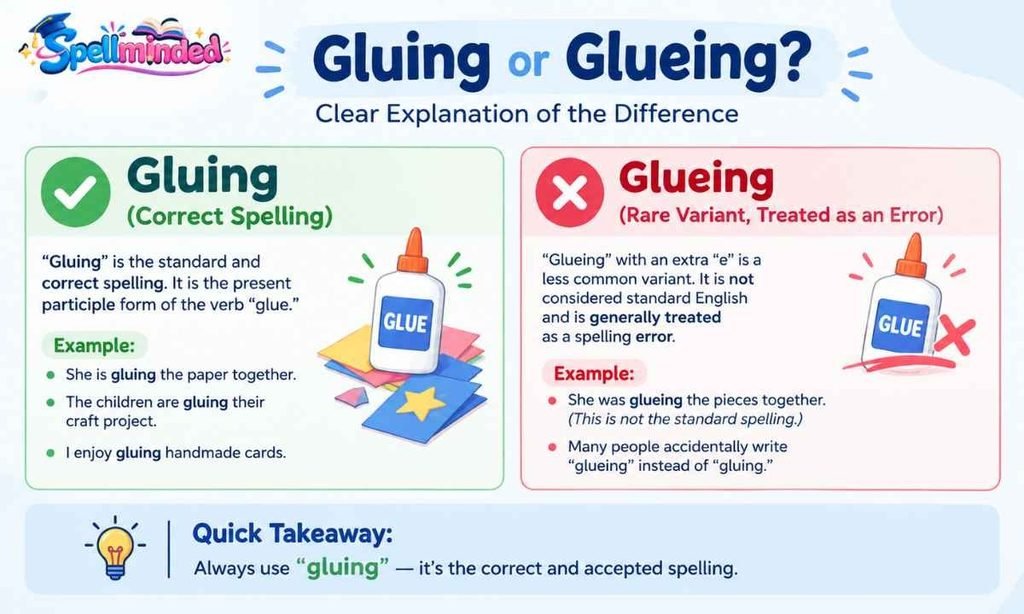
Here’s how gluing or glueing breaks down.
Gluing (Correct Spelling)
Gluing is the standard spelling. It follows a common English pattern: when a word ends in a silent “e,” you usually drop it before adding a suffix that starts with a vowel.
- She is gluing the label on the jar.
- He spent the evening gluing broken tiles back together.
Glueing (Rare Variant, Treated as an Error)
Glueing keeps the “e.” Some dictionaries record it as a variant, and you may spot it in older or British-style writing. Sources disagree on how much it’s accepted in the UK.
In everyday writing, though, editors usually mark it wrong. Spell-checkers often flag it too. Nobody will question gluing, so it’s the better pick every time.
Comparison Table: Gluing vs Glueing
| Feature | Gluing | Glueing |
| Status | Standard spelling | Rare variant |
| Dictionaries | Listed as the main form | Listed by some as “also” |
| Spell-checkers | Accepted | Often flagged |
| Follows the silent-e rule | Yes | No |
| Safe for school and work | Yes | No |
Which One to Use and When
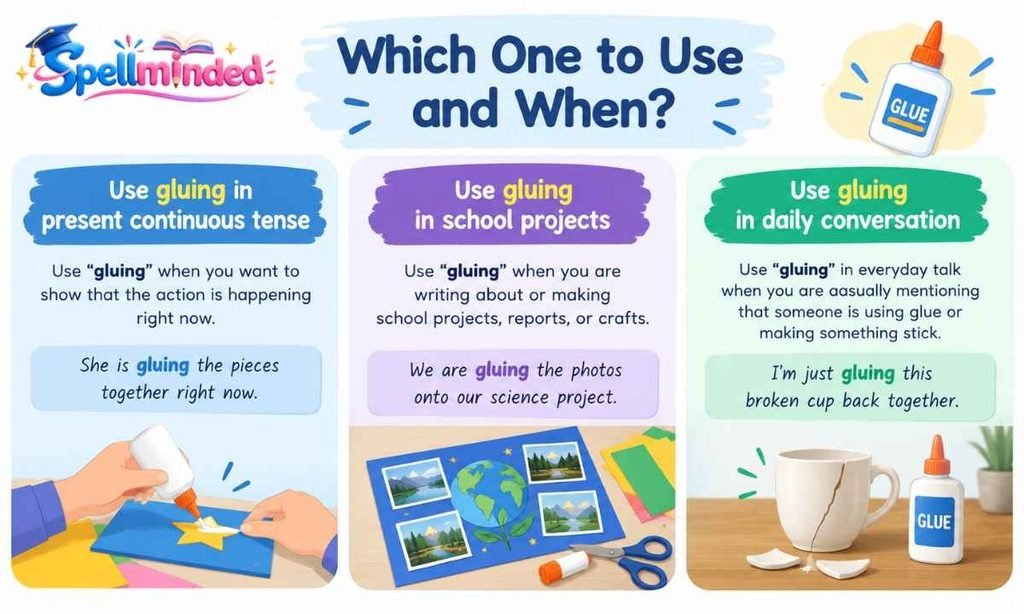
Pick gluing in every situation. The three situations below are where people most often reach for the “-ing” form.
Use gluing in present continuous tense
The present continuous describes an action happening right now: “I am gluing,” “she is gluing,” “they are gluing.”
- The kids are gluing sequins onto their masks.
Use gluing in school projects
Teachers often mark spelling, and gluing is the form they expect.
- Please finish gluing your poster before class ends.
Use gluing in daily conversation
It’s the same in speech and in texts to friends.
- I’m gluing the handle back on, so don’t touch the mug.
Common Mistakes People Make
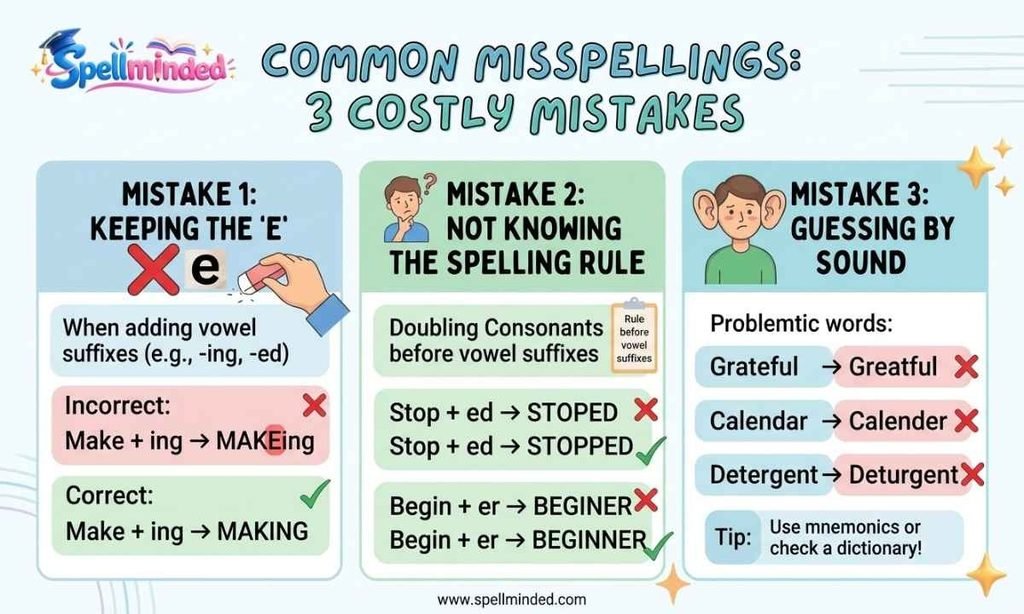
Most slips with gluing or glueing come from three habits.
Mistake 1: Keeping the “e”
“Glued,” “glues,” and “gluey” all keep the “e,” so keeping it for “-ing” feels natural.
❌ She is glueing the paper.
✅ She is gluing the paper.
Mistake 2: Not knowing the spelling rule
Many verbs drop a silent “e” before “-ing”: make → making, use → using, write → writing. Glue follows the same pattern.
Mistake 3: Guessing spelling based on sound
Both spellings sound identical. Your ear can’t help you here, so the rule has to do the work.
Everyday Real Life Examples
Example 1: School project
“I’m gluing my science photos onto the board.”
Example 2: Art and craft
“She’s gluing dried flowers into a frame.”
Example 3: At home
“Dad is gluing the loose chair leg.”
Example 4: Classroom
“The class is gluing paper leaves onto the tree.”
Example 5: Social media
“Gluing this scrapbook page together, wish me luck.”
Example 6: Office work
“The intern is gluing sample swatches into the client folder.”
Short Learning Section for Students and Beginners
If you ever second-guess gluing or glueing, use the quick tools below.
Simple rule to remember
Drop the silent “e,” then add “-ing.” Glue becomes gluing.
Easy memory trick
Picture the silent “e” sitting quietly at the end of “glue.” The “-ing” arrives, and its “i” takes the “e’s” seat. The “e” has nowhere to sit, so it leaves. That leaves glu + ing = gluing.
Practice exercise
Fill in the blank with the correct form.
- She is ______ the paper to the card. (gluing)
- We spent an hour ______ the model together. (gluing)
- He keeps ______ his notes into the notebook. (gluing)
Quick spelling rule examples
These verbs drop the “e”:
- glue → gluing
- argue → arguing
- rescue → rescuing
- make → making
A few verbs keep it, usually those ending in “-ee,” “-oe,” or “-ye”:
- see → seeing
- agree → agreeing
- canoe → canoeing
- dye → dyeing
Looking for similar words? Near matches in meaning include sticking, bonding, pasting, and fixing.
FAQs: Gluing or Glueing
Which spelling is correct, gluing or glueing?
Gluing is correct and standard. It follows the usual rule of dropping the silent “e” before “-ing.”
Is glueing ever correct?
It’s a rare variant that Merriam-Webster and Britannica list. Oxford’s American entry gives only gluing. Most editors and spell-checkers treat glueing as a mistake, so stick with gluing.
Why does “glue” lose its “e” before “-ing”?
English usually drops a silent “e” before a suffix that begins with a vowel. The same thing happens in using, making, and writing.
Is gluing used in both American and British English?
Yes. Gluing works in both. Glueing sometimes appears in British writing, but sources disagree on how accepted it is, so gluing is the safe choice either way.
What is an easy way to remember gluing?
Think of the “-ing’s” “i” taking the silent “e’s” seat. With the “e” pushed out, you’re left with gluing.
Conclusion
Gluing is the correct, standard spelling. Glueing is a rare variant that most editors and spell-checkers mark as an error, so gluing or glueing is an easy call: choose gluing.
Remember the rule: drop the silent “e,” add “-ing.” And if you ever mixed them up, don’t worry. It’s one of the most common spelling slips around, and now you’ve got the seat trick to fix it.