

You’re typing a quick post about your lake weekend. Then one word stops you cold. Is it B-U-O-Y or B-O-U-Y? You try both, squint at the screen, and hope autocorrect steps in. Sometimes it does. Sometimes it doesn’t.
This guide settles the buoy or bouy question fast. Then it explains why the word looks so odd. You’ll get clear examples, a little word history, pronunciation notes, and a memory trick that actually sticks.
Buoy or Bouy – Quick Answer
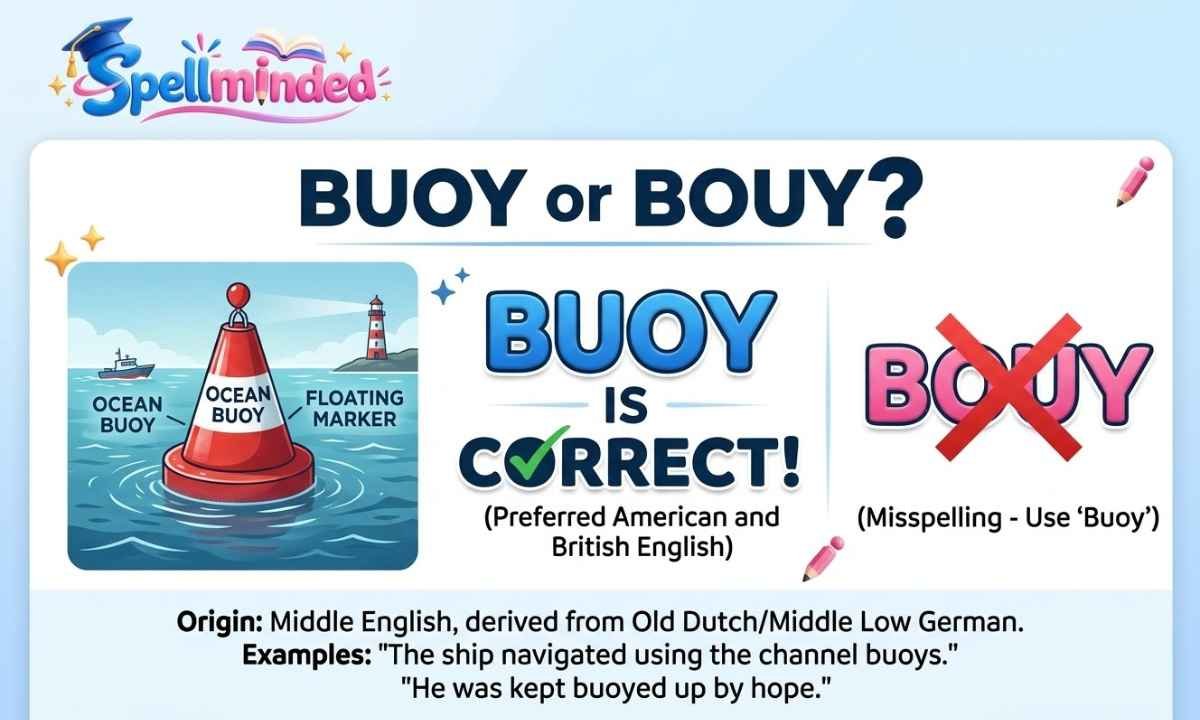
Buoy or bouy? The correct spelling is “buoy.” “Bouy” is a common misspelling, and dictionaries don’t list it.
- Correct: buoy, buoys, buoyed, buoyant
- Incorrect: bouy, bouys, bouyed, bouyant
- Regional variants: none. American and British English spell it the same.
Buoy
A buoy is a floating marker anchored in water. A channel marker, a floating sign that shows boats the safe route, is one kind. As a verb, buoy means to keep afloat or to lift someone’s spirits.
Bouy
Bouy is a slip. It swaps the u and the o. The word you want is buoy.
Simple Examples
- ✅ The swimmers stayed inside the red buoy.
- ✅ Good news can buoy your mood.
- ❌ The crew tied up to a bouy.
Quick Comparison
| Word | Correct? | Meaning |
| buoy | ✅ Yes | Floating marker; to keep afloat |
| bouy | ❌ No | Misspelling of buoy |
What Does “Buoy” Mean?
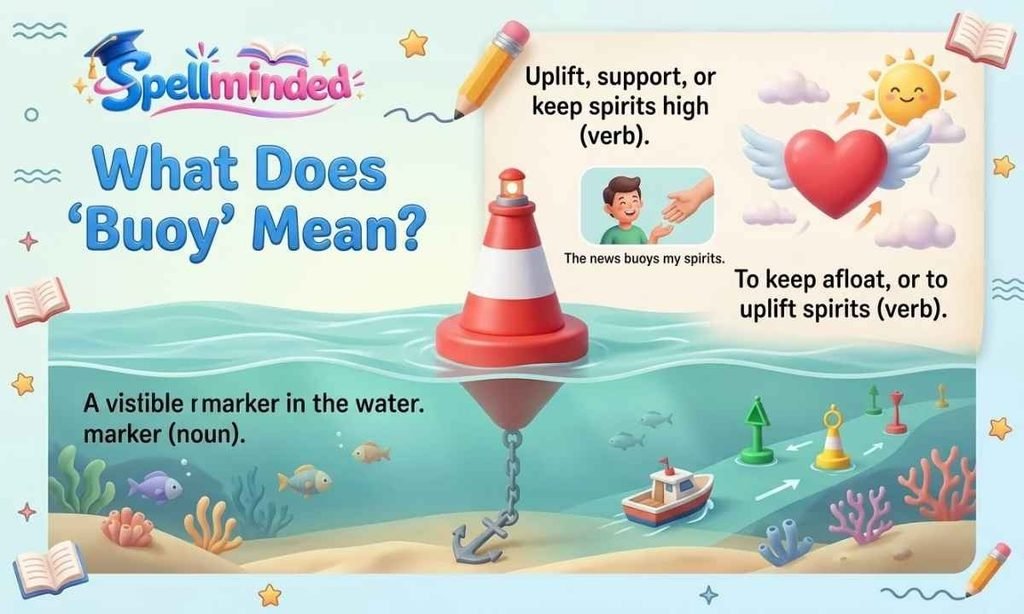
The word buoy does two jobs.
As a noun, it’s a floating object anchored in a body of water. Merriam-Webster says it marks a channel or warns of danger. Think of the bright floats that keep swimmers out of boat lanes.
As a verb, it means to keep something afloat or to lift it up. The news buoyed her. In plain terms, it cheered her up.
Is “Bouy” a Real Word?
No. Standard dictionaries such as Merriam-Webster list buoy only. They don’t offer bouy as a variant, a regional form, or an old spelling.
So if you spot it in your draft, change it. There’s no judgment call here. It’s simply buoy with two letters flipped.
The Origin of Buoy
Merriam-Webster dates the noun to the 13th century. It traces the word to Middle English boye, probably from Middle Dutch boeye. That root is tied to a word meaning “sign,” in the same family as beacon.
Some word historians point to an older word for a chain or fetter instead. The exact route is still debated.
The verb came later, in 1596. It’s a short hop from keeping a raft afloat to keeping someone’s hopes up.
Why Do People Misspell Buoy as Bouy?
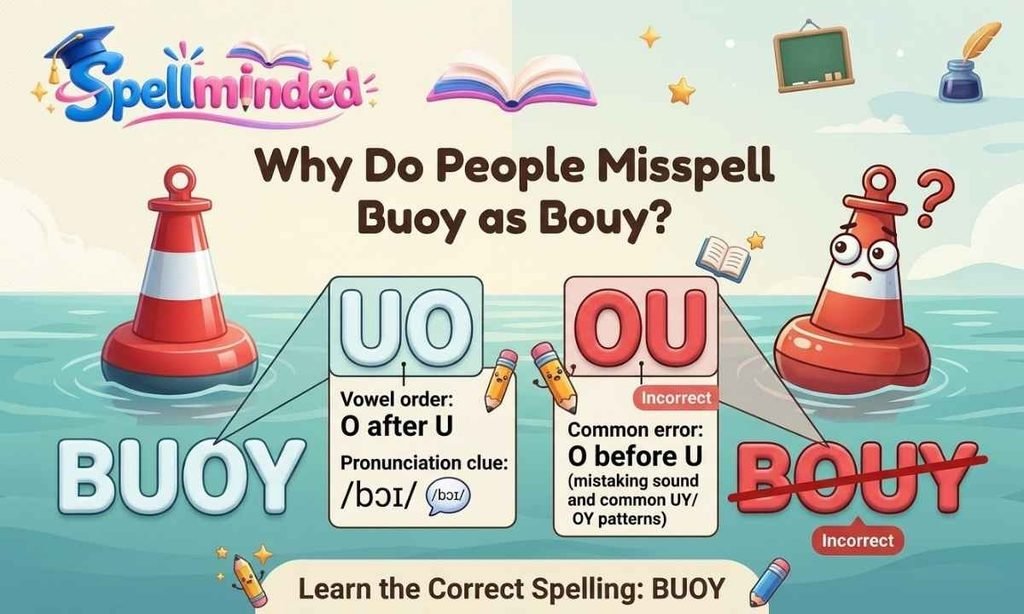
Here’s the honest truth: this word trips up almost everyone. It breaks the usual link between sound and spelling. Four things are at work.
- The sound gives no clue. Say “boy” or “BOO-ee.” Neither version hints at a u before an o.
- The spelling is a fossil. Wiktionary lists an obsolete pronunciation with a w-like glide: “bwoy.” The u in buoy once matched that sound. The pronunciation moved on. The spelling stayed put.
- Your fingers love “ou.” That pair shows up in out, house, found, and thousands of other words. On autopilot, you land on bouy.
- Spell-check isn’t perfect. It usually flags bouy. One tap on the wrong suggestion can land you on “boy” instead.
British English vs American English Spelling (Buoy vs Bouy)
Is There Any Difference?
Not in spelling. Both varieties write buoy. Only pronunciation varies, and even that isn’t tidy (more on that below).
Comparison Table
| Feature | British English | American English |
| Spelling | buoy | buoy |
| Common pronunciation | “boy” | “BOO-ee” or “boy” |
| Is “bouy” accepted? | ❌ No | ❌ No |
Which Spelling Should You Use?
With buoy or bouy, there’s no style choice to make. Use buoy every time.
Use “Buoy” When:
- You’re naming a floating marker or safety float
- You’re using the verb: buoy up, buoyed by
- You’re writing anything at all, from a text to a thesis
Never Use “Bouy”
No setting calls for it. Not a school essay. Not a boating forum post. Not a quick text to a friend.
Buoy as a Noun and Verb
Buoy (Noun)
As a noun, a buoy is a physical float. The plural is buoys.
- The harbor has three new buoys.
- Swimmers were told to stay behind the orange buoy.
Buoy (Verb)
As a verb, buoy has the forms buoys, buoyed, and buoying. It often pairs with up.
- Her friends’ praise buoyed her through the exam.
- Strong sales buoyed up the company.
Common Expressions Using Buoy
| Expression | Meaning |
| Buoy up | Lift or support |
| Buoyed by | Encouraged by |
| Buoy someone’s spirits | Cheer them up |
| Buoy confidence | Strengthen belief in something |
Pronunciation of Buoy: Why It Confuses People
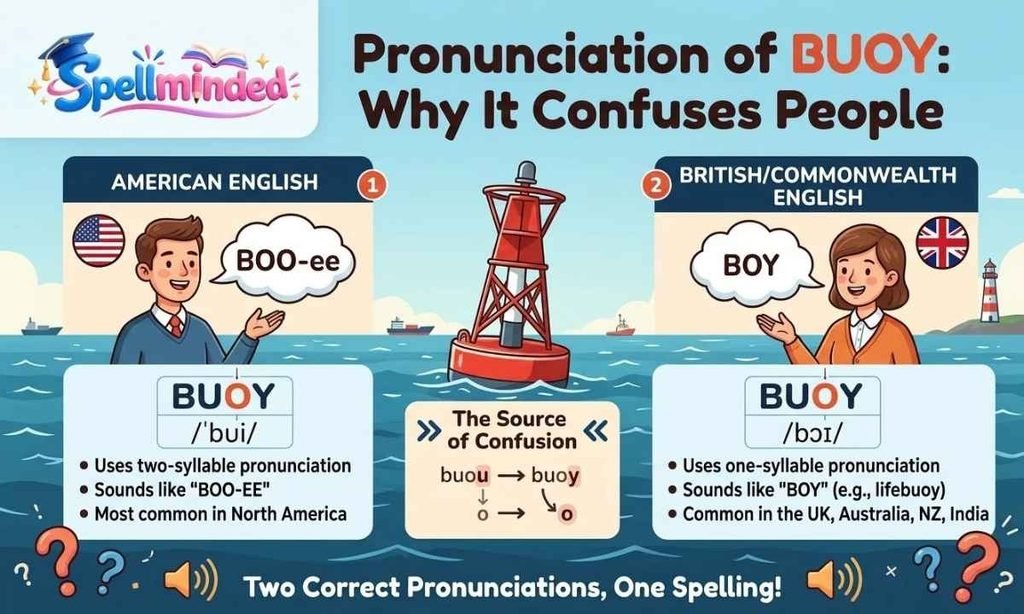
Say buoy out loud and you’ll notice the problem. There are two common ways to say it.
- BOY. Almost everyone in the UK says it this way, according to the radio show A Way with Words. Australians do too, per the proofreading service Proofed.
- BOO-ee. Many Americans say it this way. Some Americans say “boy” instead. Wiktionary lists both for General American.
Neither is wrong. Merriam-Webster even gives two pronunciations for buoyant: BOY-unt and BOO-yunt.
So pronunciation can’t guide your spelling. In the buoy or bouy puzzle, your ears are the unreliable witness.
Common Mistakes with Buoy or Bouy
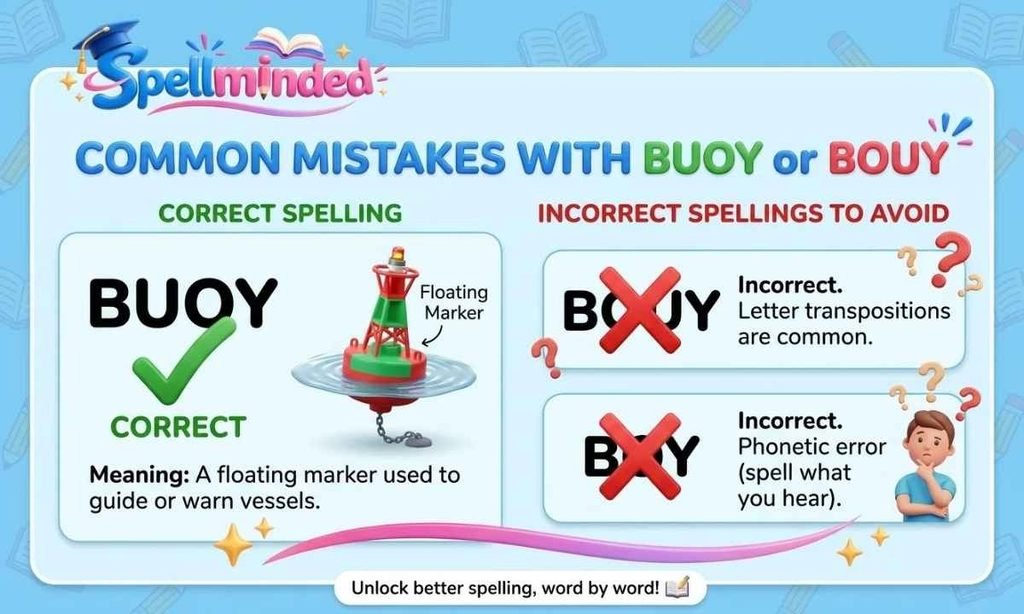
Mistake 1: Spelling by Sound
Writers hear “BOO-ee” and spell it that way. That’s how you end up with booey, buey, or bouy. English spelling often ignores sound, so check a dictionary.
Mistake 2: Assuming “Bouy” Is an Alternative Spelling
Because pronunciation varies, some people assume spelling does too. It doesn’t. Bouy isn’t a British or American option.
Mistake 3: Using Incorrect Past Tense Forms
The past tense is buoyed. Not bouyed. Not buoyd. The same goes for buoying and buoyant.
Mistake 4: Mixing Up Buoy with Boy
In many accents, buoy sounds just like boy. A boy is a young male. A buoy is a float. Check which one your sentence needs.
Buoy or Bouy in Everyday Examples
Emails
Please confirm the new mooring buoy is in place before Friday.
News
Strong job numbers buoyed investor confidence on Monday.
Social Media
Sunrise paddle. Calm water. One very yellow buoy. ☀️
Formal Writing
The survey team replaced the damaged navigation buoy after the storm.
Maritime Communication
All vessels: the red channel buoy is out of service. Proceed with caution.
Buoy in Common Phrases and Maritime Terms
Buoy shows up in plenty of nautical vocabulary. Here are the terms you’re most likely to meet.
- Mooring buoy: an anchored float where a ship ties up. A mooring is simply the spot where a vessel is secured.
- Ring buoy (life buoy): a ring-shaped float used in rescues.
- Whistling buoy: a marker that whistles as waves rock it, often at a channel entrance or over a shoal (a shallow, risky patch of water).
- Anchor buoy: a float showing where an anchor sits.
- Buoy tender: a vessel that services navigation buoys.
- Buoyancy: the ability to float.
Buoy or Bouy – Usage Data and Dictionary Evidence
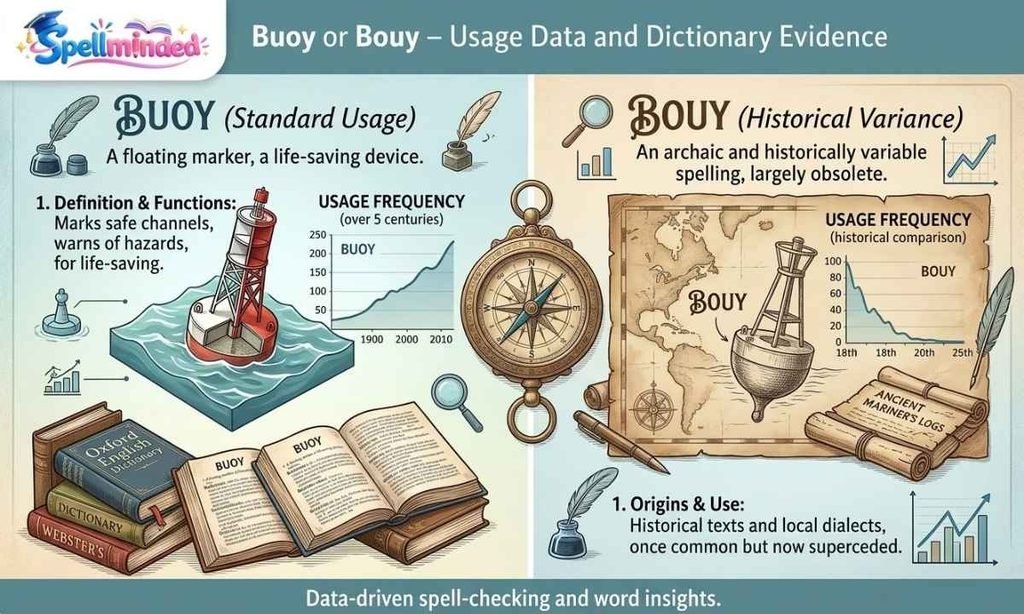
Hard numbers on misspellings are easy to invent and hard to check. So here’s what you can verify yourself.
Merriam-Webster lists buoy as the standard spelling. Its current example sentences come from outlets like ABC News, CNN, and the New York Times. That shows the verb is alive in everyday reporting.
Meanwhile, school spelling quizzes use bouy as a wrong answer. A UK Key Stage 3 quiz from Education Quizzes does exactly that. It tells you where bouy belongs: in the “incorrect” column.
Comparison Table: Buoy vs Bouy
Here’s the whole story at a glance. If you’re stuck between buoy or bouy, use this as your cheat sheet.
| Test | Buoy | Bouy |
| Listed in standard dictionaries | ✅ Yes | ❌ No |
| Works as a noun | ✅ Yes | ❌ No |
| Works as a verb | ✅ Yes | ❌ No |
| Accepted in American English | ✅ Yes | ❌ No |
| Accepted in British English | ✅ Yes | ❌ No |
How to Remember the Correct Spelling
The life-ring trick. Look at the letters: b-u-o-y. The O is a life ring bobbing between the U and the Y. A life ring is literally called a life buoy, so the picture and the word match.
The family trick. Spell the whole family from one stem: buoy, buoyed, buoyant, buoyancy. Get one right and the others follow. If you’ve ever spelled buoyant correctly, you already know the order.
The quick drill. Cover the word, picture the ring, and write it three times. Do that once and the order tends to stick.
Buoy vs Similar Confusing Words
Buoy vs Boy
Boy is a young male. Buoy is a float, or the verb meaning to lift. They sound the same in many accents. The extra u gives buoy away.
Buoyant vs Buoy
Buoyant is the adjective. Merriam-Webster defines it as able to float, or cheerful. It shares the buoy stem, so it gets misspelled the same way. Bouyant is wrong.
Buoy vs Beacon
A beacon is a fixed signal, like a light on a tower or hill. A buoy floats. They’re even word cousins: Merriam-Webster’s origin note for buoy points to beacon.
Frequently Asked Questios
Is “bouy” ever correct?
No. It isn’t an accepted variant in American or British English. It’s always a misspelling of buoy.
How do you pronounce buoy?
Either BOY or BOO-ee. Both are common. The spelling stays B-U-O-Y either way.
What’s the easiest way to remember how to spell buoy?
Picture the O as a life ring floating between the U and the Y. Then spell buoyant to lock in the stem.
What is the plural of buoy?
Buoys. Just add an s.
Why does buoy look like it should be spelled differently?
The spelling reflects an older pronunciation and a word that probably came from Middle Dutch. The sound has shifted since then. The letters haven’t.
Final Verdict: Buoy or Bouy?
So, buoy or bouy? It’s buoy, always. Bouy is a common slip that dictionaries don’t recognize. That holds whether you’re writing about harbor markers or someone’s lifted spirits.
Don’t feel bad if the word still looks wrong. It’s an odd one, and people say it two different ways. Picture the life ring in the middle. Keep the stem for buoyed and buoyant. B-U-O-Y. Done.