
You’re typing a quick message to a teacher, a coworker, or an old classmate. “We met in high…” and then you stop. Is there a space before “school” or not? Autocorrect rarely objects. You’ve also seen the one-word version online often enough to doubt yourself.
This guide settles the high school or highschool question fast. You’ll get the right spelling, the reason the wrong one looks believable, and a simple rule you can reuse. It takes about five minutes to read.
Quick Answer
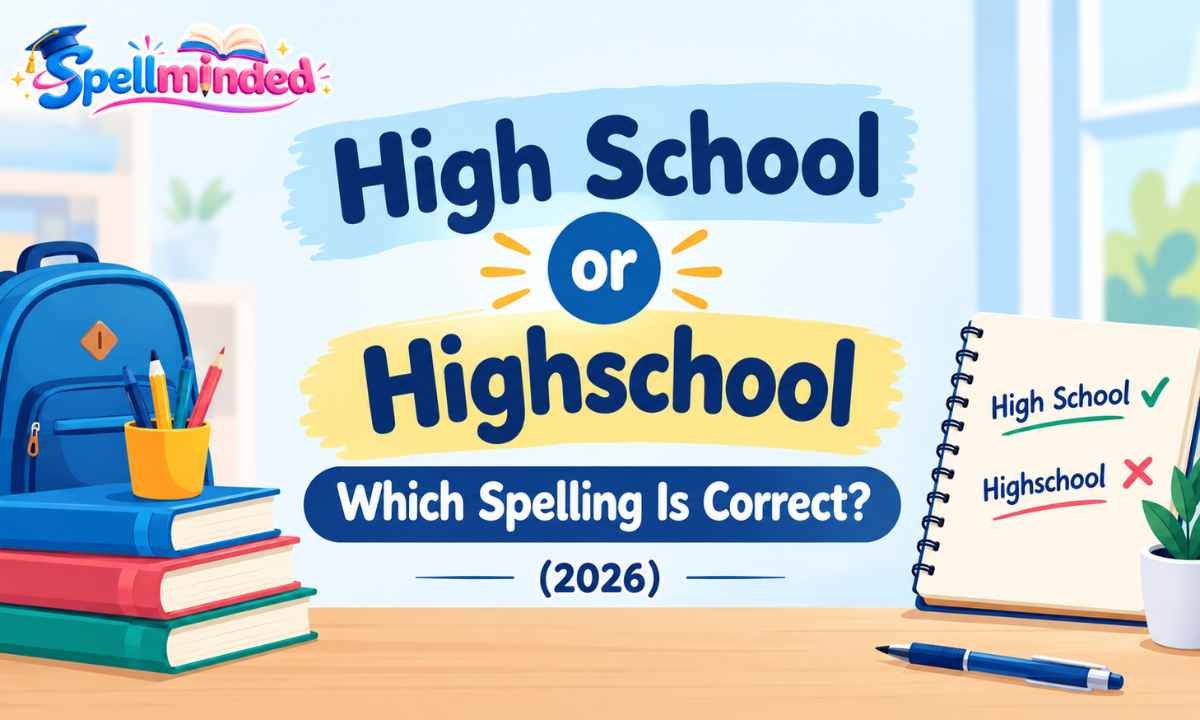
If you’re torn between high school or highschool, write two words. “High school” is the standard spelling in dictionaries like Merriam-Webster and Oxford Learner’s. “Highschool” is a common misspelling, not an accepted variant.
- Correct: She starts high school in September.
- Incorrect: She starts highschool in September.
- Quick rule: If the phrase names a school level, it takes a space.
This works the same in formal and casual writing.
Simple Origin and Background
Why is high school called high school? The name describes a level. After elementary school and middle school, students move up to the next stage. “High” simply marks that higher stage. Dictionary.com places the term in the early 1800s, so it’s been around for a long time.
In all that time, it never fused into one word. It belongs to a group called open compounds. Two words work as one idea but keep their space. Think of post office, ice cream, or living room.
Some compounds do close up eventually, like notebook or sunflower. Dictionaries haven’t made that move with high school. That’s why the one-word version looks natural but still reads as an error.
Clear Explanation of the Difference
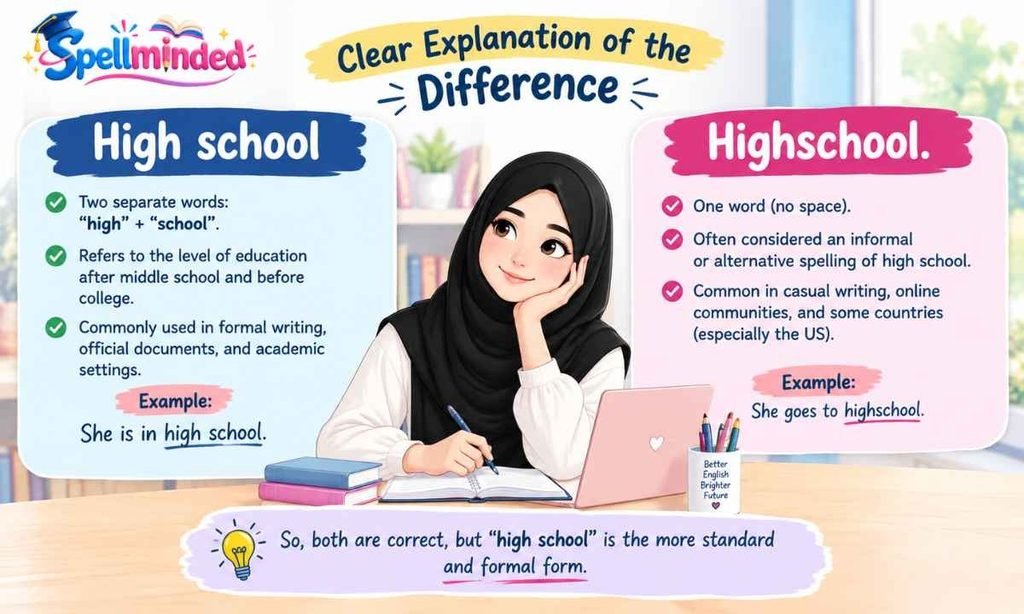
The high school or highschool question comes down to one point. English hasn’t joined these two words. Here’s how each form works.
High school
This is the correct form. Merriam-Webster defines it as a school, especially in the U.S., usually covering grades 9–12 or 10–12. So if you’re asking which class counts as high school, think ninth through twelfth grade in most U.S. districts.
Other countries use different ages and names. In British English, the term can point to a grammar school. The spelling stays the same everywhere.
Examples:
- My brother teaches math at a high school.
- We met during high school.
A student there is a high schooler, which Merriam-Webster also lists.
Highschool
This one-word form is a misspelling. Standard dictionaries such as Merriam-Webster and Oxford don’t list it as a spelling. People write it for three common reasons:
- They type fast and skip the space.
- They treat it like notebook.
- They copy what they see online.
Its cousin “highschooler” has the same problem. Write “high schooler” instead.
Comparison Table
For a fast check on high school or highschool, scan this table.
| Form | How it’s written | How it reads | Verdict |
| High school | Two words | Standard and clear | Correct |
| Highschool | One word | A typo or shortcut | Incorrect |
| High school student | Two words, no hyphen | Standard before a noun | Correct |
| High-school student | Hyphenated | Allowed by some style guides, less common | Acceptable, rarely needed |
| Highschool student | One word | A typo | Incorrect |
The pattern is simple. The space stays.
Which One to Use and When

For high school or highschool, the answer never changes. Use two words. Capitalization is the only other thing to check.
Keep it lowercase in general use, as in “I’m a senior in high school” or “my high school diploma.” Capitalize it only in a proper name, such as Lincoln High School, or in a title like High School Musical.
Here’s how that plays out in common settings.
School assignments
Teachers mark spelling, so the space matters. Example: “My time in high school taught me to manage deadlines.”
Emails
Keep professional messages clean. Example: “I graduated from high school in 2019 and then studied nursing.”
Articles and reports
News and academic writing both use the two-word form. Example: “Many students start planning careers during high school.”
Social media
Casual doesn’t mean misspelled. Example: “First day of high school. Wish me luck!”
Common Mistakes People Make

Even careful writers slip on high school or highschool when they’re typing fast. Picture a late-night reply to a teacher. You hit send, and only later notice the missing space. Here are the four slips to watch for.
1. Writing it as one word
- Wrong: I met my best friend in highschool.
- Right: I met my best friend in high school.
The one-word version feels natural because of words like notebook. This phrase simply hasn’t fused.
2. Using it incorrectly as an adjective
The space stays even when the phrase comes before another noun.
- Wrong: highschool student, highschool teacher
- Right: high school student, high school teacher
Some style guides allow a hyphen here, as in “high-school student.” It isn’t required. Most writers skip it.
3. Copying incorrect spelling online
Seeing a word often doesn’t make it right. Usernames and hashtags can’t hold spaces. Their squeezed-together spellings shouldn’t travel into your own writing.
4. Forgetting the space
Fast typing, small phone keyboards, and autocorrect all play a part. Search your draft for “highschool” before you send. It takes two seconds.
Everyday Real-Life Examples
Emails
“Hi Ms. Carter, I’m a high school junior interested in your robotics club. Could I visit a meeting?”
Social media posts
“Found my old high school yearbook today. Not ready for those haircuts.”
Conversations
“Where did you go to high school?”
“A small one near the river. You?”
News writing
“The district will open a new high school next fall.”
Personal stories
“My best memories from high school are the Friday night games with my cousins.”
Learning Section for Students and Beginners
Learning this takes one picture. Think of schooling as a ladder: elementary school, middle school, high school. Every rung is two words. So “high school” simply follows a pattern you already use.
Try these practice sentences:
- I take the bus to high school every morning.
- Her sister is a high school junior.
- Many clubs start in high school.
Abbreviations help too. Lakeside High School becomes LHS. Two words, and the initials show it.
Frequently Asked Questions
Is “highschool” ever correct?
No. In the high school or highschool debate, only the two-word form is standard. That holds for essays and reports as well as casual messages.
Why do people write “highschool”?
Mostly speed and habit. Fast typing drops the space. Closed compounds like notebook also make the one-word form feel familiar.
Is “high school student” correct, and does it need a hyphen?
Yes, “high school student” is correct. The Chicago Manual of Style advises leaving the phrase unhyphenated before a noun. Some guides allow “high-school student,” but the plain version is the safest. The same pattern covers “high school teacher” and “high school football team.”
Does the spelling change in different countries?
No. It’s two words in American and British English. Only the meaning shifts a little, since British usage can use the term for a grammar school.
How can I remember the correct spelling?
Picture the school ladder. Elementary school, middle school, high school. Every rung has a space.
Conclusion
So, high school or highschool? Write two words, always. “Highschool” is a common slip, not a second option. The space stays because high simply describes the kind of school.
If a phrase names a school level, give it a space. Before you hit send, take a second to scan for the missing one. That small check keeps your writing clean.