

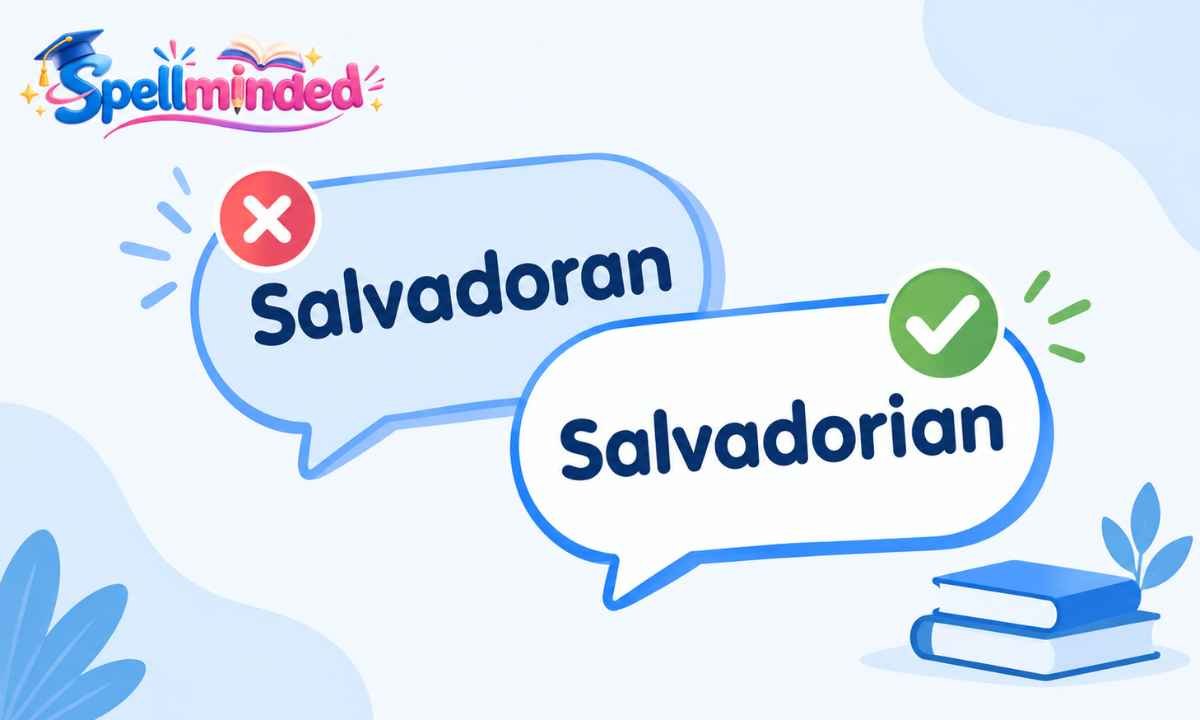
You’re typing an email, a caption, or a term paper, and you get to the word for someone from El Salvador. Your fingers hesitate. Is it Salvadoran or Salvadorian? Autocorrect doesn’t flag either one, your spell-checker stays quiet, and now you’re second-guessing a word you probably use all the time.
You’re not overthinking it. Salvadoran or Salvadorian is genuinely one of the trickier demonyms in English, and even seasoned writers pause on it. This guide settles the question fast, walks through why both spellings exist, and shows you exactly which one to use — and when the other is actually fine.
Salvadoran or Salvadorian – Quick Answer
Salvadoran is the standard, dictionary-primary spelling in English. It’s the form Merriam-Webster lists first, the one AP-style journalism uses, and the safest default for formal writing, academic work, and anything official.
Salvadorian isn’t a typo or an invented word — Collins English Dictionary gives it a full, standalone entry, and it shows up regularly in outlets like the BBC and the LA Times. But it functions as a secondary, more casual variant rather than the standard.
Quick Rule: Use Salvadoran when you want the safe, correct-in-every-context choice. Save Salvadorian for casual or conversational writing where either form reads naturally.
What Does “Salvadoran” Mean?
Salvadoran works as both a noun and an adjective.
- As a noun: She is a Salvadoran who moved to Houston as a teenager.
- As an adjective: Salvadoran pupusas are stuffed with cheese, beans, or pork and served with curtido.
It describes anything connected to El Salvador — its people, culture, government, or traditions. Salvadorans are generally considered part of the broader Hispanic population, since Hispanic refers to Spanish-speaking heritage rather than race or a single ethnicity. Spanish is the official language, though Nawat, an Indigenous language, is still spoken by a small number of communities. In terms of ethnicity, Salvadorans are a mix of Indigenous, European, and mestizo backgrounds — one reason the identity behind the word matters just as much as the spelling.
None of this changes with the alternate spelling, either — whether you write Salvadoran or Salvadorian, you’re describing the exact same people, culture, and country.
What Does “Salvadorian” Mean?
Salvadorian means exactly the same thing as Salvadoran — it’s not a separate word with its own definition, just an alternate form. Collins English Dictionary lists it as a legitimate entry, and it’s far from rare: major outlets have used it in serious reporting, not just casual posts.
That said, it leans informal. You’ll see it more in everyday speech, social captions, and conversational writing than in newspapers, government documents, or academic papers, where Salvadoran remains the expected choice.
Salvadoran or Salvadorian – Quick Comparison
| Feature | Salvadoran | Salvadorian |
| Standard spelling | ✅ Yes | ⚠️ Secondary variant |
| Used in formal writing | ✅ Yes | ❌ Rarely |
| Recognized by Merriam-Webster | ✅ Primary entry | Listed alongside Salvadorean |
| Recognized by Collins Dictionary | ✅ Yes | ✅ Yes (as a full entry) |
| Passes most spell-checkers | ✅ Yes | ⚠️ Sometimes flagged |
| Used in AP-style journalism | ✅ Yes | ❌ Uncommon |
| Common in academic writing | ✅ Yes | ❌ Rare |
The Origin of Salvadoran or Salvadorian
Knowing where each spelling comes from makes the choice between Salvadoran or Salvadorian much easier to remember — and it explains why one form ended up standard while the other stayed casual.
How “Salvadoran” Was Formed
Salvadoran comes straight from the country’s name, El Salvador — Spanish for “The Savior.” English typically builds demonyms by trimming the country name and adding a simple suffix:
- Mexico → Mexican
- Ecuador → Ecuadorean
- El Salvador → Salvadoran
This -an pattern is the one newspapers, government agencies, and universities have used consistently for decades. Pronunciation-wise, it’s said as sal-vuh-DOR-uhn, with the stress landing on the third syllable — a small detail, but it’s part of why the word sounds so natural once you’ve said it a few times.
How “Salvadorian” Appeared
Salvadorian likely grew out of analogy with other familiar -ian endings, like Victorian, Floridian, or Edwardian. Writers who hadn’t seen the standard form applied a pattern they already knew, and it stuck. Pronounced sal-vuh-DOR-ee-uhn, it’s just different enough to catch the ear without sounding wrong.
Interestingly, the community it describes doesn’t always agree with the style guides. When #GrowingUpSalvadorian trended on social media, it wasn’t a grammar mistake going viral — many Salvadoran-Americans genuinely say “Salvadorian” or “Salvadorean” in everyday speech, even while knowing “Salvadoran” is the version they’d use on a résumé or in a news article. One widely shared piece on Salvadoran-American identity put it bluntly: writing an academic paper or news article calls for Salvadoran, but in daily conversation, “Salvadorian” is simply what feels natural to a lot of people who grew up with it. That gap between spoken habit and written standard is a big part of why the Salvadoran or Salvadorian question keeps coming up in the first place.
British English vs. American English Spelling
Here’s a wrinkle most articles skip: British English often prefers a third spelling entirely — Salvadorean, with an -ean ending — which Cambridge Dictionary lists as the standard British form. American English sticks firmly with Salvadoran.
The important takeaway: neither American nor British English treats Salvadorian as its official standard. It sits outside both regional conventions, which is exactly why it reads as informal no matter where your audience is. So if you’re weighing Salvadoran or Salvadorian purely on regional grounds, that comparison doesn’t really apply — Salvadorian isn’t “the other region’s spelling,” it’s simply the more casual option everywhere.
| Region | Preferred Spelling |
| American English | Salvadoran |
| British English | Salvadorean |
| Informal/Conversational | Salvadorian |
| Spanish-speaking contexts | Salvadoreño / Salvadoreña |
Which Spelling Should You Use?
For American English Users
Go with Salvadoran. It’s the form Merriam-Webster lists first, the one AP Style aligns with, and the spelling you’ll find in major outlets like The New York Times and The Washington Post.
For British English Users
Salvadorean fits British convention most closely. Salvadoran is also widely understood internationally, so it’s a safe fallback even in UK-based writing, especially for global publications.
For Global Writing
Writing for an international audience — travel content, global news, multilingual platforms? Salvadoran crosses regional lines cleanly and won’t confuse anyone, regardless of where your reader is.
Common Mistakes with Salvadoran or Salvadorian
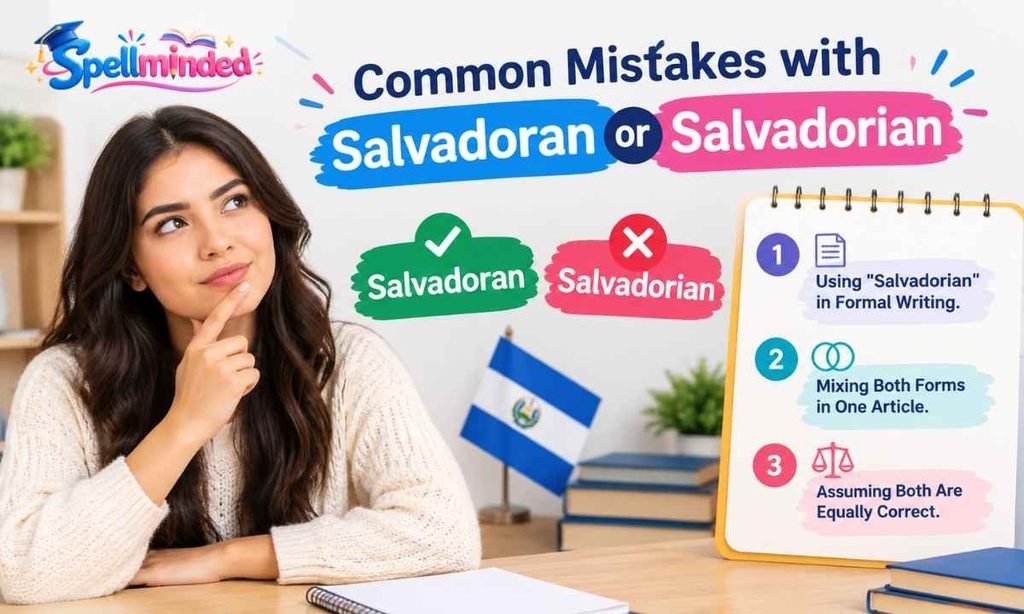
Mistake 1: Using “Salvadorian” in Formal Writing
Salvadorian might feel familiar from casual reading, but dropping it into a professional report, news piece, or academic paper reads as a small credibility hit. In formal contexts, stick with Salvadoran.
Mistake 2: Mixing Both Forms in One Article
Starting with Salvadoran, drifting into Salvadorian, then switching back is a common inconsistency that editors catch immediately. Pick one spelling — ideally Salvadoran — and hold it throughout the entire piece.
Mistake 3: Assuming Both Are Equally Correct
Because dictionaries list Salvadorian, it’s tempting to treat the two as interchangeable, the way “gray” and “grey” are. They’re not quite equivalent. Salvadoran is the dominant, institutionally preferred form; Salvadorian is a legitimate but secondary variant that most editors and style guides won’t default to.
Salvadoran or Salvadorian in Everyday Examples
Seeing both spellings side by side in real contexts makes the right choice almost automatic.
Emails
- ✅ We’re excited to welcome our new Salvadoran colleague to the team.
- ❌ We’re excited to welcome our new Salvadorian colleague to the team.
News Writing
- ✅ Salvadoran officials confirmed the agreement on Monday.
- ❌ Salvadorian officials confirmed the agreement on Monday.
Social Media
- ✅ Loved trying authentic Salvadoran pupusas at the festival!
- ➖ Loved trying authentic Salvadorian pupusas at the festival!
Social media is genuinely the one space where Salvadorian shows up often, largely because it mirrors how people actually talk. It’s not “wrong” here — just less formal.
Academic Writing
- ✅ This study examines migration patterns within the Salvadoran diaspora.
- ❌ This study examines migration patterns within the Salvadorian diaspora.
Academic writing rewards precision, and most instructors or journal editors expect the standard form.
Travel Blogs
- ✅ Salvadoran hospitality, from the beaches to the volcano trails, makes this country worth the trip.
- ➖ Salvadorian hospitality, from the beaches to the volcano trails, makes this country worth the trip.
Travel writing reaches a wide, casual audience, so either spelling reads fine here — but Salvadoran still signals a bit more polish, especially alongside cultural details like the Salvadoran flag’s blue-white-blue stripes or a mention of pupusas.
Salvadoran or Salvadorian – Google Trends & Usage Data
Search interest consistently favors Salvadoran across the US, UK, Canada, and Australia. When people do search “Salvadorian,” it’s frequently paired with clarifying terms — “correct spelling,” “vs Salvadoran” — suggesting it’s the uncertain guess, not the confident choice.
Published text tells the same story. Across news archives, government sites, and academic databases, Salvadoran appears far more often than Salvadorian, and that gap has held steady for decades rather than shifting recently.
salvadoran or salvadorian reddit
Threads on r/grammar, r/Spanish, and r/ElSalvador land on the same conclusion: Salvadoran is the standard, and Salvadorian is a widely used but non-standard alternative — not an accepted equal. Several Reddit users who identify as Salvadoran note they’ll say “Salvadorian” out loud but default to “Salvadoran” the moment they’re writing something formal, which lines up neatly with the broader research here. It’s one more sign that the Salvadoran or Salvadorian debate isn’t really about right versus wrong — it’s about matching the spelling to the context you’re writing in.
Comparison Table: Salvadoran vs Salvadorian
| Category | Salvadoran | Salvadorian |
| Part of speech | Noun & adjective | Noun & adjective |
| Meaning | From El Salvador | Same meaning |
| Dictionary status | Primary entry (MW, Collins) | Full entry, secondary usage |
| Spell-check status | Passes most tools | Occasionally flagged |
| Journalism standard | AP-aligned | Used occasionally, not standard |
| Academic use | Widely accepted | Rare |
| Frequency of use | Very high | Moderate, mostly informal |
| Regional preference | American & global English | No official regional standard |
| British equivalent | Salvadorean (alternate) | Not the UK standard either |
| Formality level | Formal and informal | Informal, conversational |
Frequently Asked Questions
Is “Salvadorian” a real word?
Yes. Collins English Dictionary lists it as a full entry, and it appears in reputable publications. It’s just not the primary or most formal choice — Salvadoran holds that spot.
Which spelling does Merriam-Webster use?
Merriam-Webster lists Salvadoran as the primary form, with Salvadorean and Salvadorian noted as related variants under the same entry.
Does the AP Stylebook address this spelling?
AP Style leans on Merriam-Webster for spelling decisions, and since Merriam-Webster puts Salvadoran first, that makes Salvadoran the AP-aligned choice for journalists.
Is “El Salvadoran” correct?
No. The demonym is simply Salvadoran — adding “El” in front is redundant, since “El Salvador” is already baked into the word’s origin. “El Salvadoran” is a common slip, not standard usage.
What do people from El Salvador prefer?
It varies. Many Salvadorans and Salvadoran-Americans use “Salvadorian” or “Salvadorean” casually and comfortably, even though “Salvadoran” remains the version used in formal, institutional, and journalistic writing.
Is “Salvadorean” the same as “Salvadoran”?
Yes — same meaning, and it’s the preferred spelling in British English. Salvadorian is the form to be more cautious with in formal writing, not Salvadorean.
Why do some websites use “Salvadorian”?
Many blogs, forums, and social platforms publish without strict editorial review, and Salvadorian reads naturally in casual speech, so it slips into writing easily. That doesn’t make it wrong — just less formal than Salvadoran.
Can I use “Salvadorian” in casual writing?
Yes, readers will understand it without any confusion. But if you want your writing to read as polished or professional, Salvadoran is still the safer default, even in relaxed contexts.
Conclusion
Between Salvadoran or Salvadorian, there’s a clear standard: Salvadoran is the spelling backed by Merriam-Webster, aligned with AP Style, and expected in academic and professional writing. Salvadorian isn’t a mistake exactly — it’s a real, dictionary-recognized variant that plenty of Salvadorans themselves use in everyday speech — but it’s the more casual option, not the formal default.
The simple rule to keep: when it matters, write Salvadoran. Everywhere else — texts, captions, casual conversation — either spelling will get your point across just fine.
