
You’re halfway through a text, an email, or an essay. You type “lie,” add “-ing,” and pause. Something looks off. So you stare at the screen, second-guess yourself, and hover over the send button, hoping autocorrect has your back.
This guide settles the lieing or lying question in seconds. You’ll get the answer, the one spelling rule behind it, a memory trick that sticks, and fixes for the mistakes that tend to show up next, like laying and past tense.
Lieing or Lying – Quick Answer
Lying is the correct spelling. “Lieing” is a misspelling.
- The short version on lieing or lying: Merriam-Webster, Cambridge, and Oxford all give lying as the -ing form of lie.
- ✅ Correct: She is lying on the couch. ❌ Incorrect: She is lieing on the couch.
- The rule: when a verb ends in -ie, change the -ie to -y before adding -ing.
What Is “Lieing”?
“Lieing” isn’t a word. It’s a spelling mistake, and an understandable one.
Here’s why it happens. For years, you’ve turned verbs into -ing forms by adding a few letters. Ride becomes riding. Smile becomes smiling. So lie seems like it should follow along. It also sounds identical when you say it out loud, which means your ear never objects. The lieing or lying mix-up survives because the wrong version looks perfectly logical.
It isn’t a British spelling, a regional variant, or a stylistic choice either. Most spell checkers underline it, and that’s a helpful nudge.
What Is “Lying”?
Lying is the -ing form of lie. Here’s the twist: English has two separate verbs spelled lie. One means to recline. The other means to tell an untruth. Dictionaries list them as separate entries, yet both give lying as the -ing form.
So the spelling stays the same, and context tells you which meaning you’re reading. You pronounce it “LIE-ing,” which dictionaries write as /ˈlaɪɪŋ/.
Meaning 1: To Be in a Horizontal or Resting Position
This is the resting sense. It covers people, animals, and objects that sit flat on a surface.
- The cat is lying in a patch of sunlight.
- I’m lying on the floor because the couch is full.
- She spent Sunday lying in bed with a book.
- Her phone was lying face-down on the counter.
Notice that every subject is already in position. Nobody is putting anything anywhere. That detail matters later, when we get to laying.
Meaning 2: To Tell an Untruth
This is the dishonest sense. It means saying something false on purpose.
- He’s been lying to his parents about the exam.
- Lying under oath is a serious offense.
- Stop lying and tell me what happened.
- She regrets lying about her age.
Only the past tense changes here, to lied. The -ing spelling stays lying.
Lieing or Lying – The Grammar Rule Explained

Adding -ing straight onto lie would stack an i, an e, and another i in a row. English spelling avoids that pile-up by swapping the -ie for a y. That’s the whole rule, and it covers a small family of verbs.
The -IE to -Y Rule
When a verb ends in -ie, change the -ie to -y before you add -ing.
| Base verb | Not this | Write this |
| die | dieing | dying |
| lie | lieing | lying |
| tie | tieing | tying |
| vie | vieing | vying |
The swap only happens before -ing. Everywhere else, the -ie stays put: lies, lied, dies, died, ties, tied. You’re not rewriting the verb. You’re adjusting one ending.
Compare that with verbs ending in a single silent -e, like ride and smile. Those drop the e: riding, smiling. That’s the pattern that tempts people. But lie belongs to the -ie group instead.
A Memory Trick That Sticks: The Y-Swap Family

Stop thinking of lying as a special case. Think of it as one member of a family whose -ie always folds into a y.
- dying (from die)
- tying (from tie)
- vying (from vie)
- lying (from lie)
There are two bonus members. Belying comes from belie, as in “a calm voice belying his nerves.” Underlying comes from underlie, as in “the underlying cause.”
Now run a quick test. Would you ever write dieing for a wilting plant? Probably not. It looks wrong right away. Give lieing the same treatment. If dieing feels wrong, lieing is wrong for the same reason. Picture the -ie getting squeezed into one letter, y, and you’ve got it.
The Origin of Lieing or Lying
The two verbs behind lie don’t share a root. The reclining verb goes back to Old English licgan. The untruth verb comes from Old English lēogan, which Oxford lists as its source.
Over time, both settled into the same modern spelling, lie. That shared spelling is why both end up as lying. The -ie to -y swap is an English spelling convention that treats them identically.
So the history explains why two different verbs look the same. It doesn’t give lieing a place in the language. The mistake isn’t inherited from the past. It’s a habit carried over from other verbs.
British English vs American English Spelling
Some spelling questions come down to region. Color and colour are the classic example. This one doesn’t.
Merriam-Webster (American), Cambridge, and Oxford (both British publishers) all give lying as the -ing form. So whether you’re writing for a UK newspaper, a US college, or a global audience, the answer is the same. For lieing or lying, there’s no regional split. No variety of English treats lieing as acceptable.
Which Spelling Should You Use?

Use lying. Every time.
Context never changes the answer. It doesn’t matter whether you’re describing someone resting or someone fibbing. Formal or casual doesn’t matter either. The mistake usually sneaks in when you’re typing fast:
- Text messages and captions written on the fly
- Essays and exam answers written under time pressure
- Emails sent in a rush
A five-second reread before you hit send is usually all it takes. If you see an -ie stuck in front of an -ing, swap in the y.
Common Mistakes with Lieing or Lying
Once you’ve fixed lieing, you’ll probably meet three nearby mistakes. Here’s how to handle each.
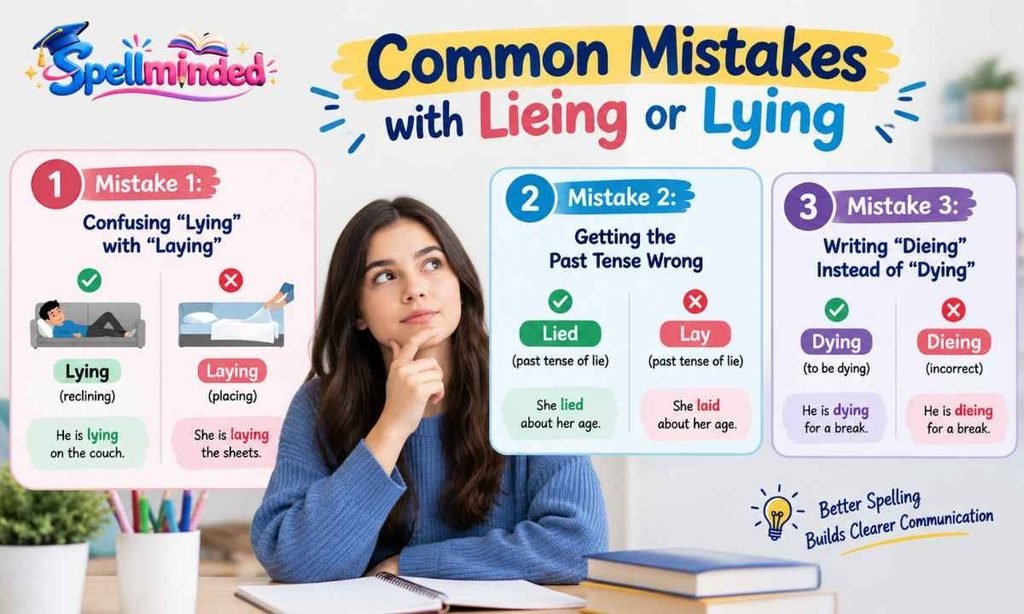
Mistake 1: Confusing “Lying” with “Laying”
Lie never takes an object. Lay always does. You lay something somewhere.
- ✅ He is lying on the bed. ❌ He is laying on the bed.
- ✅ She is laying the book on the table. ❌ She is lying the book on the table.
You’ll hear laying used for lying in casual speech. Careful writing keeps them apart.
The fix: If something is being placed, use laying. If nobody is placing anything, use lying.
Mistake 2: Getting the Past Tense Wrong
The past tense depends on which lie you mean. Here are the forms side by side.
| Verb | Present | Past | Past participle | -ing form |
| lie (recline) | lie | lay | lain | lying |
| lie (untruth) | lie | lied | lied | lying |
| lay (place) | lay | laid | laid | laying |
So you’d write: “Yesterday I lay in bed until nine.” Or: “She lied about her age.” Or: “I’ve lain here for an hour.” That last form, lain, is very formal and rarely used.
The fix: Ask yourself whether it’s resting or fibbing. That tells you whether you need lay/lain or lied.
Mistake 3: Writing “Dieing” Instead of “Dying”
Same swap, same trap. Dieing and tieing are just as wrong as lieing. Write dying and tying.
The fix: Use the Y-Swap family from earlier. Once you know one member, you know them all.
Lieing or Lying in Everyday Examples

Picture a quick text to a friend: “Can’t talk, I’m lying on the sofa with a book.” Simple, and correct. Here’s how the word shows up in daily life, sorted by situation.
Resting
- The dog is lying by the front door, waiting for you.
- We spent the afternoon lying on the beach.
- Your keys are lying under the couch.
Being dishonest
- Everyone could tell he was lying.
- Lying on a résumé can cost you a job.
- She felt awful about lying to her best friend.
Spot the fix
- ❌ I’m lieing in bed. → ✅ I’m lying in bed.
- ❌ Stop lieing to me. → ✅ Stop lying to me.
Lieing or Lying – Google Trends & Usage Data
You can see the doubt in the way people search. Related searches include “lieing down,” “lieing in bed,” and questions about the past tense. Notice the pattern. People aren’t looking for permission to use lieing. They’re double-checking themselves, usually while writing something.
If you like checking for yourself, Google’s Ngram Viewer lets you compare both spellings across published books. Either way, searching for a spelling isn’t a sign that it’s valid. It’s a sign the mistake is easy to make.
Comparison Table: Lieing vs Lying
Here’s a quick check. Find your situation, then use the form in the middle column.
| Situation | Write this | Not this |
| Resting in bed | I’m lying in bed. | I’m lieing in bed. |
| Telling an untruth | He’s lying to us. | He’s lieing to us. |
| Resting on the floor | The kids are lying on the floor. | The kids are laying on the floor. |
| Placing an object | She’s laying the plates out. | She’s lying the plates out. |
| Past tense, resting | Yesterday I lay down. | Yesterday I laid down. |
| Past tense, untruth | She lied about it. | She lyed about it. |
| Losing life or vitality | The plant is dying. | The plant is dieing. |
Frequently Asked Questions
Is “lieing” ever correct?
No. It’s a misspelling in standard English, with no exception for British, American, or any other variety. Dictionaries list lying as the -ing form of lie.
Is it “lieing down” or “lying down”?
It’s lying down. The same goes for lying in bed and lying on the floor.
What is the past tense of “lie”?
It depends on the meaning. For reclining, the past is lay and the past participle is lain. For telling an untruth, both are lied.
What’s the easiest way to remember “lying”?
Think of the Y-Swap family: dying, tying, vying, lying. The -ie squeezes into a y. If you’d never write dieing, don’t write lieing.
Are “lying” and “laying” the same word?
No. They come from different verbs. Lying means resting or telling an untruth, and it takes no object. Laying means placing something down, so it needs an object.
Conclusion
The answer to lieing or lying is lying, in every context and every kind of English. Lieing is a misspelling that comes from trying to add -ing straight onto lie.
Keep one rule in your pocket: change -ie to -y before -ing. That gives you dying, tying, vying, and lying. If you’re ever unsure, run the dieing test. If you’d never write that, you already know the right answer for lie. Type lying, hit send, and move on.