

You’re halfway through an email when you stop. Does prove have one “o” or two? The double-“o” version looks believable, and you can’t tell whether your spell-checker is about to underline it. That tiny doubt over proove or prove happens to students, professionals, and native speakers alike.
This guide settles proove or prove in a few seconds, then backs the answer up. You’ll see where the word comes from, why the mistake is so tempting, and a simple pattern that makes the right spelling stick. Real examples from emails, classrooms, news stories, and legal writing round things out.
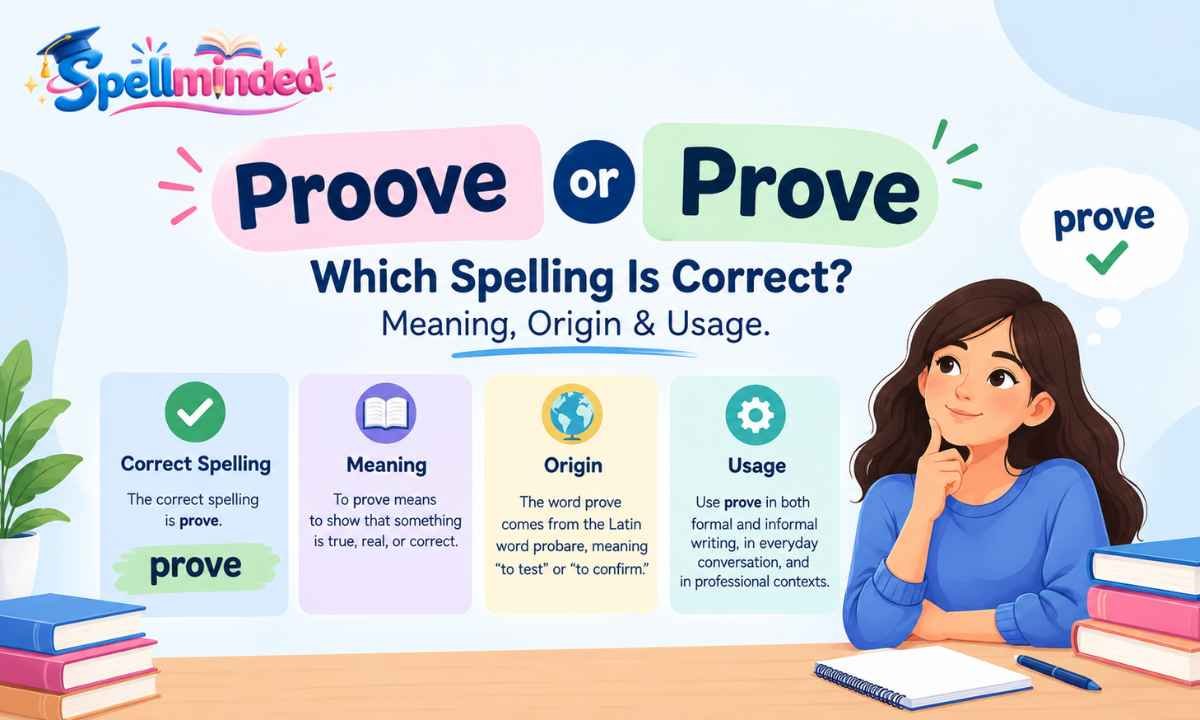
The correct spelling is prove, with one “o.” Proove is a misspelling, and it isn’t valid in modern English.
Proove or Prove – Quick Answer
The answer to proove or prove is prove. One “o,” then “v,” then a silent “e.” That holds in American English, British English, and every other standard variety, so you never need to adjust it for your audience.
Merriam-Webster lists the verb as prove, and it doesn’t offer proove as an alternative.
Proove
❌ Proove is a misspelling. Wiktionary does record it as an obsolete spelling from the 16th to 18th centuries, but that form disappeared long ago. Today it reads as a typo, and careful readers will spot it.
That also settles the proove or prove meaning question. Proove has no meaning of its own. It’s simply prove with an extra letter.
Prove
✅ Prove is a verb. It means to show that something is true through evidence, argument, or testing. It works with an object (“prove a theorem”) or with an adjective (“the plan proved effective”).
Bakers use it too. Dough “proves” when it rises before baking. And if you’re wondering whether prove is a noun or a verb, it’s a verb. The related noun is proof.
Examples:
Here is prove in a sentence, right and wrong:
- ✅ You’ll need to prove your identity at the front desk.
- ✅ She worked all year to prove the theory was sound.
- ✅ The test results prove the new design works.
- ❌ Can you proove you were there? (incorrect)
- ❌ He wanted to proove his point. (incorrect)
The Origin of Prove
The history behind proove or prove is short and tidy. The word starts with the Latin verb probare, meaning “to test” or “to prove.” That verb grew out of probus, meaning “good” or “honest.” To prove something was once to test whether it held up.
From Latin, the word moved into Anglo-French as prover and pruver. It then entered Middle English in the 12th century as proven. Pronunciation shifted over the centuries, but the spelling stayed remarkably steady.
A stray proove turns up in some texts between the 16th and 18th centuries. It never became standard. Spelling was still loose back then, and writers and printers often spelled by ear.
That’s the main takeaway. Nothing in the word’s past points to a double “o.” Its relatives, such as proof, approve, and disprove, share the same root and the same single “o.” The old sense of testing still lives in the word today, because you prove a claim by checking it.
British English vs American English Spelling
Some people wonder whether proove or prove is a UK versus US split, like colour and color. It isn’t. British and American English both use prove. So do Australian, Canadian, and Indian English.
The only real variation involves the past participle, and even there both forms are accepted in the UK and the US.
Comparison Table
| Feature | British English | American English |
| Spelling of the verb | prove | prove |
| Simple past | proved | proved |
| Past participle | proved or proven | proved or proven |
| Before a noun | proven (a proven method) | proven (a proven method) |
| Is “proove” correct? | ❌ No | ❌ No |
Proved vs Proven
Here’s the quick rule for prove or proved. Use proved for the simple past: “She proved me wrong.” After has, have, or had, either form works: “It has proved useful” and “It has proven useful” are both fine.
Before a noun, choose proven: “a proven track record.” Merriam-Webster notes that proven is now about as common as proved as a past participle, and much more common as a modifier. It began as a Scottish form and gradually worked its way into standard English.
Which Spelling Should You Use?
Always use prove. No audience, region, or style guide calls for a double “o.”
On the proove or prove grammar side, the verb has a short, regular set of forms: prove, proves, proving, proved, plus the participle proven. Every one of them keeps a single “o.”
Here’s a quick decision guide:
- Writing a formal report? → prove
- Sending a work email? → prove
- Posting on social media? → prove
- Drafting a legal document? → prove
- Sitting an English exam? → prove
Word-family check. Proof is the noun for evidence that shows something is true. Its relatives, proven, provable, disprove, reprove, and approve, all keep one “o.” If proove were right, every one of them would be wrong too.
Common Mistakes with Prove
Four slips cause most proove or prove mix-ups. Each has an easy fix.
1. Doubling the Vowel
The long “oo” sound is usually spelled with two o’s in words like groove, smooth, and cool. So a double letter feels natural. But a small group of words spells that same sound with one “o,” a consonant, and a silent “e”: move, lose, whose, and prove.
Fix: Say the pattern out loud: move, prove, improve. One “o,” silent “e,” same ending sound. Once you hear the pattern, the extra “o” looks wrong.
2. Confusing with “Approve”
Approve is just ap plus prove. Some writers see a longer, fancier word and assume the shorter one must be fancier too. It isn’t. The root inside approve is the very word you’re trying to spell.
Fix: If you can spell approve, you’ve already spelled prove. Cover the “ap” and look at what’s left.
3. Auto-Correct Mistakes
Most spell-checkers underline proove. The trouble starts when you ignore the squiggle or tap the first suggestion without reading it. Autocorrect can swap in a different word entirely, and that creates a brand-new error. A custom dictionary can also quietly accept a typo you added by accident.
Fix: Read every suggestion before you accept it. Software helps, but it shouldn’t make the call for you.
4. Mishearing Pronunciation
Prove sounds like “proov.” People who learn words by ear, including many English learners, tend to write what they hear. English doesn’t always spell the way it sounds, and this word is a clear example.
Fix: Learn the word by sight as well as by sound. Reading it inside real sentences works better than sounding it out letter by letter.
Prove in Everyday Examples
Seeing proove or prove play out in real sentences makes the rule stick. Each example below shows the slip and the fix.
Emails:
❌ Please see the attached file to proove the invoice was paid.
✅ Please see the attached receipt to prove the invoice was paid.
A work email is exactly where a typo costs you credibility. One extra letter is enough.
Education:
❌ Students must proove their hypothesis with data.
✅ Students must prove their hypothesis with data.
Teachers will likely mark this as a spelling error. Getting it right on an exam is a free point.
Social Media:
❌ This clip will proove the rumor is false.
✅ This clip will prove the rumor is false.
Posts go public fast, and replies love to point out a slip like this one.
News Reports:
❌ Investigators couldn’t proove a link between the incidents.
✅ Investigators couldn’t prove a link between the incidents.
News writing depends on precision, and prove is a word reporters use constantly.
Legal Writing:
❌ The claimant must proove that damages occurred.
✅ The claimant must prove that damages occurred.
In legal writing, the burden to prove a claim is a core idea. Accuracy matters even more here.
Prove – Google Trends & Usage Data
Searches around proove or prove follow a familiar pattern for misspellings. People don’t type proove to use it. They type it to check it. That’s why the term shows up as a question in search, not as a word in published writing.
The usage picture is consistent:
- Dictionaries list prove as the verb and don’t treat proove as a valid variant.
- Search engines and spell-checkers usually steer proove toward prove, which shows how little the misspelling is accepted.
- For participles, Merriam-Webster reports that proven is about as common as proved, and far more common before a noun.
You don’t need a chart to read this one. Prove is the word people write, and proove is the word people double-check.
Comparison Table: Prove vs Proove
Here’s the whole proove or prove question on one screen.
| Feature | Prove | Proove |
| Correct spelling | ✅ Yes | ❌ No |
| Part of speech | Verb | No separate meaning |
| Valid in modern dictionaries | ✅ Yes | ❌ No |
| Used in British English | ✅ Yes | ❌ No |
| Used in American English | ✅ Yes | ❌ No |
| Historical note | In use since the 12th century | Obsolete spelling (16th–18th c.) |
| Related words | proof, proven, disprove, approve | None |
| Usual cause of error | — | Doubling the vowel by ear |
| Quick fix | One “o,” silent “e” | Delete the extra “o” |
Conclusion
The verdict on proove or prove is simple: it’s prove, with one “o,” in every kind of English. Proove isn’t a regional variant or an acceptable alternative. It’s a slip, and an easy one to fix.
The mistake happens because the word sounds like it should have a double letter. A pattern helps more than a rule: move, prove, improve. One “o,” silent “e.” Next time you type it, you can skip the pause and keep writing.
Frequently Asked Questions
Is “proove” ever correct?
No. It’s a misspelling today. It did appear as an obsolete spelling in texts from the 16th to 18th centuries, but modern writing uses prove only.
How do you remember proove or prove?
Use the pattern move, prove, improve: one “o,” silent “e.” You can also remember that prove sits inside approve and disprove, and both of those keep a single “o.”
Is it “proved” or “proven”?
Both are accepted as past participles. Use proved for the simple past (“She proved me wrong”) and proven before a noun (“a proven method”).
Is “prooven” a correct spelling?
No. The correct form is proven, with one “o.” The extra “o” is the same mistake as proove.
Is “disprove” spelled with one “o” or two?
One. Disprove, reprove, and approve all keep a single “o,” just like prove.