


You’re typing a quick message, and your fingers write “lieing.” Something looks off, but spell-check doesn’t always catch it, so you pause before hitting send.
Don’t worry, it’s a very common slip. In this guide, I’ll settle lieing or lying in seconds, show you the one rule behind it, and give you an easy way to remember it.
Quick Answer
- Lying is the correct spelling.
- Lieing is a mistake. It isn’t a standard English word.
- The rule: change ie to y before adding -ing.
Simple Background
Think about how you type on autopilot. You write “go,” then “going.” You write “see,” then “seeing.” Adding -ing just works.
So when you reach “lie,” your brain tries the same trick. Out comes “lieing.” The past tense, “lied,” only adds a -d, which makes the pattern feel even more normal.
Why Lieing or Lying Trips Up So Many People
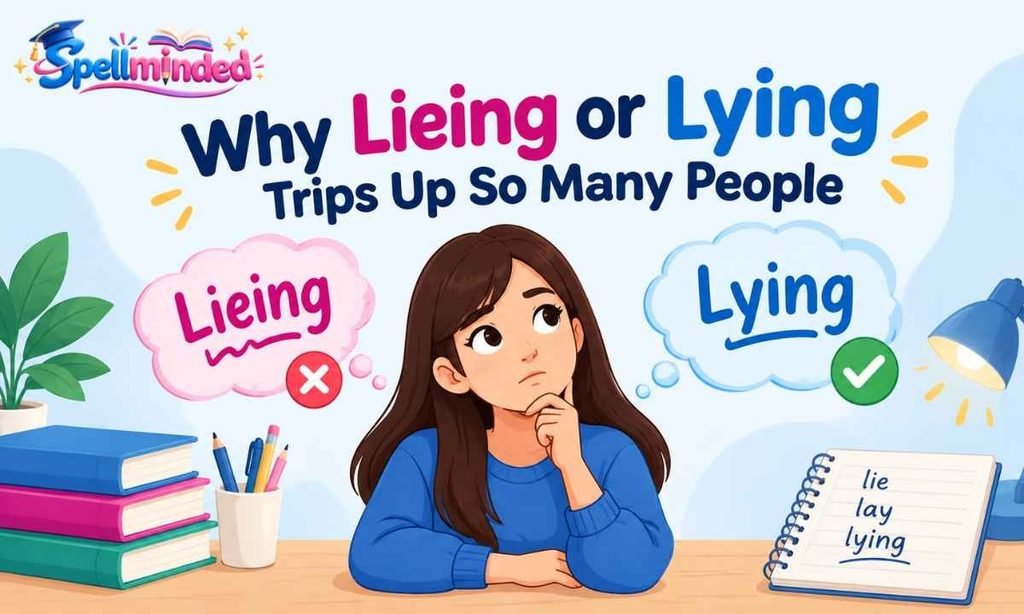
Verbs that end in -ie are a small group, so you don’t get much practice with them. They follow a special rule: the ie turns into y before -ing.
You won’t find “lieing” as a form in Merriam-Webster’s entry for lie. It lists “lying” instead. Cambridge also labels “lying” as the present participle of lie.
Clear Explanation of the Difference
The whole lieing or lying question comes down to one rule. When a verb ends in -ie, change the ie to y before -ing.
What Is “Lying”?
“Lying” is the correct spelling, and it carries two meanings:
- Not telling the truth: “He’s lying about his age.”
- Resting flat: “The cat is lying on the sofa.”
Similar words are dishonest or untruthful for the first meaning. For the second, think reclining or resting.
What Is “Lieing”?
“Lieing” is just a spelling mistake. It has no meaning of its own, so there’s nothing to look up.
❌ She is lieing on the bed.
✅ She is lying on the bed.
Comparison Table
| What you type | What it becomes | Verdict |
| lie + ing | lying | ✅ Correct |
| lie + ing (on autopilot) | lieing | ❌ Incorrect |
| die + ing | dying | ✅ Same rule |
| tie + ing | tying | ✅ Same rule |
| vie + ing | vying | ✅ Same rule |
Which One to Use and When
Use “lying” every time. It works whether you mean dishonesty or resting flat.
There’s no situation where “lieing” is the right choice, not even in a casual text.
Simple Tip to Remember
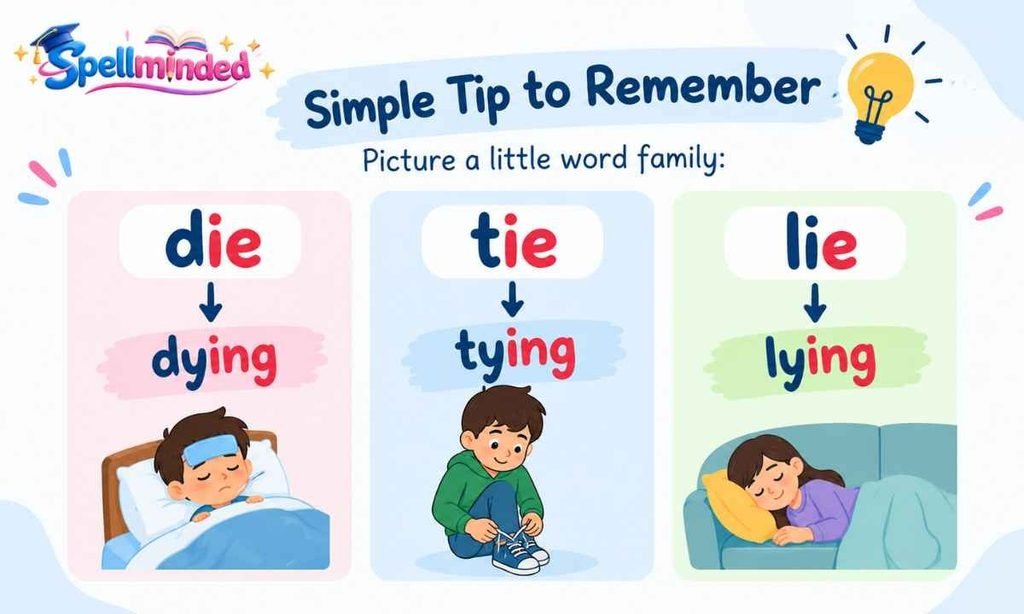
Picture a little word family:
- die → dying
- tie → tying
- lie → lying
If you’d happily write “dying,” you already know how to write “lying.”
One quick note: dye keeps its e in “dyeing.” That keeps it from looking like “dying.”
Common Mistakes People Make
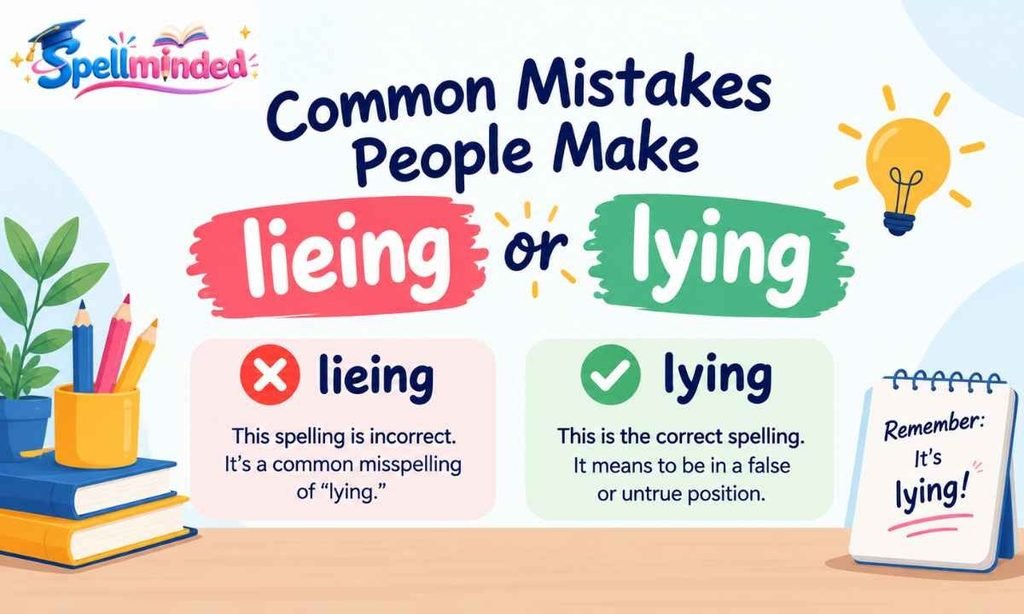
Here’s a typical slip, fixed:
❌ I was lieing down.
✅ I was lying down.
1. Keeping the “ie”
“Lie” looks like a complete word, so writers leave it untouched and tack on -ing. The ie has to go.
2. Forgetting Spelling-Change Rules
English changes letters before endings all the time. Make becomes “making.” Run becomes “running.” Lie becomes “lying.”
3. Confusing Pronunciation and Spelling
Out loud, lieing or lying sounds exactly the same: LY-ing. Your ears can’t help you here. Only the spelling rule can.
Everyday Real Life Examples
In Daily Life
- “The dog is lying under the table.”
- “He’s lying down because he has a headache.”
In Messages
- “Are you lying to me?”
- “Just lying in bed. I’ll call you later.”
On Social Media
- “Lying on the floor after leg day 😴”
In School
- “The books were lying on the desk.”
- “My notebook is lying on the floor.”
If you’re stuck on lay versus lie, that’s a separate grammar question. The spelling of “lying” stays the same either way.
Short Learning Section for Students
Step 1: Learn the Rule
Say it out loud: ie becomes y before -ing.
Step 2: Practice
Write three sentences with “lying.” Try one about a pet, one about school, and one about bed.
Step 3: Use a Memory Trick
Repeat the word family a few times: dying, tying, lying.
Step 4: Check Your Spelling
Spell it letter by letter: L-Y-I-N-G. Then reread your message before you send it.
Frequently Asked Questions
Is “lieing” ever correct?
No. It isn’t a recognized spelling, so use “lying” in every situation.
Why does “lie” become “lying”?
Verbs ending in -ie change the ie to y before -ing. Die, tie and vie follow the same rule.
Does “lying” mean both telling untruths and resting flat?
Yes. Both meanings share the same spelling.
What’s the easiest way to remember the spelling?
Think “dying, tying, lying.” If you can spell the first two, you’ve got the third.
Is it “lying down” or “lieing down”?
It’s “lying down.” That spelling works whether you’re resting on a bed, a sofa or the floor.
Conclusion
The verdict on lieing or lying is simple. “Lying” is correct, and “lieing” is a mistake. Just change the ie to y before adding -ing.
It’s a very common slip, and it doesn’t mean your English is weak. Lock in the family of dying, tying and lying, and you’ll spell it right every time.