

You’re typing an email to a client. You write “authorised,” and it looks fine. Then you pause. Should it have a z? Spell-check underlines one version, or neither, and now you’re second-guessing a word you’ve used a hundred times.
Here’s the good news. Neither spelling is a mistake. This guide settles the authorized or authorised question fast. You’ll see which spelling fits which audience, why both exist, and how to choose in a few seconds.
Authorized or Authorised: Quick Answer
Authorized or authorised? Use authorized in American and Canadian English. Use authorised in British, Australian and New Zealand English.
Both spellings mean the same thing: officially permitted or approved. Only the regional spelling changes. Pick the one that matches your readers.
| If your readers are in… | Use |
| USA, Canada | authorized |
| UK, Australia, New Zealand | authorised |
| A mix of places | Either one, used consistently |
Authorized
Authorized (with a z) is the standard American and Canadian spelling. It’s the past tense and past participle of the verb authorize. It also works as an adjective.
To authorize something means to give official permission or power. An authorized person is someone with the right to do something, such as enter a room or sign a form.
- “Only authorized personnel may enter the server room.”
- “The finance team authorized the payment on Monday.”
- “Congress authorized new funding for the project.”
Authorised
Authorised (with an s) is the standard British spelling. Australia, New Zealand and most other English-speaking countries outside North America use it too. Merriam-Webster labels it a British spelling of authorize.
The meaning, grammar and pronunciation stay the same. Only one letter changes.
- “The authorised biography came out last spring.”
- “You need authorised access to view these files.”
- “The board authorised the merger on Friday.”
The Origin of Authorized or Authorised
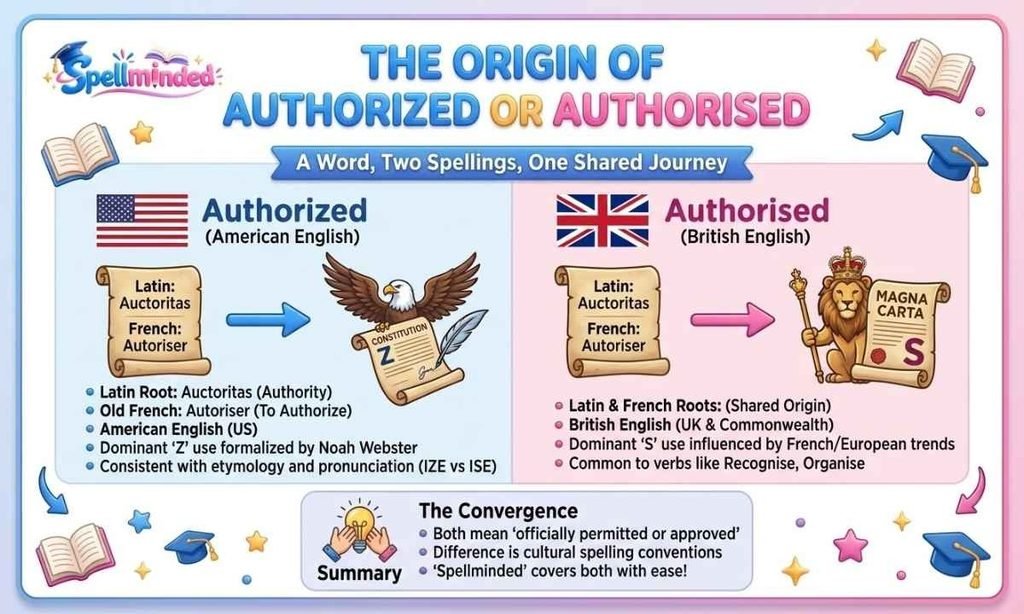
The word starts with the Latin auctor, meaning “originator” or “authority.” From it came Medieval Latin auctorizare, then Old French autoriser. English picked it up in the late 1300s. The modern spelling settled in the 1500s.
Here’s the surprising part. For a long time, authorize was the normal spelling everywhere, including Britain. Grammarist notes that it stayed standard in British English until the second half of the 20th century.
Then British publishers shifted toward -ise spellings. French influence likely played a part. Today, British newspapers use authorise roughly seven times as often as authorize. Grammarist reports that ratio for 21st-century edited British news.
Oxford note: The Oxford English Dictionary still lists authorize as its main spelling. Oxford house style uses -ize across the board. So the z isn’t “only American.” It has a long British history too.
British English vs American English Spelling
This pair is one example of a bigger pattern. Many verbs follow the same rule.
Main Rule
American English uses -ize. British English usually uses -ise. Canadian English follows the American pattern.
One caution: Oxford-style British writing keeps -ize. Some British publishers use it on purpose. If you’re writing for them, check their style guide.
Examples
| American (-ize) | British (-ise) |
| authorize | authorise |
| organize | organise |
| recognize | recognise |
| realize | realise |
| customize | customise |
| prioritize | prioritise |
| finalize | finalise |
The pattern carries through every form of the word.
| Word form | American | British |
| Verb | authorize | authorise |
| Past tense | authorized | authorised |
| -ing form | authorizing | authorising |
| Noun | authorization | authorisation |
| Opposite | unauthorized | unauthorised |
Comparison Table
| Feature | Authorized | Authorised |
| Ending | -ize | -ise |
| Standard in | USA, Canada | UK, Australia, New Zealand |
| Meaning | Officially permitted | Officially permitted |
| Formality | Standard | Standard |
| Older form? | Yes | No, a later British shift |
| Oxford house style | Preferred | Accepted elsewhere |
How to Use “Authorised” in a Sentence
Picture a finance team in Manchester. A supplier payment is waiting. The manager sends one line: “I’ve authorised it.”
That’s the word at work. It works the same way in American English, with a z instead.
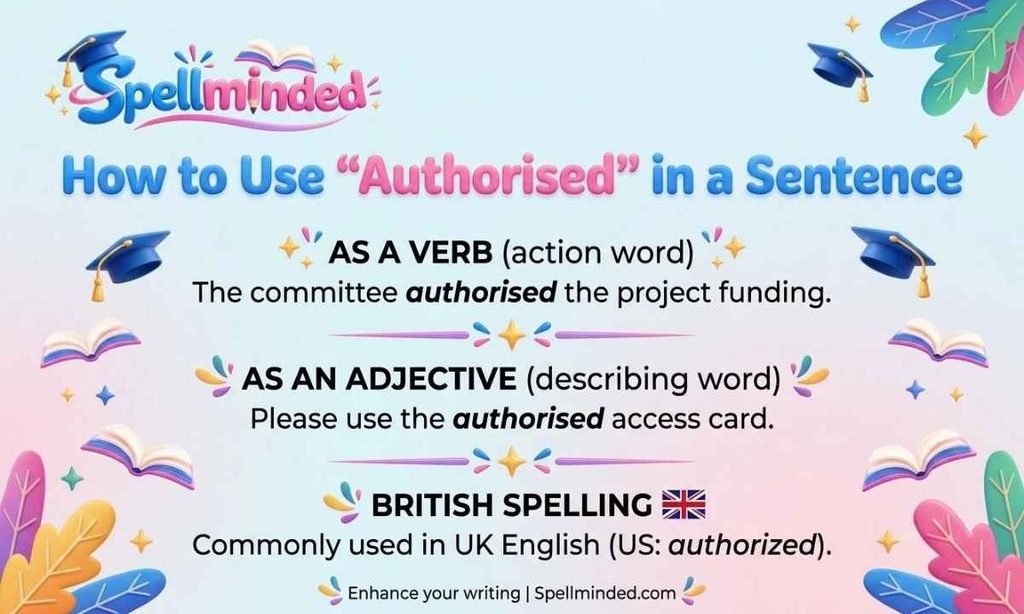
As a verb (past tense):
- “The manager authorised the refund yesterday.”
- “Parliament authorised the new law.”
As a passive verb:
- “The document has been authorised by all parties.”
- “The transaction was authorised within minutes.”
As an adjective:
- “She’s an authorised dealer for the brand.”
- “Only authorised users can open this database.”
In formal writing:
- “Mr. Smith is the authorised signatory for all contracts.”
Swap in authorized for a US audience. Nothing else changes.
Synonyms and Opposites
Using a synonym now and then keeps your writing from repeating itself. Knowing the synonyms for authorized or authorised also helps you pick the right shade of meaning.
Synonyms:
- Approved: general sign-off
- Permitted: allowed to happen
- Sanctioned: backed by an official body
- Licensed: holding a formal license
- Empowered: given the power to act
- Certified: confirmed as meeting a standard
Opposites:
- Unauthorized / unauthorised
- Prohibited
- Forbidden
- Banned
- Unlicensed
- Disallowed
Which Spelling Should You Use?
Match your audience. That’s the whole rule.
Use authorized if you’re:
- Writing for readers in the US or Canada
- Publishing on an American website
- Following APA or Chicago style
- Working for a US-based company
Use authorised if you’re:
- Writing for readers in the UK, Australia or New Zealand
- Drafting British legal or government papers
- Following a UK house style guide
- Publishing in British or Commonwealth media
Writing for everyone? Choose one spelling and stick to it. Global readers understand both. Switching halfway through a document is what looks careless.
An Easy Way to Remember
Think of it this way: Brits skip the zed. In Britain, the letter Z is called “zed.” Picture the zed taking a day off from the British spelling. That leaves authorised, with an s.
Americans keep the z. So the z version belongs to the US.
Check Your Spell-Checker Settings
Many writers hit this problem because of software. Word, Google Docs and Grammarly all follow a language setting. If it’s set to English (US), authorised gets flagged. If it’s set to English (UK), authorized may get flagged instead.
Set the language to match your audience before you proofread. It saves you from chasing underlines that aren’t errors.
Common Mistakes with Authorized or Authorised
Imagine a freelancer writing a proposal for a London client. Paragraph one says “authorised.” Paragraph four says “authorization.” Nobody sees an error. But the mix looks sloppy.
That’s the most common slip with authorized or authorised. Here are the others.
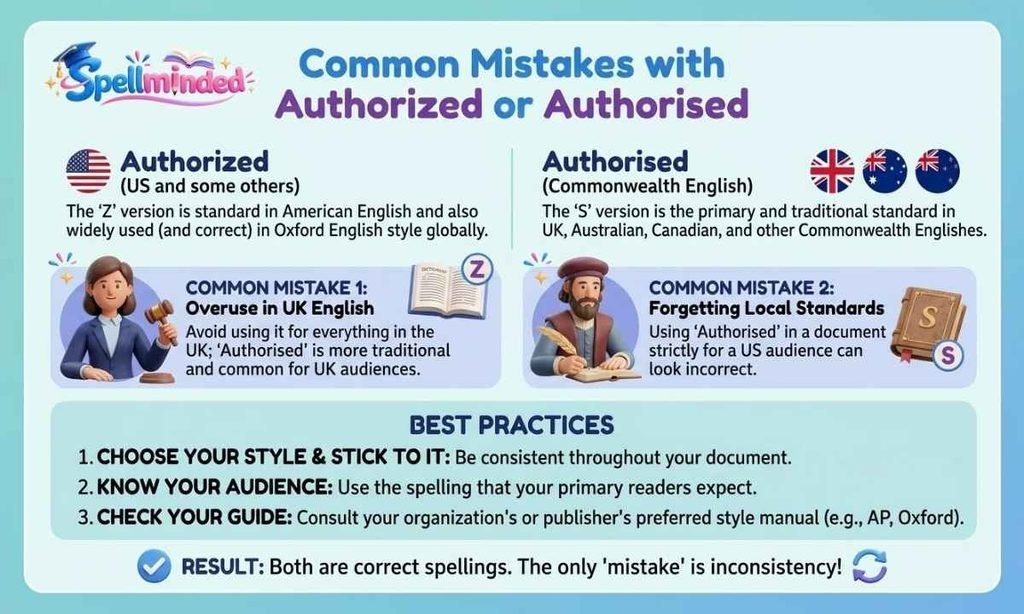
- Mixing spellings in one document. Pick one variety and keep every related word in step.
- Mixing word forms. If you use authorised, use authorisation and authorising too. Don’t blend them with authorization.
- Ignoring your audience. A US contract with authorised may look odd to American readers. A UK one with authorized may do the same in reverse.
- Treating one as more formal. Neither spelling is fancier. Formality comes from tone, not from the z or the s.
- Believing the Oxford myth. Many people assume Oxford prefers -ise. In fact, the Oxford English Dictionary lists authorize first.
Authorized or Authorised in Everyday Examples
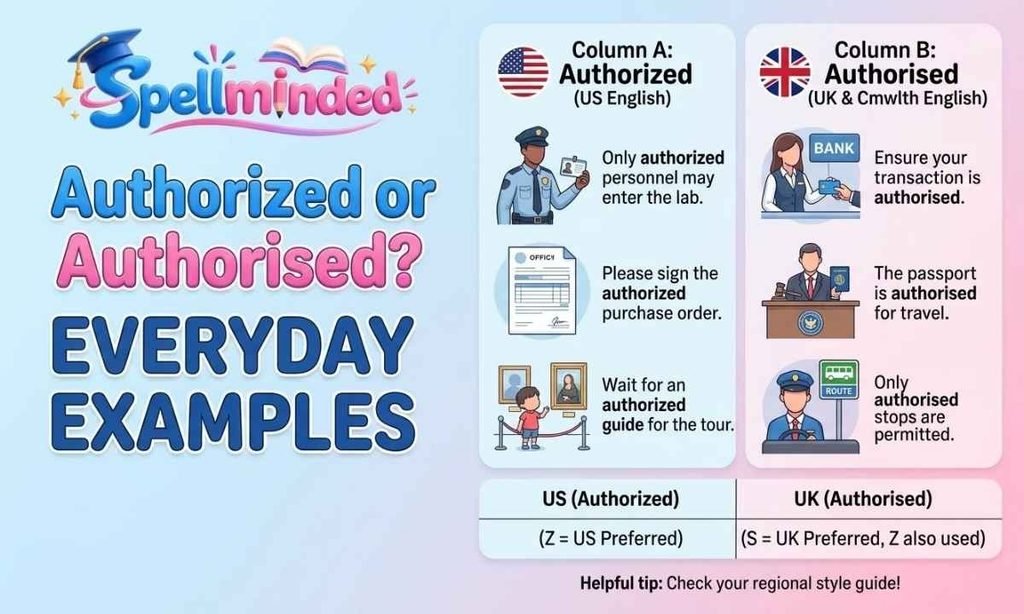
Real sentences make the rule stick. Here are US and UK pairs from common settings.
Technology:
- US: “Your device isn’t authorized to join this network.”
- UK: “Only authorised accounts can start a transfer.”
Business:
- US: “An authorized signature is required on this form.”
- UK: “The authorised signatory must approve every payment.”
Law and government:
- US: “Congress authorized emergency relief funds.”
- UK: “The minister authorised the new policy.”
Publishing:
- US: “It’s an authorized biography, written with the subject’s help.”
- UK: “It’s an authorised biography, written with the subject’s help.”
The King James Bible has a similar tradition. It’s often called the “Authorized Version,” a name in use by the early 1800s.
Everyday life:
- “Are you authorized to be in here?”
- “Do you have authorised access?”
Authorized or Authorised: Usage by Country
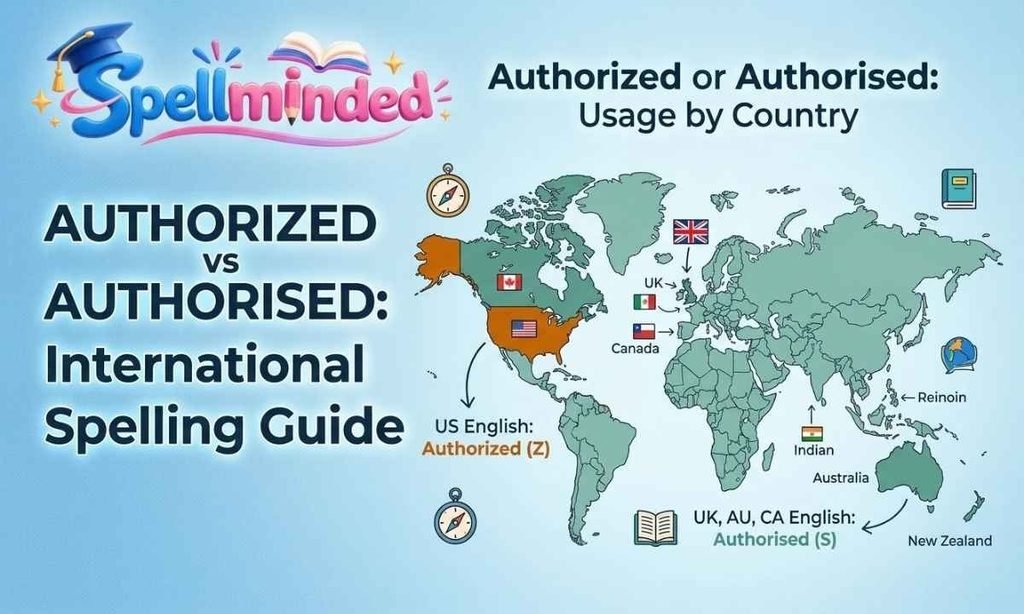
Usage data backs up the regional split. Sapling’s country-level figures show how strongly each place leans.
| Country | Authorized | Authorised |
| United States | 99% | 1% |
| Canada | 94% | 6% |
| Philippines | 97% | 3% |
| Jamaica | 80% | 20% |
| United Kingdom | 23% | 77% |
| Australia | 17% | 83% |
| New Zealand | 27% | 73% |
| Ireland | 32% | 68% |
| India | 33% | 67% |
The pattern is clear. North America leans heavily toward authorized. Britain, Australia, New Zealand, Ireland and India lean toward authorised. Neither spelling is disappearing anywhere.
Related Word Forms Comparison
You’ll often meet these spellings in common phrases. Keep each pair matched to your chosen variety.
| American | British |
| authorized personnel | authorised personnel |
| authorized dealer | authorised dealer |
| authorized signature | authorised signature |
| authorized signatory | authorised signatory |
| authorized biography | authorised biography |
| unauthorized access | unauthorised access |
| authorization code | authorisation code |
If you write forms, contracts or website copy, this table is worth bookmarking. One consistent set beats a mixed one every time.
FAQs
Is authorized or authorised correct?
Both are correct. Authorized is standard in American and Canadian English. Authorised is standard in British, Australian and New Zealand English. The meaning is identical.
Is “authorised” a misspelling in American English?
No. It’s a recognized British spelling. American readers may see it as a regional variant, so use authorized for a US audience.
Does Oxford prefer authorize or authorise?
The Oxford English Dictionary lists authorize as its main spelling. Oxford house style uses -ize, even though Oxford is a British institution.
How can I remember which spelling to use?
Think “Brits skip the zed.” The British spelling drops the z and uses an s. The American spelling keeps the z.
Which spelling should I use for global content?
Choose the variety your main audience uses and apply it everywhere. If you have no clear audience, authorized matches the largest online readership. Consistency matters more than which one you pick.
Conclusion
The answer is simple. Authorized is standard in American and Canadian English. Authorised is standard in British, Australian and New Zealand English. Neither is a mistake, and both mean “officially permitted.”
So choose by audience, then keep every related word in the same style. Set your spell-checker to match, and you’re done. Between authorized or authorised, the right one is the one your readers expect.