


You’re typing fast and want to say you won. Out comes “I beated him at chess.” Something looks off. Autocorrect says nothing. Now you’re second-guessing yourself before hitting send.
Good news: you’re not alone. The fix is easy. This guide settles the Beat or Beated question in plain language, with real examples and a memory trick that actually sticks.
Quick Answer
Beat or Beated? Use beat. It’s the simple past tense: “She beat the record.” The past participle is beaten: “She has beaten the record.” Beated isn’t a standard English word.
- Past tense: beat
- Past participle: beaten
- Beated: don’t use it
Simple Background
Beat is an irregular verb. Regular verbs add -ed in the past, like walk and walked. Irregular verbs follow older patterns instead.
Beat stays the same in the present and the past. Both sound like “beet” and rhyme with meet. Older English did use beated. It faded out long ago. Today it reads as a mistake.
Clear Explanation of the Difference
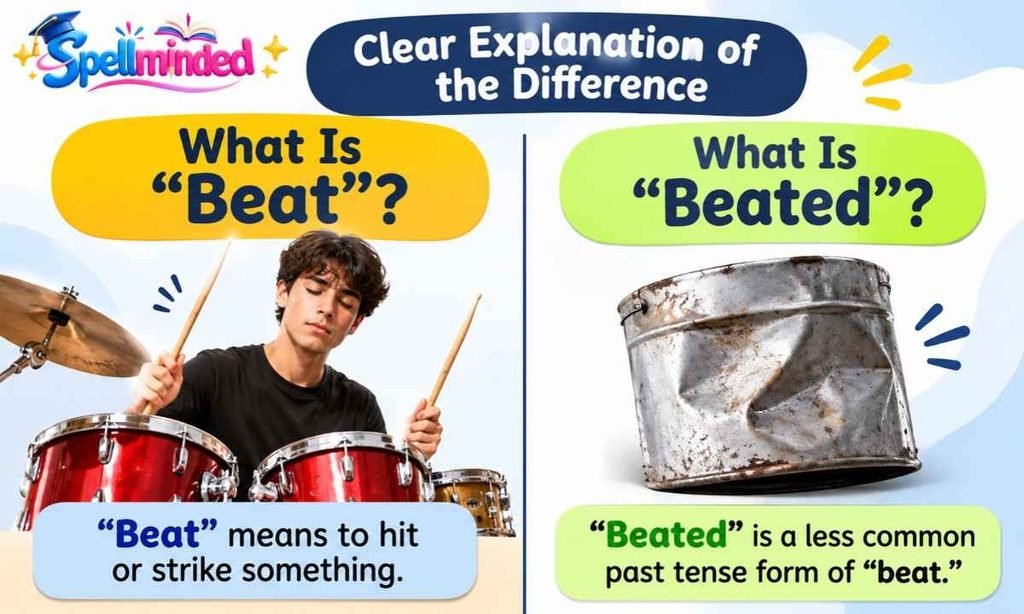
What Is “Beat”?
Beat means to hit repeatedly, to defeat someone, or to mix food briskly. It’s also a noun for rhythm. Here are its forms:
- Present: I beat, she beats
- Simple past: beat
- Past participle: beaten (say BEE-tn)
- -ing form: beating
Because the past tense looks like the present, time words do the work. “We beat them last night” is past. “We beat them every year” is present.
You’ll also hear “I’m beat,” meaning exhausted. That’s an informal use of its own and perfectly fine.
What Is “Beated”?
Beated has no meaning of its own. It happens when people apply the regular -ed rule to beat. The result sounds logical. Dictionaries still don’t treat it as standard English. Even when your meaning is clear, it counts as an error.
Comparison Table
| Situation | Correct | Common mistake |
| Simple past | She beat me. | She beated me. |
| Past participle | She has beaten me. | She has beat me. |
| Passive | We were beaten. | We were beated. |
Quick reminder: the past participle always needs a helper verb.
Which One to Use and When
Ask one question: is there a helper verb like has, have, had, was or were?
- No helper verb: use beat. “We beat them last night.”
- Helper verb: use beaten. “We have beaten them twice.”
Never add -ed.
Simple Tip to Remember
Think eat, ate, eaten. Now match it: beat, beat, beaten. Both participles end in -en. Neither takes -ed.
Common Mistakes People Make

Most Beat or Beated slips come from three habits.
1. Adding “-ed” to Irregular Verbs
People treat beat like walk. The same trap catches swimmed and buyed. Irregular verbs don’t follow the -ed rule. Check them instead of guessing.
Wrong: “He beated the game.” Right: “He beat the game.”
2. Confusing Past Tense and Past Participle
The past tense stands alone. The participle needs a helper verb. Mixing them gives you “She has beat me twice.” The correct version is “She has beaten me twice.”
3. Using “Beaten” Incorrectly
Some writers overcorrect and use beaten alone. “I beaten him yesterday” doesn’t work without a helper. Say “I beat him yesterday.”
Everyday Real Life Examples

In Sports
Our school team beat the defending champions on Friday. They’ve never been beaten at home.
In Video Games
“I finally beat the final boss!” Then my brother said, “You beat me again.” Here, “I beat you” simply means “I won.”
In Daily Life
She beat the traffic by leaving at six. The eggs should be beaten until fluffy.
In Music
Here, beat is the steady pulse you tap your foot to. The drummer beat out the rhythm. The song’s beat never wavered.
Short Learning Section for Students

Learning Beat or Beated takes about five minutes. Follow these four steps.
Step 1: Learn the Forms
Memorize three words: beat, beat, beaten.
Step 2: Practice
Fill in the blanks:
- Yesterday, we ___ the other team.
- They have ___ us twice.
- Mom ___ the eggs this morning.
Answers: beat, beaten, beat.
Step 3: Use a Memory Trick
Say eat, ate, eaten out loud. Then say beat, beat, beaten. The rhythm locks it in.
Step 4: Practice Common Sentences
Repeat these until they feel natural: “I beat him.” “I have beaten him.” “He was beaten.”
Frequently Asked Questions
Is “Beated” a Real Word, or Is It Ever Correct?
No. It isn’t standard today. It’s never correct in modern writing. Older English used it. Writers dropped it. Use beat or beaten instead.
What Are the Past Tense and Past Participle of “Beat”?
The past tense is beat and the past participle is beaten. You say “she beat me” but “she has beaten me.”
Is “Beat” an Irregular Verb, and Can It Be Both Present and Past?
Yes to both. Beat keeps one form in the present and the past. Time words and helper verbs show the tense.
Why Is This So Confusing?
Present and past look identical. Many people assume the past needs an ending. Regular verbs trained us to add -ed.
What’s the Easiest Way to Remember It?
Use the eat, ate, eaten rhyme. It matches beat, beat, beaten. No -ed ever appears.
Conclusion
So, Beat or Beated? It’s beat. Use it for the simple past. Use beaten after a helper verb. Beated isn’t standard English.
This is a very common slip. It’s easy to fix. Remember eat, ate, eaten and you’ll get it right every time.