

You’re typing an email and you reach the spot where you need a “while we wait” phrase. One word or two? Autocorrect stays quiet. So you pause, second-guess yourself, and hover over the send button.
This guide settles Meantime or Mean Time in a few minutes. You’ll get the quick answer, a simple swap test, and real examples for emails, texts, and tech writing.
Quick Answer
Write “meantime” as one word when you mean “while we wait.” That covers the everyday phrase “in the meantime.”
Meantime or Mean Time: one word for waiting, two words for averages. Use “mean time” only for the average or clock-time sense, such as Greenwich Mean Time.
- Correct: In the meantime, please review the draft.
- Correct: Greenwich Mean Time is a global clock reference.
- Incorrect: In the mean time, please review the draft.
Simple Background
“Meantime” combines “mean,” an old word for “middle,” with “time.” Think of it as the middle stretch between two events.
Dictionary.com notes that it began as two separate words. Writers joined them over the years. Merriam-Webster traces the word to the 1300s.
Today the one-word form is the standard spelling for the waiting sense. The two-word form lives on as a separate timekeeping term.
Clear Explanation of the Difference
What Is “Meantime”?
Meantime is the time between two events. Merriam-Webster lists it as a noun and as an adverb meaning “meanwhile.”
As a noun, it appears in “in the meantime.” As an adverb, it can stand alone: “Meantime, the oven is heating up.”
What Is “Mean Time”?
Mean time is two words with a different job. In maths, the “mean” is the average of a set of numbers. So mean time is an average amount of time.
It also names time based on an imagined “average” sun. That idea gives us Greenwich Mean Time.
Here’s the catch. The one-word “meantime” has no maths meaning. Only “mean” does.
Comparison Table
| Form | Meaning | Use it for | Example |
| meantime | The time between two events | Waiting, gaps, “in the meantime” | In the meantime, I’ll start the report. |
| mean time | Average time, or time based on the mean sun | Maths, tech, time zones | Greenwich Mean Time |
| in the mean time | A dated spelling of the waiting phrase | Avoid it. Write “in the meantime.” | ~~In the mean time, I’ll call you.~~ |
Which One to Use and When
“Meantime” works as a noun in “in the meantime.” It also works as a standalone adverb. If you’re talking about waiting for something, write one word. That’s all the Meantime or Mean Time grammar you need.
Need a synonym for the waiting sense? Try “meanwhile,” “in the interim,” or “for now.” In the meantime, none of them will look out of place in business writing either.
Simple Tip to Remember
Try the swap test.
Replace the word with “meanwhile.” If the sentence still works, write meantime. Now replace “mean” with “average.” If that works, write mean time.
“In the meanwhile, I’ll call them” works. So you write “meantime.” “The average time between failures” works. So you write “mean time.”
Common Mistakes People Make
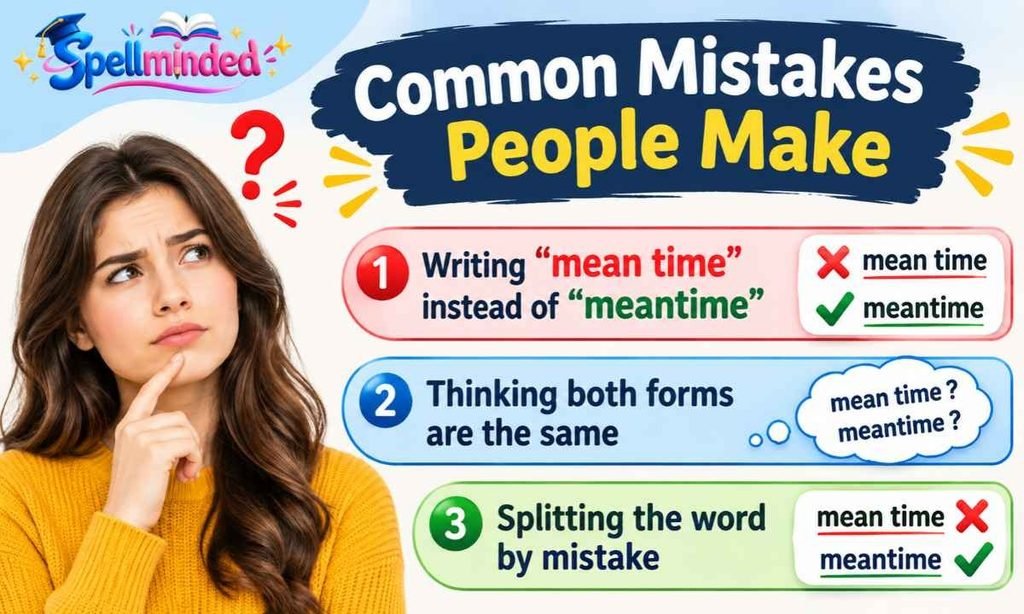
1. Writing “mean time” instead of “meantime”
This is the big one. “In the mean time, I’ll send the files” looks natural, because both words are familiar. For the waiting sense, though, it’s a dated spelling that most style guides treat as an error.
The fix: “In the meantime, I’ll send the files.”
2. Thinking both forms are the same
They share letters. They don’t share jobs. “Greenwich Meantime” is wrong, because GMT names a time standard. Write Greenwich Mean Time.
The same goes for tech terms. It’s “mean time between failures,” never “meantime between failures.”
3. Splitting the word by mistake
Two related slips show up often. Some writers split “meanwhile” into “mean while.” Others drop the article and write “in meantime.”
You’ll also see “during the meantime.” It carries the same idea. Still, “in the meantime” is the standard phrase.
Everyday Real Life Examples
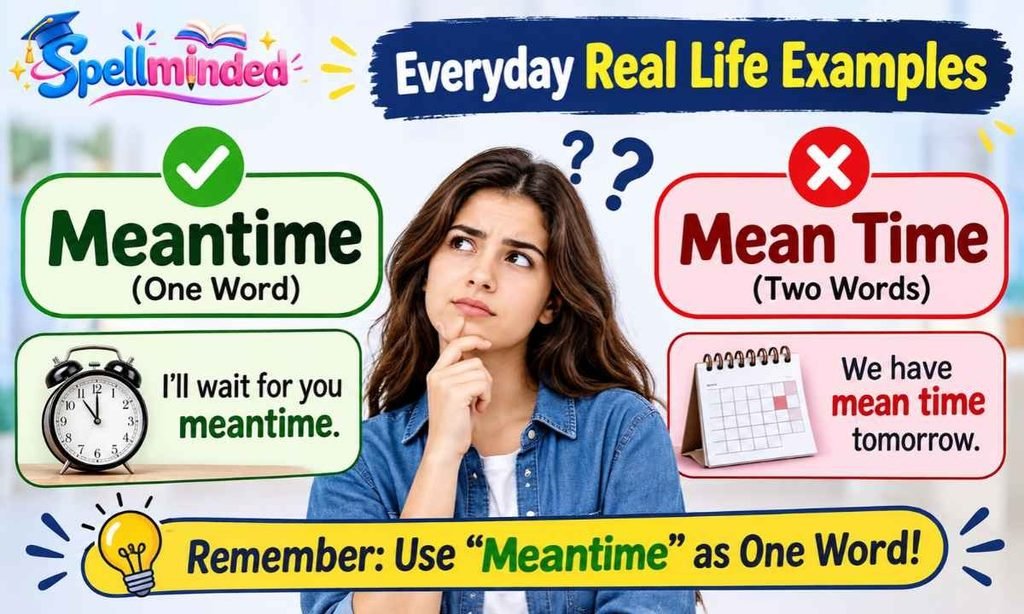
Here are Meantime or Mean Time examples you can borrow for your own writing.
In Emails
- “I’ll send the report on Friday. In the meantime, please review the summary.”
- “Thanks for waiting. In the meantime, I’ve updated the schedule.”
In Messages
- “Running ten minutes late. In the meantime, order me a coffee!”
- “Meantime, I’ll save you a seat.”
On Social Media
- “New episode drops Friday. In the meantime, rewatch the finale.”
In Daily Life
- “The pasta needs a few more minutes. In the meantime, I’ll set the table.”
In Technical Use
Engineers use “mean time” correctly all the time. Mean time between failures (MTBF) is the average time a system runs between breakdowns. The formula is simple: total operating time divided by the number of failures.
You’ll also see “mean time to repair.” For example: “The mean time to repair improved after the update.”
Short Learning Section for Students
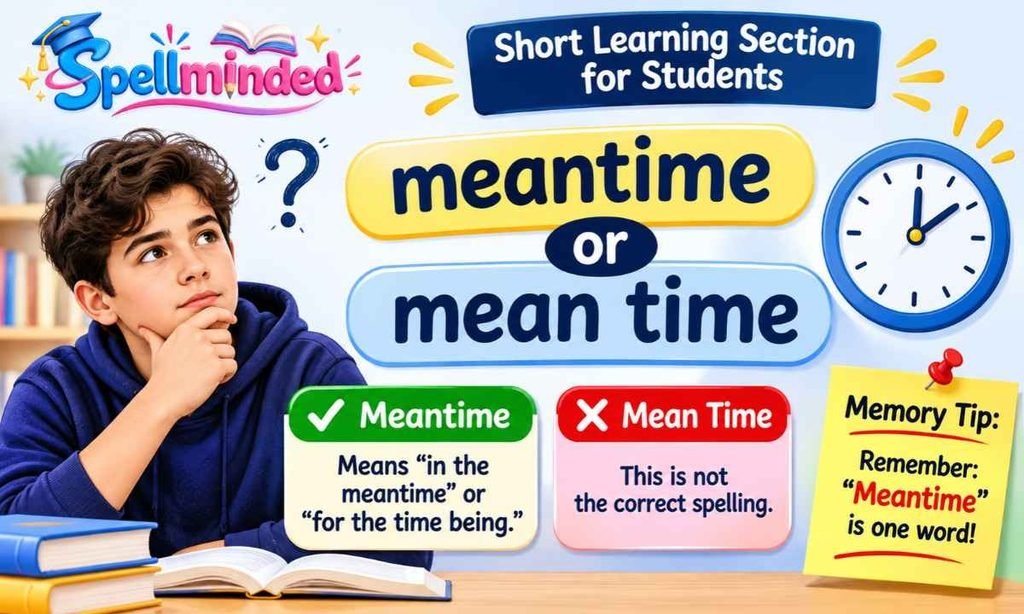
Short on time? Follow these four steps.
Step 1: Learn the common word
Start with “in the meantime.” It’s the phrase you’ll write most. Memorize it as one word.
Step 2: Practice
Fill in the blanks.
- The bus is late. ______, let’s grab a snack.
- The server’s ______ between failures improved this year.
Answers: (1) In the meantime. (2) mean time.
Step 3: Use memory trick
Run the swap test from earlier. “Meanwhile” fits? One word. “Average” fits? Two words.
Step 4: Check your writing
Search your draft for “mean time.” For each hit, ask whether “average” fits. If it doesn’t, join the word.
Frequently Asked Questions
Which is correct, meantime or mean time?
It depends on the meaning. Meantime or Mean Time comes down to one rule: one word for waiting, two words for averages and clock time.
Is “mean time” ever correct?
Yes, for averages and timekeeping, like Greenwich Mean Time or MTBF. For “in the meantime,” no. That spelling is dated and most guides treat it as an error.
Can I use “meantime” in formal writing?
Yes. “In the meantime” is a standard phrase in reports and business emails.
What’s an easy way to remember the difference?
Use the swap test. If “meanwhile” fits, write one word. If “average” fits, write two.
Why do people confuse them?
The two-word form is the original, according to Dictionary.com. Both words also look natural on their own. “Mean time” turns up in tech and clock contexts too, which keeps the split alive.
Conclusion
Meantime or Mean Time isn’t hard once you know the rule. For the waiting sense, write “meantime” as one word, as in “in the meantime.”
Save the two-word form for averages and clocks, like Greenwich Mean Time. When you’re unsure, swap in “meanwhile” or “average” and let the sentence decide.